
Then and Now: Spokane International Railway
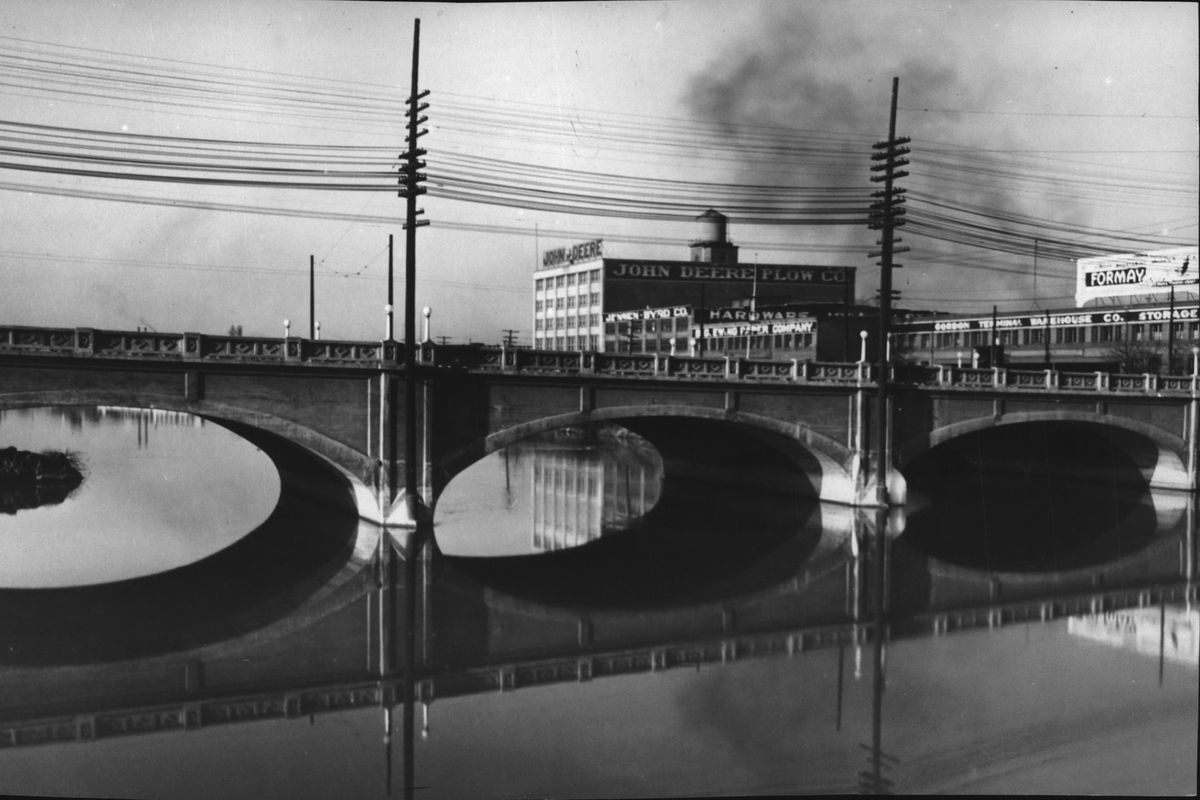
The row of warehouses on the north bank of the Spokane River between Washington and Division streets once lined the tracks of the Spokane International Railway, a short line connecting Spokane to Canadian railroads.
Daniel Chase Corbin, born in New Hampshire in 1832, was one of the busiest and wealthiest businessmen in the region’s history. After working in Iowa, Nebraska and Colorado, he headed northwest in the 1860s, following news of gold strikes in Montana and ore discoveries in the Coeur d’Alene mining district in 1885. He invested in mines, smelting and railroads. Two of his early rail lines were the Spokane Falls and Idaho, which was a feeder to the Northern Pacific, and the Coeur d’Alene Railway and Navigation Company, which connected steamships on Lake Coeur d’Alene to rail lines to move ore, freight and passengers.
Over the years, Corbin bought, sold and traded many businesses in railroad, mining, land development, agriculture and banking.
Around 1888, Corbin sold the CR&N started the Spokane Falls and Northern, a short line running to the Canadian border. A decade later, Corbin sold that line to the Great Northern and began building the Spokane International with other investors around 1904, when he was more than 70 years old.
A new SI depot was finished on the north riverbank at Washington Street around 1906 and tracks ran east to Division Street, eventually crossing into Idaho. The tracks would go through Post Falls, Bayview, Sandpoint and Bonners Ferry before reaching Eastport and connecting to the Canadian Pacific line, which was one of Corbin’s backers. The railroad’s roundhouse and shops were built on a triangular parcel south of Mission Avenue and east of Greene Street.
Corbin sold the Spokane International to the Canadian Southern in 1917. The line almost went bankrupt during the Great Depression but survived. The Union Pacific took over the SI in 1958. The downtown depot and most of the tracks in Spokane were removed for Expo ’74.
Corbin died in 1918 at the age of 85.
Corbin was often called the wealthiest man in Spokane, but no one knew for sure because he shared little about his wealth and business activities. His name remains on the Corbin Art Center, his former residence, and Corbin Park, the centerpiece of the North Side neighborhood he developed before donating the park to the city in 1902.