
The Wall that Heals rolls into Spokane to remember all the lives lost in the Vietnam War
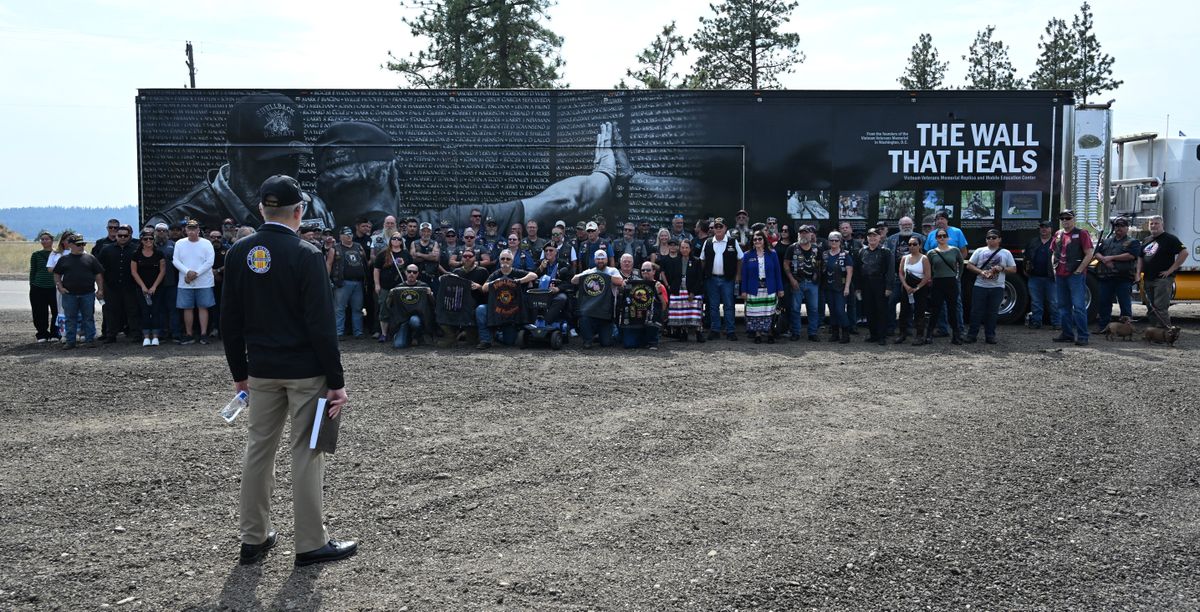
The Wall that Heals is a traveling three-quarter scale replica of the Vietnam Veterans Memorial in Washington, D.C. that bears the names of 58,281 soldiers who died serving their country.
Starting Wednesday at 2 p.m., the 375-foot long and 7½-foot tall memorial at its apex is completely open to the public at Dwight Merkel Sports Complex. On Tuesday, 99 vehicles, most of which were carrying motorcyclists from the Combat Vet Riders and some law enforcement, accompanied the semitruck towing the Wall that Heals to Dwight Merkel.
Keirsten Lyons, the director of the Washington Fallen Heroes Project, said that Spokane was one of 31 cities chosen this year for the Wall that Heals to visit. Of the 171 cities that applied, Spokane was fortunate enough to be one of the few to host the replica of the Vietnam Veterans memorial. The display is open 24 hours a day for anyone to check out until Sunday.
Lyons is a Gold Star mother who lost her son, Jake, in 2014 while he served in Afghanistan. Lyons said she had a lot of energy and grief in the wake of her son’s death, and decided the best way to use all the feelings she had pent up was to get involved in something that would give back to the veteran community.
Once the Wall that Heals had parked, pictures were taken and speeches were given. A man named Stan Inzer walked up to Lyons with a book in his hand, “The Names on the Wall.” Inside were the names of thousands of veterans who died in the Vietnam War, including 20 young men from Inzer’s company. Some he knew personally and others he’d only heard stories of. Lyons said she was successfully able to hold back all her tears from the day, until she started leafing through that book.
Inzer was 21 when he was drafted and sent off to Vietnam. He spent two years in the army, one of those in Vietnam. Inzer said that when he returned from Vietnam, he was an alcoholic. He admitted that his alcoholism led to the dissolution of his first marriage and created a fracture between him and his children.
The 1,000-yard stare plastered across Inzer’s face when he came home to his family served as a testament to the horrors he witnessed in Vietnam. To his parents, even just a year in the jungle had completely transformed their son.
Inzer said South Pacific combat veterans in World War II averaged 40 days of battle over four years. In comparison, Inzer said the average Vietnam combat veteran averaged 240 days of battle in just one year because of the mobility helicopters provided. And the anti-war effort going on at home during this time meant that what should have been a warm welcom e-home committee from members of Inzer’s community was quite the opposite.
“When I came home, I was a recipient of the cursing, spitting and whatnot,” Inzer said. “Then my father, a World War II veteran, couldn’t look me in the eye. We couldn’t even carry a conversation. I had nobody to go talk to. So I buried it. I did, and most of them did, and I carried it for 30 years.”
It wasn’t until Inzer took a fateful trip to the Vietnam Veterans Monument in 2000 that he began to heal. Today, Inzer takes opportunities to speak publicly. He said he’ll talk to anyone about anything they’re going through. He even gave a speech on Tuesday in front of an attentive group of veterans, motorcyclists and law enforcement gathered in front of the Wall that Heals.
Much of Inzer’s focus today is around veterans’ mental health and suicide prevention in the veteran community. He pointed to a 2016 study from the National Library of Medicine that stated at least 115 people are affected every time a person commits suicide.
“I’m in counseling now 55 years after coming home,” Inzer said. “I still do counseling. I mean, I carry my nightmares.”
Candace and Hector Padilla are two veterans who met while serving in Vietnam and have been together ever since. Candace Padilla was one of the first woman helicopter pilots to serve in Vietnam. She flew a Bell UH-1 Iroquois, otherwise known as a “Huey,” during Vietnam. During her years flying between 1971 and 1977, Padilla transported wounded soldiers, supplies and even body bags through the jungle.
“This is our hero here,” Inzer said about Candace Padilla. “She picked us up out in the jungle.”
Candace Padilla was born in Newport, Washington, grew up in Priest River, Idaho, and went to school in Spokane. Hector Padilla, who enlisted in the army as a 17-year-old kid from Brooklyn, served as a military policeman during Vietnam. He said repeatedly that his wife saw way more combat than he ever did. As of July 17, the pair have been married for 50 years.
The camaraderie shared between veterans who served, no matter what war, is always tangible. But Lyons said that’s especially the case for Vietnam veterans.
“I think Vietnam, in particular, was a very different kind of war,” Lyons said. “Obviously I wasn’t there, but from the stories that I’ve been honored to have shared with me, it was very different from the war my son served in Afghanistan. You only know that if you’ve been there. So when Vietnam veterans meet each other, it’s just a different kind of connection, because they share that experience; even if they weren’t in the country at the same time or in the same place, they share the experience of what that was like.”
Bill Benson didn’t serve in Vietnam, but joined the Marine Corps in 1984 and got out in 1997. From 1997 to 2006, Benson lived as an average civilian. That was until an “unscrupulous fellow” from the Army National guard asked Benson if he wanted to mess around with the 25 millimeter cannons they had. Benson said yes and wound up in Iraq as part of Operation Iraqi Freedom. He was a battle tracker for “Bravo Company,” which was an Army National Guard unit based out of Moses Lake.
Today, Benson is the Western Sector Coordinator for the Spokane Motor Pool, a passionate community of military vehicle collectors, restorers and history enthusiasts. For Tuesday’s event that welcomed the Wall that Heals to Spokane, Benson brought his 1953 Dodge M37 he affectionately named “Old Grumpy.”
Benson described “Old Grumpy” as his one-to-one Tonka toy. He said the tools required to keep the vehicle in good condition are limited to a flathead screwdriver, a roll of bailing wire and some chewing gum. He saw the presence of the Wall that Heals in Spokane as a unique opportunity to honor the sacrifice that millions of veterans have made over the years across countless battles.
“I don’t want (people) to come here and see me, I want (people) to come here and see them,” Benson said, pointing towards a group of older men and women, like the Padillas and Inzer, chatting on a nearby hill.
“When I’m them and you’re talking, in 50 years, next to an M5 53 Hover Tank to some kid that could be my great-grandson, I want him to say the same thing about me sitting over there. The torch has passed.”