
Michael Wright: Riding the (former) rails on the Route of the Hiawatha
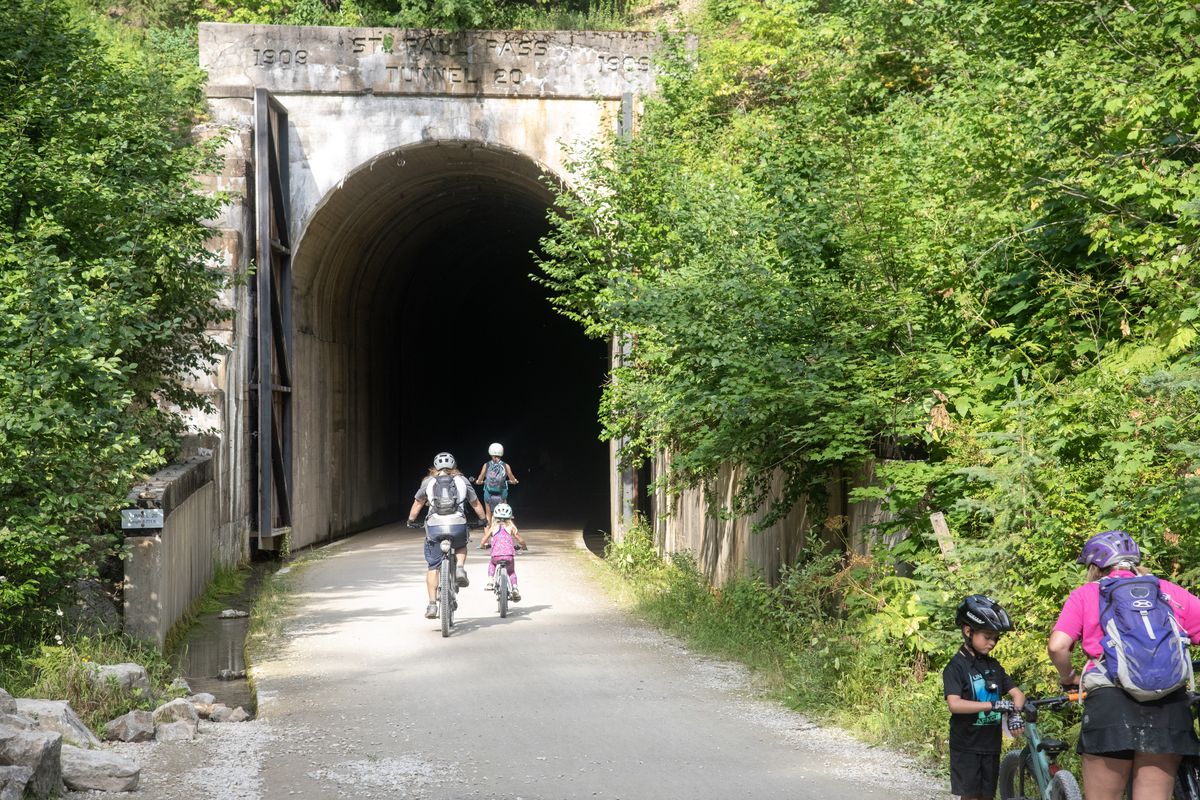
TAFT, Mont. – For most of the ride through the Taft Tunnel, there’s no light at the end.
Damp, dark and echoey, biking through the 1.66-mile hole in the Bitterroot Mountains would have been disorienting if it weren’t for the dozens of other riders pedaling through last Saturday morning, lights glowing from their handlebars.
Instead, it seemed like the perfect place to remember how to ride a bike – albeit an ill-fitting rental – and the only appropriate place to start the Route of the Hiawatha trail.
The 15-mile bike trail follows an old rail line from near the top of Lookout Pass and winds through the Bitterroots down to the North Fork of the St. Joe River, where a shuttle bus runs riders back up to a trailhead near the top.
Along the way, there are tunnels and trestles and other signs of the grand visions railroaders had for the Milwaukee Road’s Pacific connection, back when trains trumped all other forms of transportation.
Trains did rumble through here for decades, but the route’s history is pockmarked with financial failures. Exactly a century ago, the Chicago, Milwaukee and St. Paul Railway Company – which owned the Milwaukee Road – went bankrupt, a result of mounting debts fueled by the construction of its western expansion.
Reorganization followed, as did another bankruptcy. The high-speed Olympian Hiawatha train gave the line a boost after World War II but couldn’t save it. Passenger train traffic ended in 1961. A final bankruptcy arrived in 1977, followed by the end of freight traffic in 1980.
Abandoned sections of the rail line were sold off in pieces. A sawmill operator from St. Maries bought the stretch from Taft to Avery with plans to use it as a logging road. That led to a conflict with the Forest Service, which also wanted a logging road in the area and argued that it deserved control of the route because it was built with federal land grants.
The dispute continued until Congress approved legislation pushed by Idaho Sen. James McClure that ordered the Forest Service to pay the sawmill operator $3.7 million in exchange for the road.
The payment was made in 1986. Seven years later, the Forest Service began formal work on turning the road into a recreational trail, with the Taft Tunnel as a major draw. In 1998, it formally opened as the “Route of the Hiawatha” trail.
Over the past 27 years, it’s become known as one of the premier rail trails in the U.S. and a summertime staple for families in the Inland Northwest. It draws thousands of riders each summer.
Serious mountain bikers should seek thrills elsewhere. The Hiawatha is the place for the casual cyclist, or those who ride so infrequently that they cannot reasonably be called a cyclist. That would describe my wife and I – we own one bike between us, and it rarely leaves the garage.
We did not bring it to the trail on Saturday, doubting its ability to go 15 miles. We picked up our tickets, rental mountain bikes and handlebar lights from Lookout Pass Ski Area, which manages the trail, and drove over to the trailhead.
It was crowded, which is to be expected on one of the last sunny Saturdays of summer. We clicked on our handlebar lights and started down the Taft Tunnel. A steady stream of riders went both ways. After we came out the other end and continued downhill, the crowds thinned out.
In all, there are 10 tunnels along the route, some walled with even layers of cement and others with walls of jagged rock. The Forest Service has been working on several of them over the past two summers as part of a $5 million maintenance project. Patrick Lair, a Forest Service spokesperson, said crews finished scaling and rock bolting last year, and that this summer they’re patching some concrete holes.
Next, the Forest Service plans to work on the trestles. Those marvels of engineering bridge unthinkable gaps in the hills. The first one riders encounter is called the Kelly Creek Trestle, an 850-foot span standing some 230 feet high built in a month during the winter of 1908 and 1909 with the help of a rolling crane.
Cruising the trestles makes for a long, easy descent to the bottom of the trail. The tunnels offered a reprieve from the heat, even if they made me tinker with the handlebar light. For some reason, I couldn’t get it to turn on or off reliably.
Eventually we hit the Pearson Trailhead near the North Fork of the St. Joe River. A century ago, trains would have continued south from there to Avery, passing through more tunnels and trestles. These days, cyclists either turn around and ride uphill or wait in line for a seat on a yellow school bus that takes riders back to the top.
My wife and I are not the types to ride uphill. That’s for overachievers and e-bike owners. We’d also been reminded of the posterior discomfort inherent in spending four hours on a bike. A bus seat never sounded so good.
The shuttle drops riders off at the downhill end of the Taft Tunnel, meaning we had to go back through it one more time.
Around the middle of the tunnel, my handlebar light died. I must have left it on during the shuttle.
Nobody else’s light died, though, so I just stayed close to the rider in front of me, poaching the glow from his handlebars until the end came into view.