
Wonder Killer aims to get people off Google and searching for answers instead in the community

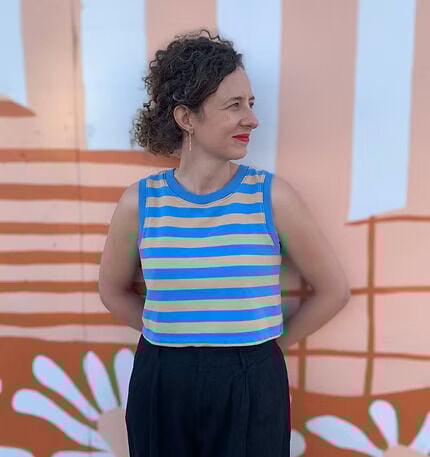
Can you eat the aloe from your aloe plant? Local artist Kate Reed found the answer in a book in the library, while looking for a reference photo of the plant. On her Instagram account, @partykrill, you can watch her paint an overhead view of a sprawling aloe plant, with two white gym shoes peeking through the interstices of the leaves, based on a picture she found in her daughter’s school library.
This was after a search at the Spokane Public Library where she found an answer to another question that had been percolating: Why aren’t my roses blooming?
At first, she tried to ask her friends who garden more than her, but “found out a lot of people don’t grow roses, because they’re very persnickety,” Reed said.
She found a book in the library about troubleshooting pruning roses. Turned out, she needed to fertilizing with phosphorus, pruning in the spring.
“… Anyways, I’ve been thinking about it and talking about it for so long, and asking people for so long, so when it came to me – the book – I was way more excited than one would be if you had just googled it.”
All of this wondering and off-Google searching is part of Wonder Killer, the book project she’s doing with her husband, local poet and teacher, Tim Greenup.
There are two ways to participate in the Wonder Killer project. First, when you have a question, rather than typing your query into a search engine or a large language model (i.e. Chat GPT, Claude, Gemini, etc.), try to find the answer in a different way.
Reed has a running list of unanswered questions, and she asks people who she thinks might know the answer, searches for books in the library and thinks about other ways she might be able to find the information.
“I found that holding on to those questions is the valuable thing,” Reed said. “The information isn’t really valuable, because holding on to the question makes my brain more creative, because I’m looking for answers, I feel like I’m looking for people to connect with.”
Two, you can write poetry or prose about your curiosity, submit your entry, and you may be published in the book of poetry, prose and illustrations that Reed and Greenup release this summer. Greenup, who teaches at Spokane Community College, is teaching a free poetry workshop at the Liberty Park branch of the Spokane Public Library.
After a 20-minute orientation to the project “my plan is to have three different writing prompts that invite wonder in different ways, and we’ll do freewriting exercises in response to those prompts,” Greenup said. “Hopefully, participants in the workshop will exit with three little seeds of poems that they can take home and nourish on their own time.”
Both Reed and Greenup hold MFA degrees in creative writing from Eastern Washington University, his in poetry, hers in fiction. In fact, it’s where the couple met. Greenup, who resurrected Legends, the Spokane Community College’s literary and art journal, will edit the book.
The project received its name from a conversation on Handsome, a podcast starring comedians Tig Notaro, Fortune Feimster and Mae Martin.
“So, they’ll have a question about something, and then Fortune will pull out her phone,” Reed said. “And Tig said, ‘You know what I call that? The wonder killer, because everyone’s like, I wonder blah, blah, blah, blah, blah, and then you pull out your phone and you find the answer to it.’”
Both Reed and Greenup said that the spirit of the project is keeping a beginner’s mind, something explained in “Zen Mind, Beginner’s Mind” by Shunryū Suzuki.
Greenup explained it as “really valuing approaching things with a beginner’s mind, so a fresh set of eyes, where you’re not imposing judgments on anything. It goes back to the idea of openness and receptivity in a way of being in the moment and accepting the moment for what it is.”
The deadline to submit work for Wonder Killer is December 31. Spokane Arts awarded the project a SAGA grant, which on top of being able to print the book with the accepted poetry, prose, and Reed’s illustrations, will allow Reed and Greenup to pay each published writer $50.
While sitting side by side on a couch at t he Meeting House in the Perry District, Reed said, “We’re in an interesting age about … do they call it the Information Age, is that what we’re in?”
“It’s what they used to call it,” Greenup offered. “I don’t know if they call it that anymore. I wonder …”
Both seemed comfortable not knowing the answer, for now.