
CDC panel removes recommendation for birth dose of hepatitis B vaccine

Spokane pediatrician Dr. Sarah d’Hulst has “basically never” treated a baby with hepatitis B. She fears that may change soon.
On Friday, a federal panel tasked with providing vaccine guidance removed a decades-old recommendation to administer the hepatitis B vaccine to all infants shortly after birth. Nearly eradicated in the United States, the virus can cause lifelong liver disease in infected infants.
Members of the federal Advisory Committee on Immunization Practices argued the blanket recommendation for all babies was supported by shaky evidence and did not give parents enough agency in their child’s health.
But d’Hulst is concerned the federal government’s policy reversal will result in more cases of the disease in infants.
“If we back off our vaccination of newborns, we certainly expect to see more mom-to-infant transmission during delivery and household transmission within families,” said the MultiCare Rockwood clinic physician. “We have seen a decrease in the number of children with chronic hepatitis B infections, and we attribute that to the vaccines given at birth.”
Hepatitis B is a viral infection of the liver. While uncurable, mild cases of the disease can cause weeks to months of nausea, vomiting and abdominal pain. Untreated, the condition can cause cirrhosis and liver cancer. While most healthy adults only experience intermittent mild symptoms, it can be deadly for infants.
Spread through the exchange of bodily fluids, mothers infected with hepatitis B can transmit the virus to their child during birth. Infection can be prevented in a newborn if the vaccine is administered within hours of birth. To ensure babies do not contract hepatitis B, the Centers for Disease Control and Prevention has historically recommended all infants get vaccinated at birth even if the mother has tested negative for the disease.
“There are many reasons we provide the vaccine to all children,” d’Hulst said. “We can have an unknown hepatitis B status of the mom. That status can be incorrectly communicated during delivery. There are false negative tests.”
The pediatrician calls the birth dose a “safety net” to prevent the most amount of infection possible.
If an infection does slip past these precautions, consequences for the child are quite high. If not treated, these infants have an approximately 95% chance of developing lifelong liver disease or liver cancer, she added.
“There isn’t a cure for hepatitis B. For those little kids there, there is nothing you can do to cure it,” d’Hulst said.
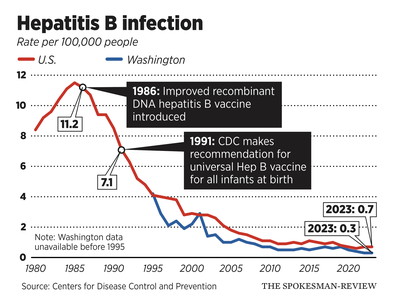
Cases spiked in the 1970s and 1980s before falling dramatically in the 1990s. At the peak, more than 26,000 Americans were infected in 1985. The CDC implemented the universal birth vaccine recommendation in 1991, and cases dramatically fell in the 21st century to several hundred cases each year.
Why is the CDC reversing course?
Traditionally nonpartisan, the Advisory Committee on Immunization Practices had been made of independent experts who create the Centers for Disease Control and Prevention’s vaccine recommendations for physicians across the country to follow. In June, U.S. Health Secretary Robert Kennedy Jr. replaced all 17 members of the committee with new members, many of whom agree with his critical view of vaccine recommendations or usage.
In a vote Friday, the body voted 8-3 to remove the universal recommendation for infants born of mothers who have tested negative for the disease.
Between birth and 15 months of age, children typically receive three doses of the vaccine. A second 6-4 vote removed the recommendation that all children receive each of the three doses.
“If your baby was born to a mother that was tested negative to hep B, you need to realize as a parent that your risk of infection throughout your early stage of life, and probably throughout most of your childhood, is extremely low,” ACIP member Retsef Levi said Friday. “We encourage you in consultation with your physician to think very carefully if you want to expose your child, your baby to a vaccine intervention that could have potential harms.”
During a presentation of hepatitis vaccine safety, Kennedy senior adviser and anti-vaccine activist Mark Blaxill said the “safety evidence” for the vaccine is “quite limited.”
“There’s really not sufficient evidence to evaluate whether or not there are safety risks or injury risks,” he said.
Blaxill is not a medical doctor, nor vaccine researcher. He is the former head of SafeMinds, which has sought to link autism with vaccinations.
Outside experts argued against this characterization of the evidence, including former CDC Director Rochelle Walensky.
“A review of over 400 studies that spanned four decades found evidence confirming the safety and effectiveness of the hepatitis B vaccine when delivered soon after birth,” she said ahead of the Friday vote. “The birth dose has a strong safety record. Decades of data that we reviewed from randomized trials, national safety systems and long -term follow-up show that the vaccine is safe at birth with only mild, temporary and expected reactions. No serious adverse events or deaths have been causally linked to the birth dose.”
ACIP member Cody Meissner was one of three to vote against the change, calling his colleagues’ suspicions “baseless skepticism.”
“We know this vaccine is safe and we know it is very effective. Making the changes being proposed, we will see more children and adolescents and adults infected with hepatitis B,” he said.
Others on the committee suggested other vaccines could soon be on the chopping block.
“I suggest to parents to be very, very suspicious when people tell them that something is safe, especially a vaccine,” Levi said. “Because we have been adopting a very, very confident way of telling parents about vaccine products that they are completely safe when we essentially never tested them appropriately.”
The ACIP recommendation will now go to Kennedy, who will make final determination. Despite the move, d’Hulst said she expects most local physicians to continue recommending expectant patients get their child vaccinated at birth.