
Across the Cascades, avalanche dogs come to the rescue
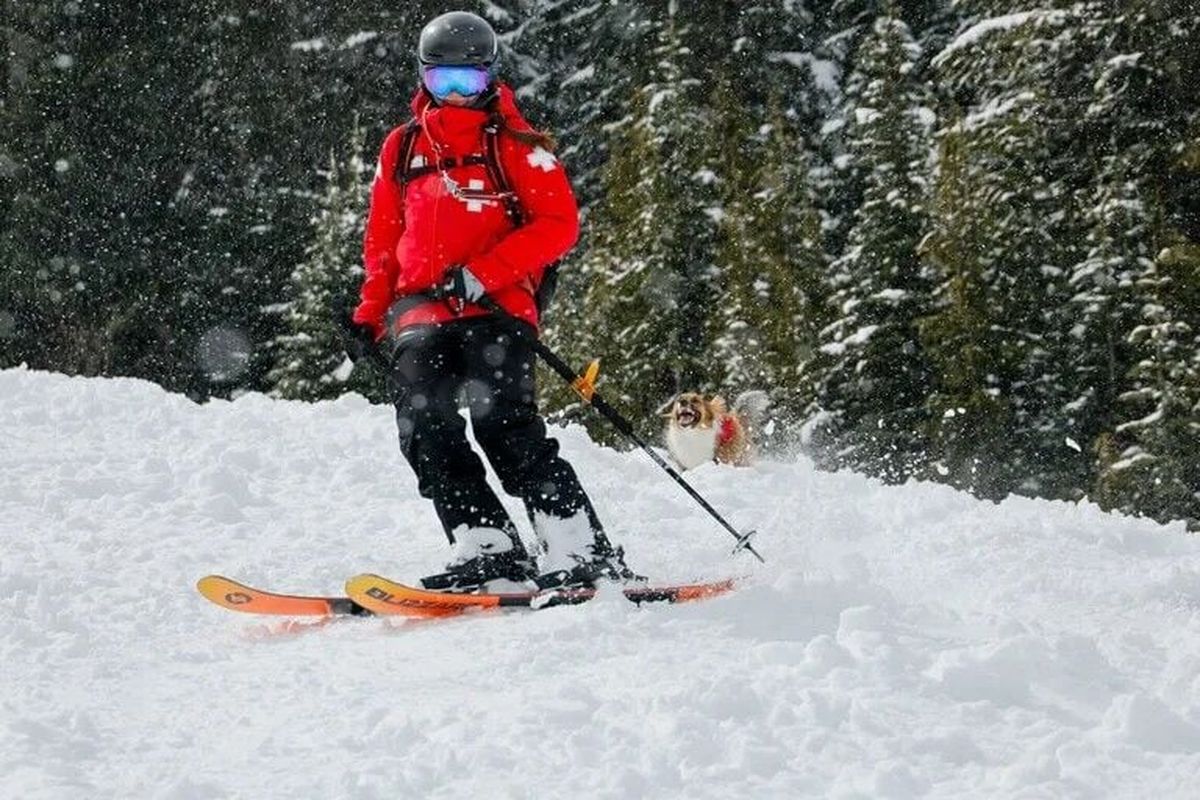
CRYSTAL MOUNTAIN RESORT – “Are you ready to work?” ski patroller Alisha Bator whispers into the ear of Kio, a mountain rescue dog, at the edge of a meadow near the Forest Queen chairlift at Crystal Mountain Resort. Fresh snow blankets the ground, and somewhere underneath, Bator has buried an article of clothing. But the surface is crisscrossed with ski tracks and shovel prints, so it’s not obvious to the naked eye where the hidden garment is tucked.
She rubs Kio’s hindquarters, then commands, “Search!”
The English shepherd takes off, sniffing furiously at the snow. Some 90 seconds later, the 4-year-old dog cocks her ear, then snaps her head. Kio’s picked up a scent. Pawing at the snow, she wrests a ratty sweatshirt out of the hole with her teeth and dutifully returns it to Bator.
Bator’s voice shifts from stern handler to loving owner. “Oh my gosh, what did you find?” she asks Kio in high-pitched baby talk, slipping her a treat.
The exercise is just another day on the clock for Kio, who has been trained since puppyhood to suss out human scents buried in the snow. In this case, the sweatshirt has spent four days in a fellow patroller’s gear bag, soaking up sweat, skin cells and hair follicles that give the garment a ripe odor – perfect bait for dogs with their refined olfactory prowess.
Kio is one of a dozen-plus dogs who work in the Washington Cascades high country as an additional line of defense for ski patrollers tasked with ensuring skiers’ and snowboarders’ safety, especially at ski areas that include avalanche terrain. Trained canines have been a fixture of Washington winters since the early 1980s and have participated in incidents ranging from workaday rescues of lost skiers to a dramatic recovery of a deceased ranger on Mount Rainier.
“It’s another resource (in the event of an avalanche or accident),” said Bator. “So that as responders, we can say that we’ve given every single thing that we have to either make sure nobody’s there or get somebody out if somebody is there.”
North American skiing goes to the dogs
Mountain dogs have aided lost travelers in the snow since at least the 17th century, when monks at Great St. Bernard Pass on the Swiss-Italian border trained the namesake mastiffs now beloved as pets. But in North America, the role of dogs in snow-covered search-and-rescue responses was largely unproven until the deadly March 1982 avalanche at Alpine Meadows, California, when a wall of snow crashed into buildings at the Lake Tahoe-area ski resort, killing seven. Miraculously, a German shepherd named Bridget sniffed out a survivor who had been trapped for over 117 hours.
That successful rescue raised awareness about the viability of mountain rescue dogs. According to patroller Kim Haft, Crystal Mountain started its program in the winter of 1984-85 following a close call – patroller Faith Clark was partially buried in a slide during the previous winter and dug herself out. She returned the next season with a Chesapeake Bay retriever and began training him for avalanche rescue.
Stevens Pass followed in 1993 and has trained over 20 dogs in that time. (A Nova Scotia duck tolling retriever, or toller, named Jazz joined patrol last month.) Alpental stood up a program in the 1990s. While numbers ebb and flow, each of the three main resorts closest to Seattle with avalanche terrain typically employs around a half-dozen dogs at a time. (White Pass acquired one dog, Maverick, in 2018.)
The dogs’ primary duty is to keep skiers and snowboarders safe inside resort boundaries, part of a web of safety measures that mountain operations and ski patrol undertake, including weather forecasts and avalanche control work, in order to open as much inbounds terrain in as timely a manner as possible.
For example, in March 2024, ski patroller Charlie Stewart and his chocolate Lab, Iggy, searched a wet slide on the Exterminator run under the Crystal Mountain gondola to make sure nobody was caught inside – even though the trail was closed to the public, ski tracks suggested someone had ducked a rope and poached the off-limits run. Washington’s avalanche-prone ski areas are also all located on public land, which means ski patrollers are potential first responders to join any kind of search-and-rescue effort across the Cascades. In February 2012, two dogs accompanied patrollers who responded to the Tunnel Creek avalanche at Stevens Pass, which caught 16 people who had traveled out of the ski area boundaries.
Rainier recovery
A few months after Tunnel Creek, a Cascades canine performed the most heroic feat yet accomplished by a Washington mountain dog. On June 21, 2012, Mount Rainier National Park climbing ranger Nick Hall helped rescue a group of climbers who had fallen into a crevasse descending from the summit. Hall himself then lost his footing and took a fatal tumble a couple of thousand vertical feet down the mountain, with his body coming to rest somewhere between 10,000 and 11,000 feet in elevation. Fellow rangers confirmed his death but could not evacuate his body before a storm moved in, dumping 5 feet of snow.
Five days later, a Chinook helicopter deposited Brent Okita, then assistant ski patrol director at Crystal, and mountain rescue dog Cirrus into the approximate area where Hall’s body was presumed to be located. Cirrus’ primary trainer, Crystal Mountain patroller Andrew Longstreth, was unavailable for the mission but lent Cirrus to Okita, the dog’s secondary handler. Okita donned crampons and wielded an ice ax for the search, during which he clipped a rope to Cirrus’ work harness for safety. The rescue team eventually settled on an 80-by-80-meter search grid, then unclipped Cirrus. Despite the passage of five days that diluted the human scent of a deceased body – itself less pungent than a living person – Cirrus located a spot on the surface within four minutes. David Gottlieb, the climbing ranger in charge of the recovery effort, used a probing stick and found a rescue stretcher with Hall’s body strapped to it.
Okita, who’s also a guide on Rainier, recounted in a written incident summary that Cirrus seemed “a little unsettled” after the rescue – the dogs are used to finding live mock victims who then play with the dog – but went on to serve several more years working at Crystal.
Unfortunately, the role that Cirrus played on Mount Rainier is a more typical scenario.
“It’s more for the families and recovery efforts and less about rescue,” said Stewart. “To be perfectly honest, the outcomes of these rescues are often pretty bleak.”
A day in the life
The small number of dogs at Washington ski areas reflects the enormous commitment. The handler must tackle dog training in addition to their usual ski patrol duties. And in the case of Crystal, the handler is also the dog owner – so Bator and Stewart are responsible for feeding and caring for Kio and Iggy even in their downtime.
Training to certify a mountain rescue dog takes two to four years, and all begins with selecting the right breed. Despite the reputation of the burly Saint Bernard, that’s not what today’s dog handlers seek out.
“We look for more slender, athletic dogs as opposed to a big Swiss mountain dog whose joints are going to probably degrade over years of moving downhill,” said Haft, who runs Cascade Mountain Rescue Dogs, the nonprofit that provides financial support to Crystal’s dog owners/handlers to help with the cost of a dog, travel to pick up a dog and insurance. “We find the ones who are built to move for hours at a time if you need them.”
That range includes everything from field Labradors like Iggy to English shepherds like Kio to Haft’s own recently passed dog, Darwin, a toller. While there is no way to breed for a mountain rescue dog per se, dogs with a search-and-rescue lineage in their bloodline are an encouraging sign.
“This is not a dog that is necessarily sleeping on the couch all day,” she said. “Although they do get a lot of nap times because we ask them to function highly in a pretty crazy world.”
That world includes riding chairlifts – trained dogs can jump onto a chair, but also must be light enough for their handler to lift up as needed – and running downhill while skiers and snowboarders zip past.
Several times per season, Crystal patrol trots out the dogs for a show and tell, but most training occurs out of the public eye, like the sweatshirt rescue in the meadow. While obedience training takes place in the locker room where the kennels are, there’s no substitute for burying something – or someone – in the snow and teaching a dog to find them.
Training techniques include toys, clickers and positive reinforcement as dogs tackle progressively more challenging burials. In the case of humans, trainers dig snow caves and use snow blocks to close off the cave in order to create a safe space for a living person to wait out their mock rescue. The best dogs roam as far as 300 feet from their handler while on the hunt, detecting scents up to 6 feet below the surface, even as wind whips and snow blankets everything. When they find their human, there’s usually a dog treat waiting, but also a friendly game of tug-of-war.
While the stakes in a real-world scenario would be life or death, successful training is all about remaining upbeat. When Kio, Iggy or any of their fellow dogs across the Cascades find a human during a practice burial, they receive what to them is the ultimate reward. Not just a treat, but a playmate.