Analysis: In Potato Bowl win over Utah State, WSU reminded us what football in Pullman can look like
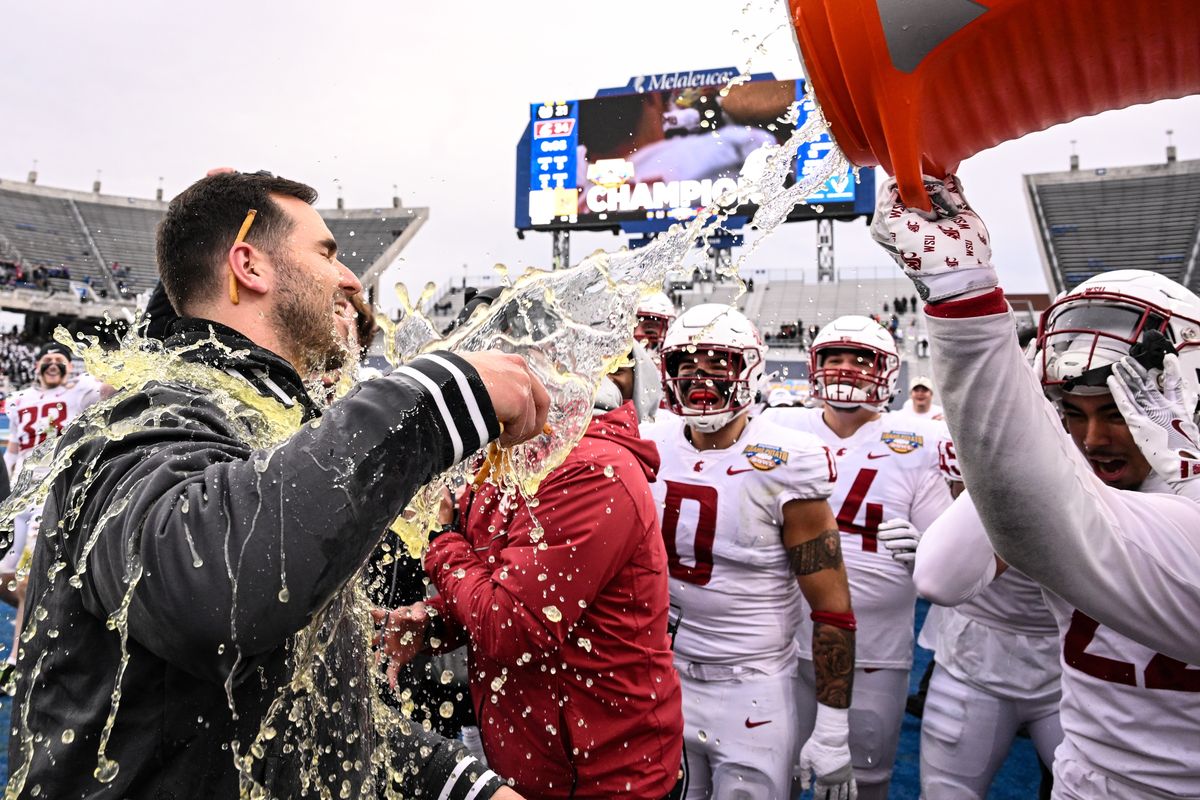
BOISE – Not a single french fry found Danny Freund, the Washington State offensive coordinator who was pilloried over and over this season. He waded through the celebration, around the Cougars taking pictures, around the ones throwing potatoes, in between the ones throwing french fries into their mouths like it was their last meal.
As he traversed Boise State’s blue turf, where the Cougs earned the right to eat their hearts out with a 34-21 win over Utah State in Monday’s Idaho Potato Bowl, Freund looked relieved. Exonerated. For nearly four months, he was the target of invective from thousands of WSU fans, who blamed him for every shortcoming of their team’s offense, every time a running back plunged into a pile and every time a receiver whiffed on a key perimeter block.
Freund is far too diplomatic to demand an apology from Cougars fans, but after watching the way he operated without marching orders from his higher-ups, perhaps he should.
Under Freund’s watch, WSU’s offense piled up 628 total yards, by far the team’s most all season. The Cougars racked up 255 rushing yards, another season high, aided by redshirt freshman running back Maxwell Woods’ 117-yard outing. And their offense engineered 373 yards of passing offense, almost all of which belonged to quarterback Zevi Eckhaus, who paired three interceptions with three eye-popping touchdown tosses.
The Cougars averaged a whopping 7.1 yards per play, enjoying the kind of easy rhythm they rarely established during the regular season, Eckhaus’ three picks notwithstanding. Eckhaus threw 44 passes, his most all season, airing things out to 12 different receivers. He also rushed for 34 yards, and that number would have been higher if he hadn’t taken a long sack in the second quarter.
Where was that kind of offense during the Cougs’ regular season? In those 12 games, WSU averaged 21.6 points per game, the program’s fewest since Mike Leach’s debut season in 2012. The Cougars had supposedly pivoted to a run-first approach on offense, but they stuck to it a little too strongly in a few second halves, leading to several crushing losses, and Freund became the scapegoat.
With one unshackled outing in Boise, Freund demonstrated this: He may not have been a perfect offensive coordinator all season, but when he gets a chance to call a game the way he sees fit, the Cougars can establish a compelling rhythm, through the air and on the ground.
“It was nice,” Eckhaus said, “trusting in the O-line, running backs, tight ends, wide receivers. I think we got everybody involved. Unless I miscounted, it was 12 guys who caught the ball today. That’s huge, just to be able to have trust and faith in everybody to go make plays, and obviously we did. I thought coach Freund did a great job just putting us in good positions.”
Which speaks to the larger point that this WSU win, this entire season in general, illustrates: The Cougs can play the kind of high-flying football the program became famous for decades ago. They can play the type of swarming defense that only visits the program once in a blue moon. Put it together and this season, these Cougars taught us what football can look like in Pullman.
It can look like what Freund engineered on a cloudy Monday afternoon: Eckhaus dropping in a long touchdown pass to redshirt freshman Landon Wright, Woods breaking free and unleashing blazing speed, tight end Hudson Cedarland faking a block and popping into the end zone wide open to catch his first career touchdown, walk-on receiver Mackenzie Alleyne miming kicking down a door in the end zone to celebrate another touchdown pass from Eckhaus, teammates swarming him to memorialize the occasion.

It can look like what defensive coordinator turned interim head coach Jesse Bobbit dialed up all season long and again on Monday: Defensive end Buddha Peleti surging into the backfield for a sack, safety Matt Durrance leaping for an interception in the end zone, linebacker Caleb Francl and cornerback Jamorri Colson converging to stuff another run in the backfield, defenders flocking to the ball so quickly that it feels like they’re playing with 15 on the field.
As WSU transitions into a new era, with a new coach and a rebuilt conference and unfamiliar opponents, this is what it can look like.
Across nearly four months and 12 games in the regular season, Freund didn’t look capable of convincing anyone of that, and maybe it was understandable at the time. Under first-year head coach Jimmy Rogers, Freund and the Cougars wanted to play a level of smash-mouth football that their players didn’t always look ready for. Freund called up-the-middle runs for running back Angel Johnson, who disappeared into a pile of defenders. He dialed up screen passes that went nowhere. Heck, Freund and Rogers spent the first three games starting the wrong quarterback.
Freund took the blame, which is the way things go in his profession, and it’s reasonable to place blame on the offensive coordinator when the offense is scuffling. But now that Rogers is off to Iowa State and Freund got a chance to call his kind of offense – without worrying about playing to the style of Rogers, who wanted to keep things on the ground, running clock and keeping the opposing offense off the field – he showed what he can do with the handcuffs removed.
That much was hard to miss late in the fourth quarter, after coaches turned to Dugger with the game out of reach. At the Utah State 36, Freund dialed up a QB keeper for Dugger, who used his speed to race untouched up the left side, leaving defenders in his wake as he cruised into the end zone for a touchdown. As Dugger celebrated, so did Freund, who unleashed a primal scream as he galloped along the sideline, even flexing for a moment.
Freund beamed as he returned to players and coaches. He embraced offensive line coach Taylor Lucas, who thumped him on the chest. He high-fived another coach. He didn’t just look elated. He looked absolved: of looking like the unimaginative playcaller he was wrongly maligned as, of calling plays that were destined for losses, of getting conservative in the second halves and costing the Cougars chances at signature wins.
Instead, this much has become clear: Much of that blame should go to Rogers, who insisted on playing that way, even at the expense of putting players in position to win games. Freund may have been calling runs that were stuffed at the line of scrimmage. But it came from a sense of pressure from Rogers, who wanted to run a style of offense that never really suited the players on this team.
“Not to discredit coach Rogers at all,” Eckhaus said. “I mean, when he was here, he did a phenomenal job of instilling everything that we (showed) out there today. But the biggest thing that the better teams have is they’re player-led. Obviously the coaches, they kinda set the foundation, and us as players, we have to run with it. That was just another opportunity for us to lead by example. There are a lot of seniors on this team who wanted nothing more than to win this game.”
Was Freund perfect? Hardly. He should share some blame for some of the Cougars’ more forgettable showings on offense, like a seven-point outing against Oregon State and a 13-point performance against FCS Idaho. But that’s where Bobbit came in and did his part with WSU’s defense, which might already rank among the best this program has ever seen.
Bobbit, who is set to join Rogers’ staff as Iowa State’s defensive coordinator in the days and weeks ahead, arranged one of the nation’s finest defenses this fall. In the regular season, the Cougs finished No. 17 nationally in total defense, permitting only 303 yards per game. They allowed only 173 passing yards per game, which is No. 12. And they finished No. 12 in first downs allowed, with only 203.
We could be here until the sun comes up reciting the numbers about the Cougars’ defense, but the real story is in the physicality they established, in the renewed sense of trust they fostered among observers of all kinds. In years past, when Washington State desperately needed a stop, nobody quite held their breath. Surely someone would miss a tackle. Surely a safety would get caught flat-footed. Surely the pass rush wouldn’t get home.
This season, these Cougars turned each trend upside down. Francl developed into a sure tackler, and even when his teammates whiffed, three more swarmed to the ball. Veteran safety Tucker Large, who left Monday’s game early with a knee injury, was always there in coverage. And defensive ends like Peleti and Isaac Terrell, like Malaki Ta’ase and Raam Stevenson, helped their team total 31 sacks, piling them up left and right.
When this defense needed a stop, the Cougs didn’t just make people believe they could deliver. They did it. Remember in the final moments against Idaho, which had a chance to take the lead, only for WSU to force the Vandals into a field goal? Remember in crunch time against SEC power Ole Miss, which had to punt on their final drive, giving the Cougs a chance to walk it off? How about in the fourth quarter against ACC foe Virginia, which had to settle for a field goal after a potential game-turning interception?
Time and again, these Cougs bowed their necks and delivered timely stops, doing it with such regularity – such frequency – that it gave fans a sense of trust. Trust that WSU could produce a stop when it needed to, that the Cougars could find ways to win games thanks to their defense, which isn’t exactly what this program has prided itself on in recent years.
“That’s just our defensive mentality,” Francl said. “No matter what happens, we’re gonna go out there and do our jobs to the best of our abilities. There’s a lot of older guys on that defense too that have been around for a long time. And when stuff like that happens (turnovers), they tend to pick the other guys up in those roles. It’s just a mentality that we go out there with every drive.”
Rogers may have overstepped his bounds in the Cougs’ offense, but credit him for this: He helped install a ferocious defense – the kind that could have transformed the entire program’s culture had he chosen to stay longer than one season. Whatever you say about Rogers, you can’t deny the way his team played defense.
Can incoming coach Kirby Moore keep that going? He has hired a defensive coordinator, former Oregon State coach Trent Bray, whose 2022 and 2023 defenses ranked among the nation’s best. If a few key Cougars return next season, their defense could look the way it did this season.
But in today’s college football ecosystem, where the transfer portal and NIL dollars determine just about everything under the sun, nothing is guaranteed. The Cougs’ defense could look even better next season. It could look exponentially worse. When you turn over coaches and players like WSU is this offseason, you’re playing the lottery.
Still, this should not go forgotten: This team showed us what football can look like at WSU. Freund demonstrated it on Monday. Bobbit illustrated it all season. The players exemplified it themselves. And even if their season wasn’t perfect, they went out on just about perfect terms, ushering in the next era of Washington State football with a bath of french fries on a blue field.