
Escaping life’s cares on Upper Priest Lake
Most folks don’t know it, but a canoe trip to Upper Priest Lake would do them a world of good. Out there, far from cell phone service, internet connectivity and electronic “friends,” Mother Nature sets the tempo. There’s time to pick huckleberries, go exploring and savor spectacular sunsets back in camp.
Some friends and I were there recently, paddling through sun, wind, rain and mist. We saw eagles diving to take fish, shy deer nosing around in the woods and great blue heron taking wing at our approach. As day turned to dusk, the haunting cry of a loon echoed across the lake.
Like countless others before us, we found canoeing into the backcountry is a journey into the world as it used to be. The mechanics of daily life are pared down to the basics, so there’s time to pull your chair up to waters’ edge and behold the simple pleasures of nature.
Taken as a whole, our visit was a feast for the senses and a tonic to the soul. By the time we returned home, it felt like we’d been away for weeks.
Little brother of a big lake
Upper Priest Lake is less than 3 miles north of Priest Lake, which is one of North Idaho’s three great lakes – along with Lake Pend Oreille and Lake Coeur d’ Alene. The launch site for hand-propelled boats is at the Beaver Creek Recreation Site, roughly 120 miles from Spokane. To get there, drive to the town of Priest River, then turn north on State Route 57. Turn east at Nordman on Reeder Bay Road and follow it north along the big lake all the way to its northern tip.
The first question confronting canoeists, kayakers and paddleboarders is where to begin. They can launch on the northern tip of the big lake, which is exposed to wind and waves, before turning up the slow-moving Priest River. Or they can start their voyage with a 300-yard portage to launch directly on the sheltered river.
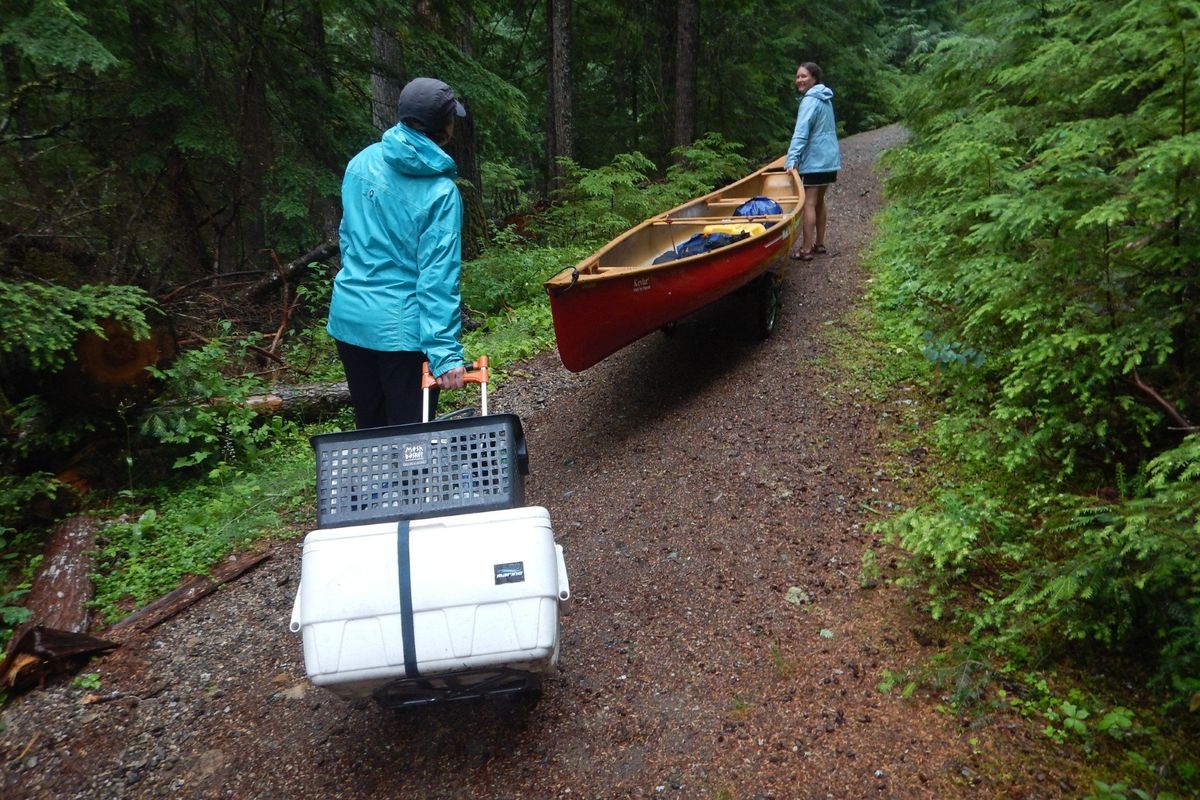
The wind was blowing from the south when we arrived, and waves were piling up on the northern shore of Priest Lake, so we opted for the portage. A canoe cart and a couple of folding hand trucks took the sting out of the ordeal; once our canoes were in the water, we used a bike lock to secure the wheeled carts to a tree.
Easy running
Upper Priest Lake is connected to its larger, southerly neighbor by a gorgeous stretch of river known as the Thorofare. The current is barely perceptible along The Thorofare, and its banks are hemmed with mature forests that march right up to the waters’ edge. The gentle river is about 3 miles long, but it wiggles and squiggles a bit on the southern end, so it’s a little more than 2 miles from the portage launch to Upper Priest Lake.
Less than 30 minutes after setting out, our party of two canoes arrived at the upper lake. It was July 3, so other people were ahead of us, but there were still plenty of options for camping. Running roughly north-south for 3 miles, Upper Priest Lake offers a number of dispersed camp sites with gritty sand beaches along its eastern shore.
There are also four U.S. Forest Service campgrounds sprinkled around the lake, with two on opposite shores at the southern end and two more on opposing shores at the northern end. Each of these campgrounds has a handful of campsites with amenities that include tables, metal bear bins for food storage and outhouses. Effective July 4, all four Forest Service campgrounds on Upper Priest Lake are fee areas with overnight camping priced at $15 per night.
The first of these campgrounds – Geisinger – is located squarely where the Thorofare ends and Upper Priest Lake begins. It was pretty full by the time we arrived, so we charted a course for the far end of the lake.
A place to feel small
While Priest Lake is speckled with waterfront cabins, Upper Priest Lake reveals few signs of human development. It’s this untrammeled quality that makes it an oasis of peace.
“Personally speaking, I like the upper lake best,” said Chris Noyes, district ranger for the Priest Lake Ranger District of the Idaho Panhandle National Forest. “It’s got a primitive shoreline and minimal infrastructure.”
With the exception of four small campground signs, the shoreline is utterly devoid of man-made structures. Nature has the upper hand, but powerboats are still allowed to visit. They can motor up the Thorofare, provided they don’t kick up a wake; once on Upper Priest Lake, powerboats can let ’er rip, but they are prohibited from pulling water skiers.
Simply put, Upper Priest is a sanctuary for the soul. It is not the place for loud music or hijinks.
It’s also big country, with the Selkirk Mountains looming to the north and east, and Plowboy Mountain rising sharply from the western shore. Every shade of green is visible on the forested slopes, and when the wind is still, the mirror-smooth lake offers a perfect reflection of the scene above.
Moments of doubt
It was windy when we arrived at Geisinger, so we hugged the eastern shore and continued chugging north. The wind, blowing from the south, created long, rolling swells that rose up behind us and occasionally surfed our boats for a moment. At that point, our Anxiety Index was hovering somewhere around two.
An hour and a half after launching from the portage trail, we rounded a point and pulled into a sheltered cove with the lake’s finest campsites – Trapper Creek. Sure enough, the best sites were taken and the occupants urged us to consider Navigation Camp, due west across the lake.
It was a tough decision, but Trapper Creek was crowded so we shoved off for Navigation. Paddling beyond the point at Trapper Creek was a real moment of truth because the wind and waves – coming from the south – slammed into the port sides of our canoes. The Anxiety Index quickly climbed above five, but we heeled our boats slightly to starboard to defend the windward gunwales and ran dry for the nervy, 18-minute crossing to Navigation.
Shore leave
Once ashore, the full beauty of Upper Priest Lake began to reveal itself. The forest is thick on the west side of the lake, so it’s cool and shady even on hot days. We had our pick of campsites, and we didn’t encounter anyone except two guys on mountain bikes and a couple of hikers who kept going.
The solitude was profound, far deeper than anything one can find at home or in town. Camping on the west side of the lake, we were delightfully surprised by the beauty of the sunrises. Low-angle sunlight reflected off the glassy surface of the lake and lit up the tree trunks with lively, shimmering light. It was a dappled optical effect, with ephemeral flecks of golden light swirling through the forest.
Across the lake, wisps of campfire smoke drifted lazily in the still air. It was too early for the powerboat crowd, so the silence was broken only by the occasional cry of birds. On calm summer mornings, Upper Priest Lake is the image of peace.
A follow-your-nose adventure
The plan for Day 2 was to paddle to the east shore and investigate a hiking trail that runs north-south.
The Canadian border is about 15 miles from the northern end of Upper Priest Lake, so a partial reconnaissance sounded like fun.
As it turned out, we never arrived on the east shore because we stumbled across something even better along the way.
In years past, the Upper Priest River – which feeds the lake – has been choked with a tangle of fallen trees, branches and other woody debris. This year, the inlet is open and inviting, so instead of continuing to the east shore, we swung our canoes north and nosed up the inlet of Upper Priest Lake.
It was a wise decision that proved to be the highlight of our three-day trip. Just like the Thorofare, the inlet is smooth and glassy, reflecting the world above with flawless clarity. The water is gin clear, allowing paddlers to peer down on the skeletal remains of sunken trees. Cutthroat trout are common here, and bull trout – which are a threatened species – are found as well.
After about a mile of easy paddling, the current became too strong for further progress, so we stepped ashore to soak in the scene. A large ungulate, probably a moose, had left tracks in the mud. A great blue heron, startled by our approach, hoisted itself aloft and glided through the treetops.
Flies droned, the sun beat down, and time seemed to stand still. It might have been 1 p.m., or it might have been 3. At that point, time didn’t seem to matter.
It’s hard to say what, exactly, we were looking for during those long, lazy days on Upper Priest Lake, but we clearly pierced the veneer of superficial things and found our place in the wild.