
‘It’s unapologetic’: Theater on the Verge brings ‘Torch Song’
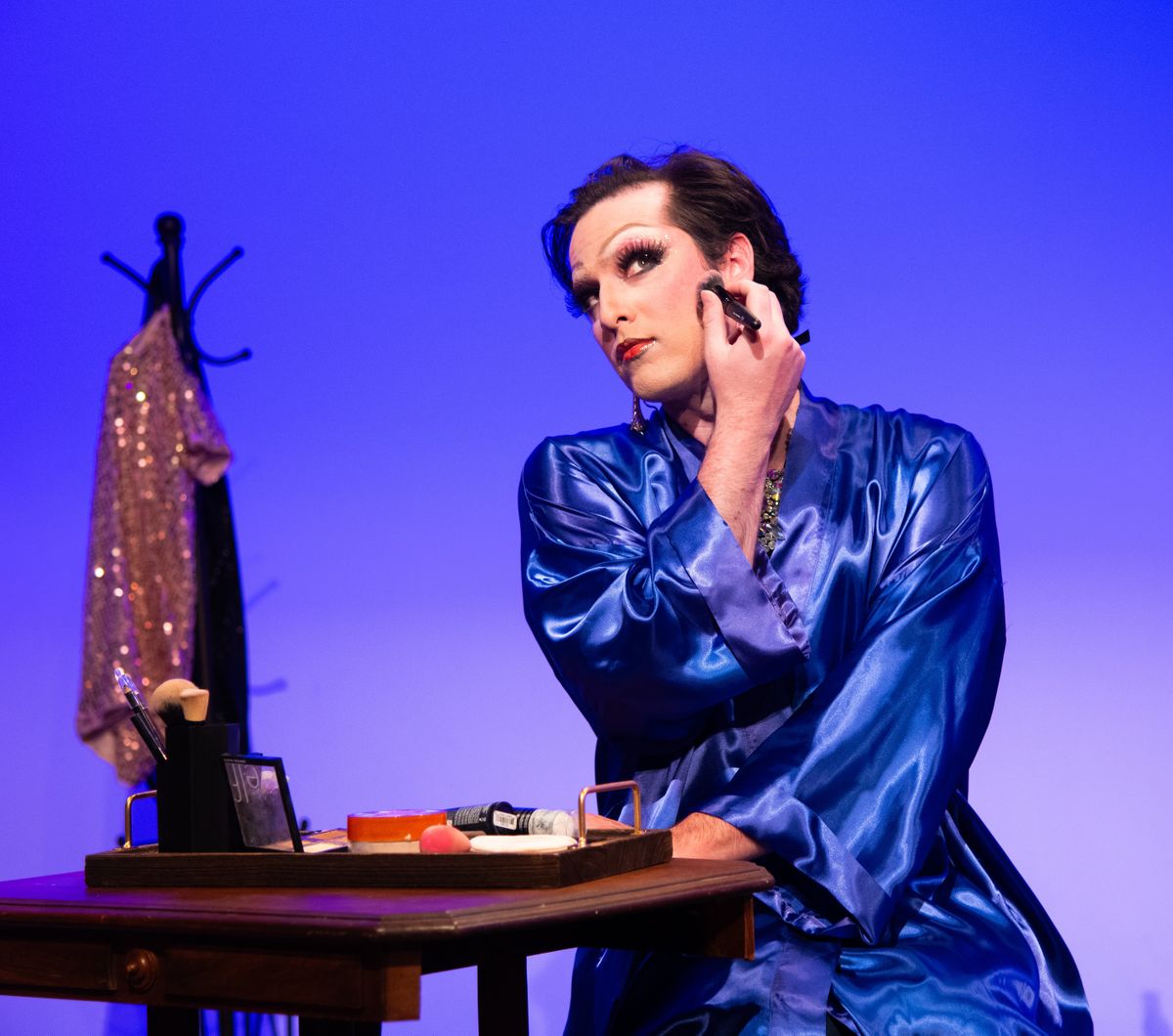
Last summer, Troy Nickerson and Chris Jensen were combing through scripts in search of the perfect show with which to debut their independent theater company Theater on the Verge.
Harvey Fierstein’s “Torch Song” came to mind, and the pair went so far as to get the rights to produce the show.
“Torch Song” is the revised, shorter version of Fierstein’s “Torch Song Trilogy,” a collection of three plays performed as three acts: “International Stud,” “Fugue in a Nursery” and “Widows and Children First!”
Each act focuses on a part of Arnold Beckoff’s life. Beckoff is a gay, Jewish man who performs drag and is a torch singer, or someone who sings about unrequited love, living in New York City in the late 1970s and early 1980s.
With “Torch Song” as a front-runner, the pair looked through a few more scripts and discovered “Every Brilliant Thing,” a one-person show written by Duncan Macmillan with Johnny Donahoe. Thinking it was best to start simply, Nickerson and Jensen decided to debut with “Every Brilliant Thing.”
“It was a wise decision, because it allowed us to figure out how this thing works on simpler terms, before moving into something a little more complicated with a larger cast and with the set,” Jensen said. “If we’d been trying to do this on our very first one? No.”
After a successful run of “Every Brilliant Thing” earlier this year, the pair started thinking about the next show in the season and announced they’d produce “American Idiot,” a musical based on the Green Day album of the same name.
But with other work on their plates, including Nickerson’s direction of “Waitress” at Spokane Civic Theatre, the co-founders again decided to pare things down, moving from a musical with a full cast and band plus choreography to a straight play.
Nickerson was the one to bring “Torch Song” back into the conversation, and Jensen agreed they were ready to tackle the play. They both felt the choice was appropriately timely given current conversations around drag.
In the first act of the original trilogy, Beckoff (Jonah Taylor) meets Ed Reiss (Steve Lloyd), a man uncomfortable with his bisexuality. This discomfort becomes a sore spot for the pair, and Reiss ends up breaking up with Beckoff and starts to date Laurel (Nicole Dietrick).
In the second act, which takes place one year after the first, Beckoff meets Alan (Trey Salinas), and the two settle down and even talk about adopting a child. The pair visit Reiss and Laurel, where tensions from Reiss and Beckoff’s past relationship arise.
In the third act, several years have passed, and Beckoff is now a single father to gay teenager David (Danny Post). Beckoff is also working to deal with his disrespectful mother (Marianne McLaughlin) when she visits from Florida.
“Torch Song” is directed by Nickerson and features set design by Jeremy Whittington. Theater on the Verge’s production, which runs Thursday through Aug. 2 at Hamilton Studio, marks the regional premiere of the play.
After announcing “Torch Song,” Nickerson and Jensen were met with, primarily, one of two responses. Many people the pair talked to at the Pride parade and Pride in Perry thought the play sounded interesting. But “gay men of a certain age,” 50 and older, the pair said, would often gasp and say “You’re doing ‘Torch Song’?”
“It’s something that for that generation is really important,” Jensen said. “I know people who saw the original production in New York, and for them, it’s this touchstone, because it was a landmark piece, especially for the LGBTQ community. I love that we’re getting a chance to, I hope, introduce this to a new generation of theater goers.”
“The audience needs to be widened,” Nickerson added. “It’s for everyone.”
The first play in the trilogy, “International Stud,” premiered off-off-Broadway at La Mama Experimental Theatre Club in February 1978. It moved off-Broadway in May of the same year.
“Fugue in a Nursery” and “Widows and Children First!” played at La Mama in 1979, and “Torch Song Trilogy” opened Oct. 16, 1981, at the Richard Allen Center. Less than a year later, the show opened on Broadway, where it would run for more than 1,200 performances.
The production earned Tony and Drama Desk awards for best play and best actor in a play for Fierstein. The trilogy was made into a film of the same name in 1988.
McLaughlin recalls watching the film when it was released but hadn’t read the play script until becoming part of the Theater on the Verge production. Taylor hadn’t heard of the show before Nickerson sent him the script, but he was immediately interested in what he called a “titan of a role.”
“The biggest challenge for Arnold as a character is the emotional ups and downs,” he said. “He’s a roller coaster of a character. We’ll go from screaming at each other, and then he’ll be cracking a joke the next line.
“Each scene, you have to go from really low and feeling all the feelings and the next scene to try to get the audience to feel a little joy and light-heartedness. That’s really the biggest challenge, aside from the line load. I mean, there’s close to 500 lines in this show.”
For McLaughlin, one of the biggest challenges of playing Ma lies in understanding the love she has for her son while also shaming him for living a lifestyle she believes he’s chosen.
“She has so much love for him, but she also has disdain,” she said. “I’m a mother of two sons, so I was like ‘I wouldn’t do that,’ but it’s not about me, it’s about her, so I had to really, and I still am, flush out the complexity about her, but also the love. They have such a great love, and they do kid each other and have fun.”
“Torch Song Trilogy” was, and still is, seen as groundbreaking for its presentation of a gay man who is simply looking for love, respect and a family.
McLaughlin noted that there is not a focus on HIV/AIDS, though the show is set in 1980s New York City.
“(Fierstein) may have stayed away from that for a reason, not because he didn’t think it was important, but because he really wanted to focus on another side of being gay and family and how is that affected? I appreciate that,” she said.
The fact that he performs as a drag queen is also seen as just one part of Beckoff’s life.
“The representation of gay people, especially in that period, when they’re represented in any media, it’s always going to be the crazy drag queen or the butch or the leather, which is all part of the culture, but I think one of the things about this show that affected me early on is that he’s a drag queen, and that’s what he does for a living,” Nickerson said.
“It’s part of who he is,” Jensen added.
“His life can be rich and his friendships are real,” Nickerson said.
Finally, Nickerson and Jensen pointed out that Beckoff is not punished for being gay, unlike LGBTQ characters in many plays and other media before “Torch Song.”
“He just goes on living his life, and he’s trying to find love and respect,” Jensen said. “That’s what I’ve read from LGBTQ folk who first saw this play in its original context is how struck they were by ‘This is not here to punish him.’ It’s unapologetic. It’s not shame-based. It’s just ‘Let’s build a life.’ ”