
‘Just existing’ is an act of protest for featured Chase Gallery artist, bring ‘What If You Stay’ neon painting series
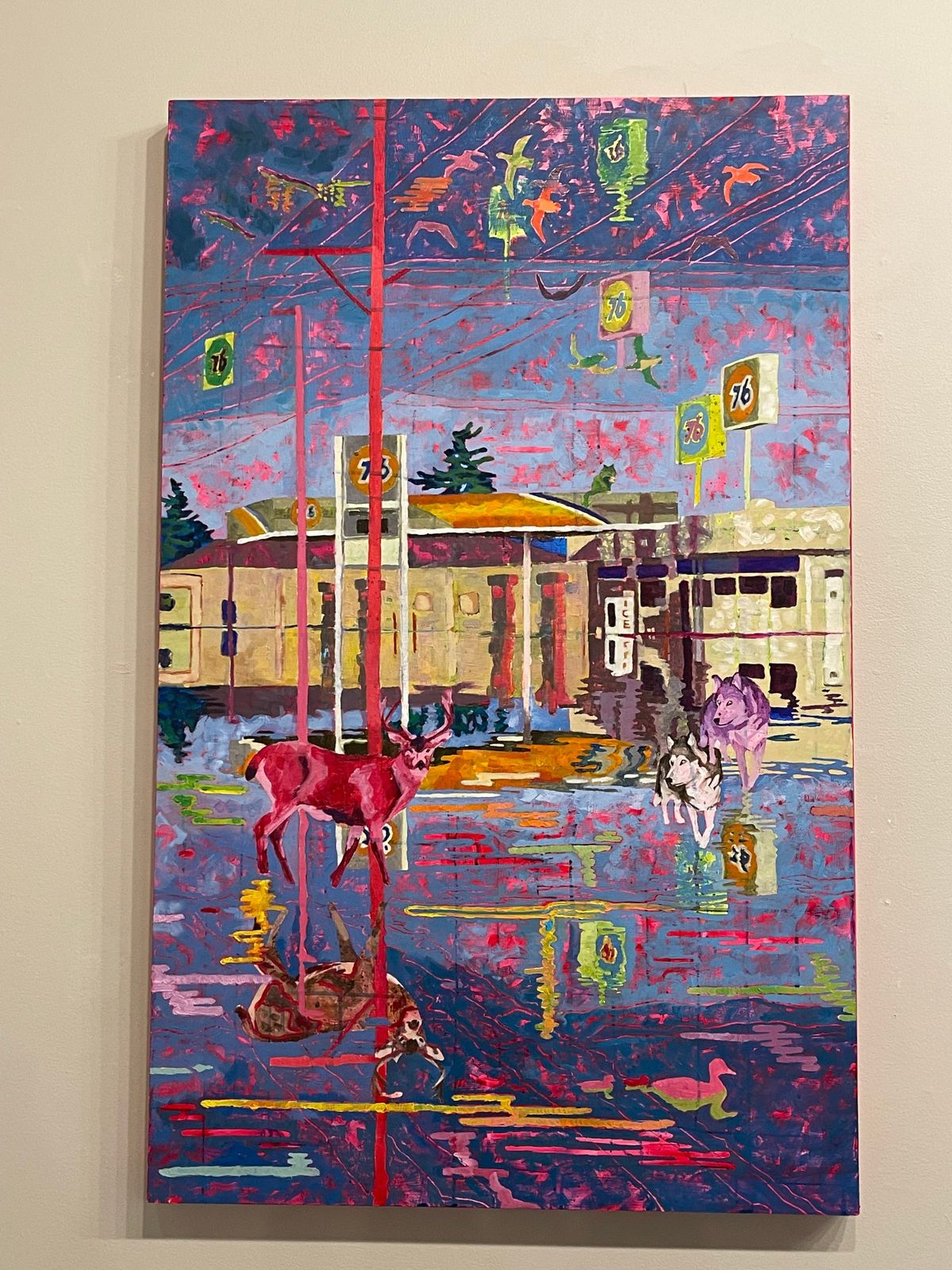
On the walls of Spokane City Hall’s Chase Gallery, neon acrylic shades peek through oil-painted scenes of nature, and, more specifically, depict what happens when disaster strikes.
In one painting, a deer and a wolf cross paths near a 76 gas station on a street so flooded a duck can swim in it.
This painting, titled “Electric Apocalypse,” is one of 19 pieces from Seattle-based artist Tesla Kawakami that make up the Chase Gallery’s latest exhibit, “What If You Stay,” which opened on July 4. Since graduating from Western Washington University with a bachelor’s of fine arts in 2023, Kawakami has had work featured in group and invitational shows, including one at the Museum of Northwest Art in La Conner, Washington. “What If You Stay,” however, is Kawakami’s first solo show.
While “Electric Apocalypse,” like many others in the collection, depicts destruction in some way, Kawakami hopes the art can provide viewers a space to reflect, and even find beauty within the chaos.
“I think that I want my paintings to be a way to filter out the sort of really intense climate news and information that we’re all having to digest, and turn that into something that’s really visually appealing,” said Kawakami, who uses they/them pronouns. “I think the depiction of these really intensely destroyed and altered environments that still have a lot of life in them is sort of like a testament to the tenacity of life, and like how we as communities will continue to find space and grow and thrive, and make the best of the situations that we’re given.”
The flooding depicted in not only “Electric Apocalypse” but also several others in the collection are inspired by real flooding that happened in Kawakami’s college town, Bellingham. The painting was created during Kawakami’s time at WWU, and with the vibrant colors, experimentation with water reflections and incorporation of animals, Kawakami said the piece was a “first glimpse” into the themes they’ve been exploring in their practice for the past four years.
“It is definitely really sentimental and special,” Kawakami said, regarding “Electric Apocalypse.” “I was using a kind of photo collage with really vibrant acrylic underpaintings, and then painting on top with oil in a more realistic color palette, and then letting those like really vibrant colors show through hot pink or orange.”
While still being painted in this kind of style, three of the exhibition’s paintings are different from the rest. All completed during Kawakami’s time at Western, the pieces are diptychs, meaning they are made up of two panels put together to make one image, Kawakami said.
“The top panel kind of reflects the bottom one, because the bottom one is the water and the flooding,” Kawakami said. “They’re pretty much symmetrical, but they’ll be little animals or wavy distortions to kind of break up that symmetry.”
The diptychs not only allowed Kawakami to create bigger pieces of work and explore with reflective elements, but they were also much easier to transport.
“It’s kind of funny, with the diptych format, I wanted to make paintings that were big, but I only have a Subaru sedan,” Kawakami said. “I couldn’t fit any bigger paintings in my car, so I just made the two panels so they could fit. And then, it ended up really working for the kind of imagery that I was doing and working with – like solidifying that symmetry.”
While most of Kawakami’s bigger pieces in the exhibition depict flooding, there are several smaller pieces that Kawakami calls “nature studies.” Creating smaller paintings not only increased potential painting sales, Kawakami said, but also gave them the opportunity to hone in on the little details.
“Since those ones were smaller, I kind of started doing this technique of painting on (the canvas) with oil paint pretty heavily. And then I would just take my thumbnail and scratch out lines that will bring the neon underpainting forward and have these really vibrant, buzzing (and) neon contours come forward into the finished painting. And so I was really enjoying that,” Kawakami said.
The last two additions to the exhibition – one titled “New Haunts,” and the namesake of the collection, “What If You Stay” – were completed in April during a monthlong artist residency on Vashon Island, Washington, where Kawakami said “everything came together.”
“I was more productive in that month than I had been in the last year, just with all of my distractions and everything,” Kawakami said. “It was so nice to just be like, ‘Well, today I’m gonna get up and paint and I’ll probably sit at the beach for a little while and eat a meal and then I’ll paint again and then I’ll go to bed.’ And that was just like the entire month.”
In the painting “What If You Stay,” one of the central themes in Kawakami’s work – queerness – really shines through.
“I think queerness is something that has always informed my practice,” Kawakami said. “(What If You Stay) is a portrait of my girlfriend and our cat. It’s kind of like this blend of environmental surrealism, and it felt like a kind of serene depiction of queerness in an unreal environment that feels just very, very peaceful and natural, even though it is, you know – imaginary.”
As a whole, Kawakami said the exhibition allowed them to directly articulate and conceptualize their own personal relationship with queerness to the issues of climate disaster that their work also explores.
“(It’s) creating something, thinking about myself and other people as people who are experiencing the world in harsh or volatile conditions, and thinking about this physical environment that is harsh and volatile,” they said. “Comparing these different bodies of destruction or change and still finding the growth and the beauty in these environments that are experiencing changes that are being done to them by other people.”
During their time on Vashon Island, Kawakami met Wisconsin-based artist and professor Okja Kwon. The two artists worked in painting studios adjacent to each other, Kwon said, and soon became good friends.
“I think Tesla very quietly lives within the realms of queerness in their day-to-day life,” Kwon said. “They’re uniquely ingrained in this sort of balance between difficult truth and evidence, and (they’re) a very keen witnesser of things and embody this sort of innocent wonder that allows them to ask bigger questions and find larger solutions than we normally take the time to sit with.”
Jeremy Whittington, curator of the Chase Gallery and the program director at Spokane Arts, is one of several commissioners who decide which artists get to be featured at the Chase Gallery.
“(Kawakami’s) work focuses on environmentalism and the destruction of climate, and how we as humans interact with that, and how nature interacts with it,” Whittington said. “I thought that that messaging is current and important, and the way that Tesla evokes these themes is new and exciting. There’s a lot of neon touch work in their painting that really brings out something vibrant that you don’t see in all this destruction that they’re painting.”
After seeing their work, Kawakami said they hope viewers walk away feeling empowered.
“I think that with the political climate, it feels like a lot of the time there’s just nothing we can do,” Kawakami said. “We should be proud of existing – and that is like an act of defiance – just existing in these really harsh conditions, and being able to thrive. That is a way to protest, and even feel like we’re making a difference.”
“What If You Stay” will be on display at the Chase Gallery through Aug. 29, and will be celebrated at two events, one on First Friday, July 11, and the second, on Aug. 29. The event will run from 5 to 7:30 p.m. and include a reception where visitors can meet the artists, as well as live music from Spokane musician and xylophonist Rosie CQ.