
Four applicants vie for appointment to four-month stint on Spokane City Council ahead of July 28 vote
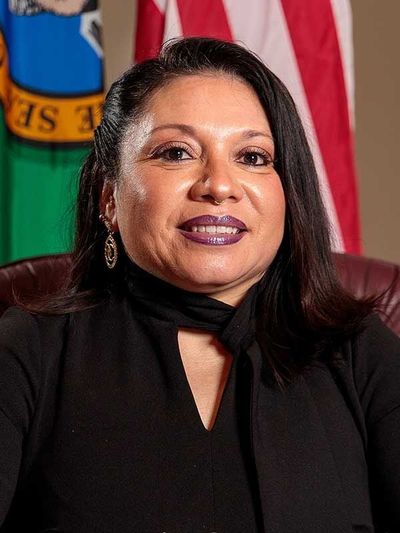
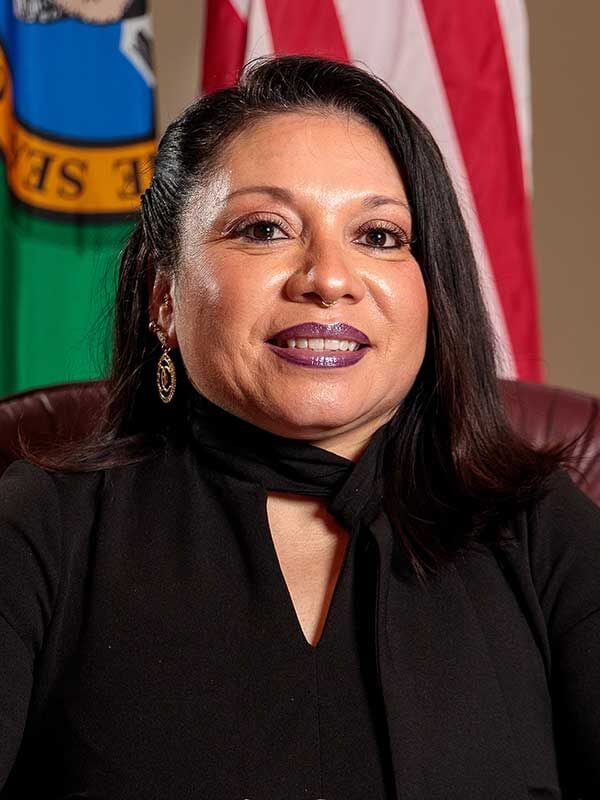
By the end of July, one of four people will be appointed for a four-month stint on the Spokane City Council to fill a seat vacated by former Councilwoman Lili Navarrete, who resigned citing health concerns effective July 1.
Though voters will have an opportunity in November to choose a successor for a full four-year term – Kate Telis and Alejandro Barrientos are currently vying for the seat – the rest of the City Council will have to choose Navarrete’s temporary replacement. The appointment vote is scheduled for July 28.
Though nine people originally applied for the opening, only four attended a public interview on July 10: Shelby Lambdin, Kris Neely, Ryan Oelrich, and Kristina Sabestinas. Given the short time they will serve on council, they were cautioned during the public interview that it is unlikely they will be able to spin up major initiatives from scratch, but they will still face major challenges, including balancing a roughly $3.8 million budget deficit by the end of the year.
Lambdin serves as the population health director at the Community Health Association of Spokane, more commonly known as CHAS Health, and previously worked as an integrated operations specialist for that organization.
Lambdin argued that her experience in public health would bring expertise to the council on addressing related issues and hoped to advocate for cost savings in the city through the use of technology and artificial intelligence to streamline operations and potentially reduce personnel. She also argued in favor of programs to make the city’s outdoor recreation more accessible to marginalized communities and for advancing the council’s work on making various services available in other languages.
Neely is a technology consultant and business process engineer and a writer of nonfiction works exploring Zen Buddhist teachings. She has served in numerous roles in nonprofits and city boards and commissions, including on the boards of The Lands Council, the Spokane County Conservation District, and as vice chair of the Spokane County Democratic Party.
Neely broadly spoke of a desire to lean more on data to determine whether certain programs were functioning efficiently, particularly regarding homelessness, which Neely experienced as a child. He also argued his role would be primarily to come prepared to meetings, versing himself in materials provided by city staff, and try to keep things moving forward, comparing the four-month stint as “jumping on a plane that’s already in the air.”
Oelrich serves as the executive director of Priority Spokane, which identifies and works to address key problems in the county, and has worked as a commissioner, director and secretary for the Spokane Regional Continuum of Care board, which helps to coordinate federal resources to address homelessness. He was appointed to a roughly two-month stint to the Spokane City Council in 2023.
Oelrich noted his prior experience and argued his role was as a “warm up act” for whoever voters elect to fill the position for a full term in November, noting that “as a former magician, I appreciate” the importance of a good warm up act. He hoped to be able to advocate for affordable housing and better coordinate homeless service providers during his time on council.
Sabestinas serves as the executive director of the recently formed Cathy McMorris Rodgers Leadership Institute, a nonprofit foundation that aims to cultivate a new generation of American leaders that was formed by the former congresswoman in her first public move after retiring from Congress at the end of 2024. Sabestinas previously worked as McMorris Rodgers’ district director and for a year as the director of the office of former Spokane Mayor David Condon.
Sabestinas acknowledged her Republican affiliations while applying for a seat in the city’s most liberal district, but she argued she did not “have an interest in toeing the party line,” and described herself as a “bridge builder” who would “bring some new voices to the table” if selected to serve. She hoped to be able to advance the cause of substance-exposed children in the community, praising the council’s anticipated financial support for Maddie’s Place, a local organization dedicated to serving children born addicted to drugs.
Each applicant was asked a series of prepared questions from each of the sitting council members, touching on budgetary issues, checks and balances, labor agreements and more. The full interviews are available on the Spokane City Council’s various social media pages, including YouTube.
Council President Betsy Wilkerson pressed each on how they would improve the community’s perception of the city’s work to address homelessness.
Lambdin similarly argued the city needed to break down the “silos of work occurring within the community” and to have a more systematic eye to addressing the issue, but also argued that addressing community perceptions that the city was not “moving the needle” could be partially addressed through education campaigns.
“There are a lot of issues surrounding the topic that can make folks feel uncomfortable, so I think having that lens of education, really going to the evidence around the issue, is really important because it helps us take some of the feelings out of it and we can really focus on having some evidence-based solutions,” Lambdin said.
Neely argued the city wasn’t doing enough to collect and rely on data to show what programs were most effective, and that this lack of easy-to-understand data made it difficult to communicate with residents.
“We need to study the data. Are they getting better? What’s the recidivism rate?” Neely said. “We need to pull that data together, and we’re not doing a good job of that, so it’s hard to report back to the average citizen the successes and the headwinds, so what you end up with is generalizations.”
Oelrich argued that more needed to be done to coordinate homeless service providers toward particular policy goals and push them to meet success metrics, while also recognizing the “impossible solutions” they are asked to accomplish when much of the funding is dependent on the whims of the federal government and is outside of the city’s control.
“So I think there’s an important balance there of both listening and supporting and then also as a (council member), asking the tough questions but asking them compassionately,’ Oelrich said.
Sabestinas, who said she found herself feeling like she did not belong in Spokane, noted her own perception that the city had become unsafe.
“As someone who lives here, the perception I have as I drive downtown is I don’t feel safe,’ she said. “My kids don’t feel safe coming downtown, and that makes me really sad because I want them to be able to enjoy our city.”
She expressed that the city needed to better communicate its efforts to address these issues, arguing the average resident going about their lives was unlikely to see those investments, but praised the council’s focus on funding housing and human services.
Residents were able to provide public testimony in favor or opposition to the four candidates during July 14’s city council meeting: only two people signed up, both in favor of Sabestinas.
“I used to feel safe in Spokane,” said Candy Galvan. “I felt protected in Spokane. I shopped downtown, I went to restaurants downtown, I went to events downtown. It no longer feels safe to come downtown at night and sometimes even during the day.”
“I have no voice here anymore,” she continued. “If everyone belongs here, as we say, then my voice should be represented in the city too, or I don’t belong here anymore.”
Editor’s note: This story has been corrected to accurately reflect the two candidates running this November for a four-year term for the seat, Kate Talis and Alejandro Barrientos.