
Trump wants to dismantle the Education Department. What would that mean?
The Supreme Court cleared the way Monday for the Trump administration’s sweeping cuts to the Department of Education – a win for President Donald Trump, who has been pushing to do away with the department altogether.
Trump signed an executive order in March saying he would take “all lawful steps” to close the Education Department, although the White House acknowledged at the time that only Congress can do so. Trump has claimed that the current education system is “failing” children and their families.
Republicans have advocated off and on for abolishing the department since its inception. Trump has argued that the Education Department is unnecessary, ineffective and a tool of a “woke” culture war.
Here’s what to know.
What does the department do?
Trump has repeatedly promised to “return” responsibility for education to the states. In fact, education has long been the responsibility of state and local governments, which provide 90% of the funding and set most of the rules. The department does not dictate curriculum or have a hand in most school policies.
But the federal agency plays an important role.
It administers federal grant programs, including the $18.4 billion Title I program that provides supplemental funding to high-poverty K-12 schools, as well as the $15.5 billion program that helps cover the cost of education for students with disabilities. The department oversees the $1.6 trillion federal student loan program and sets rules for what colleges must do to participate.
It also runs achievement tests dubbed the Nation’s Report Card and collects statistics on enrollment, crime in school, staffing and other topics.
And the agency is charged with enforcing civil rights laws that bar discrimination in federally funded schools on the basis of race, sex and other factors. The Biden administration prohibited schools from discriminating against students on the basis of gender identity. The Trump administration last week sued California for declining to comply with its demands to ban transgender athletes from participating in women’s and girls sports.
What has Trump said about the Education Department?
Closing the Education Department is a central plank in Trump’s schools agenda.
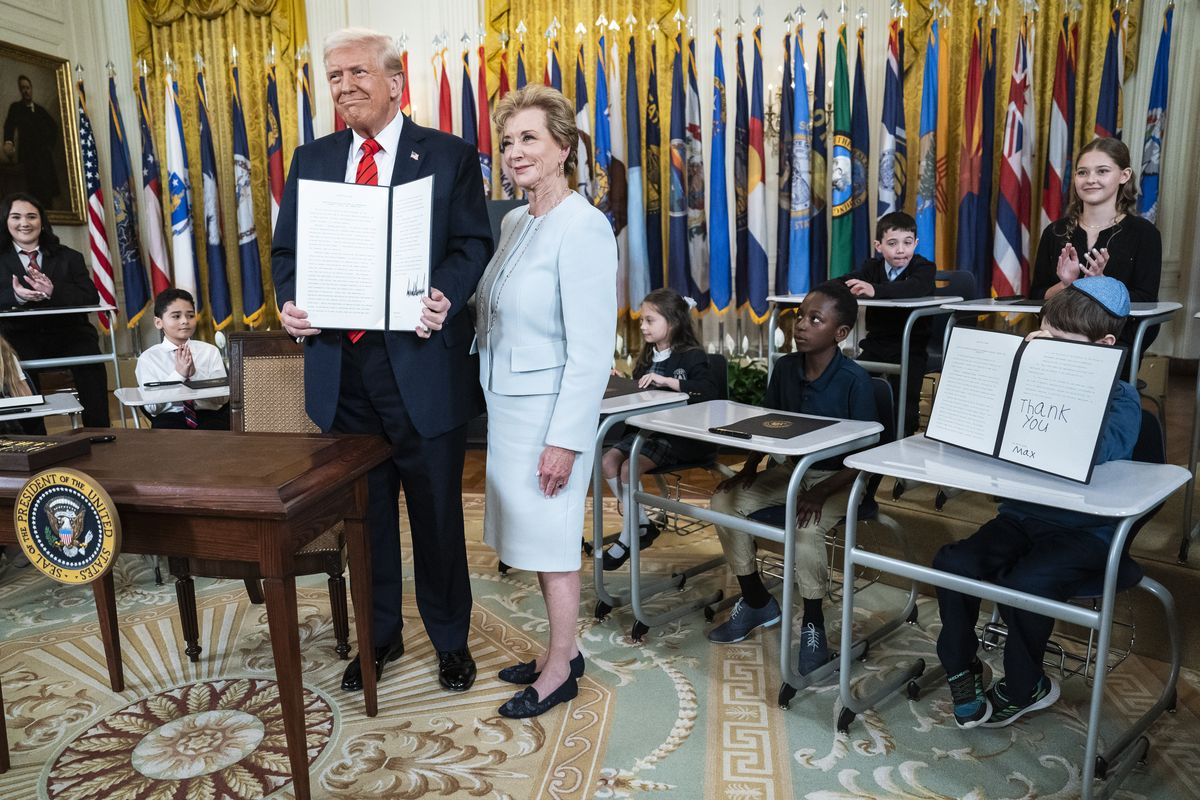
“We’re not doing well with the world of education and we haven’t for a long time,” Trump said as he signed an executive order in March, flanked by rows of schoolchildren sitting at desks.
Specifically, Trump has criticized the department’s work under Democrats to promote racial equity and protect the rights of transgender students, much of it through enforcement of civil rights law.
What did the Supreme Court do?
More than 20 states, teachers unions and school districts filed challenges to the cuts, and the lawsuits were later consolidated. They said in a filing with the Supreme Court that the cuts would effectively strip the department “down to the plywood,” with deleterious effects on schools, districts and children across the country.
In a 6-3 decision on Monday, the Supreme Court lifted a temporary lower-court ruling that had prevented Trump officials from slashing more than a third of the Education Department’s more than 4,100 workers and shifting some of its functions to the states and other agencies as litigation over the cuts plays out in the lower courts.
Justice Sonia Sotomayor and two other liberal justices, Elena Kagan and Ketanji Brown Jackson, dissented calling the ruling “indefensible” and a major expansion of presidential power.
Trump celebrated the ruling on Truth Social and Education Secretary Linda McMahon vowed in a statement to return “education to the states” and reduce “education bureaucracy.”
The cuts will hit some offices particularly hard, including the Office for Civil Rights – which will lose about half its staff and seven of its 11 regional offices – and the Federal Student Aid office, charged with overseeing the student loan program. The Institute of Education Sciences, which runs the achievement tests dubbed the Nation’s Report Card, will also be impacted.
Could Trump eliminate the agency?
Trump cannot eliminate the agency on his own. Any bill would require 60 “yes” votes in the Senate, which means at least seven Democrats would have to support it – which observers see as highly unlikely if not impossible. A 2023 vote in the House to abolish the department, considered as an amendment to a parents’ rights bill, failed. It garnered 161 yes votes, but 60 Republicans joined every Democrat in voting no. The bill was defeated.
What is the agency’s history?
The Education Department was created by an act of Congress in 1979, under President Jimmy Carter.
A much smaller Education Department briefly existed more than 100 years earlier. In 1867, President Andrew Johnson signed legislation creating the first such department – but it was soon downgraded to an office of education because of backlash from lawmakers who feared it would lead to federal overreach.
The federal government’s role in education grew after World War II when it increased spending, including through the GI Bill, which provided millions of military veterans with educational benefits such as free college tuition. Passage of civil rights legislation gave the federal government new powers to ensure that schools do not discriminate against students on the basis of race or sex.
Education was part of the Department of Health, Education and Welfare until 1980, when that agency was divided into two: the Education Department and the Department of Health and Human Services. The new education agency began operations in May 1980.
What would be the implications of eliminating the department?
Closing the Education Department would surely have symbolic impact. There would no longer be a member of the Cabinet focused solely on education issues and empowered to speak to Americans about the challenges schools face. It would be harder for the federal government to elevate education issues or press for change in schools.
Beyond that, the practical impact would depend on how Congress restructured the work of the department. Trump has argued for major functions of the Education Department to be moved to other agencies.
Though popular among some Republicans, a majority of American voters are against the department’s closure. A March Economist/YouGov poll found 2 in 3 Americans said the department should be expanded or kept the same. Another poll by Quinnipiac University the same month found 60% of voters opposed Trump’s plan to eliminate the agency, and 33% supported it. Two-thirds of Republicans backed the idea.