
Greenacres fire destroys seven homes in Omak; residents look ahead to recovery
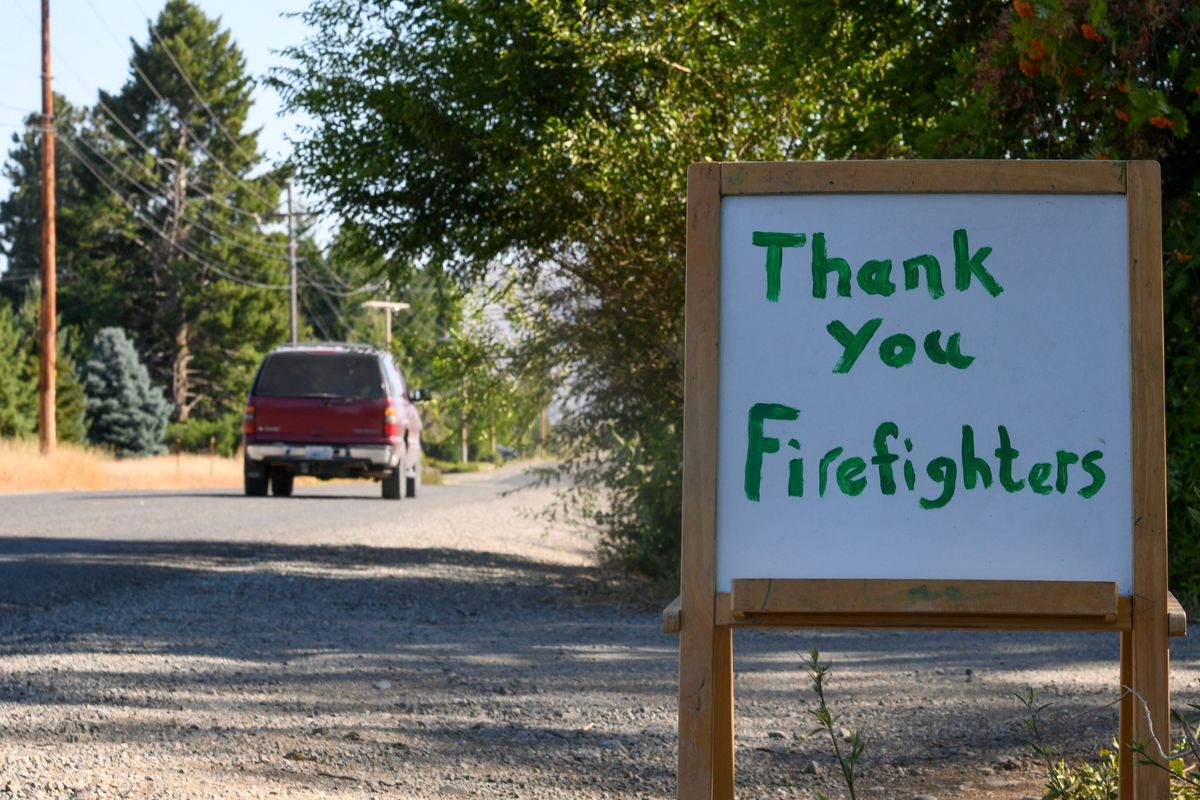
OMAK, Wash. – Geoffrey Pearson drove to his property Monday night unsure if his house would still be standing.
He and his family had evacuated just hours before, passing neighbors’ houses engulfed in flames and black smoke.
Luckily, his home was mostly intact, albeit with windows severely smoke damaged and several fallen fence posts.
His mother’s residence was less fortunate. A wildfire destroyed the floors of her 18-year-old house, burning various items and furniture along the way.
Pearson reviewed the damage while walking around his mother’s property Wednesday afternoon, pausing to look at the gaping hole in a bedroom wall that responders knocked in to fight the fire.
“That was in my bedroom when I was a kid,” he said, pointing to a melted plastic alarm clock sitting atop a damaged wooden table.
Her luscious green lawn was now a sandy brown due to the heat from the fire. Rows of plants in raised-bed gardens became wilted and yellowed. Piles of ash and splinters submerged in her above-ground pool completely coated its tiled floor.
“We feel very fortunate,” he said. “We know there’s other people that are hurting a lot worse than we are.”
Their properties are just some of the those damaged in Okanogan County by the Greenacres fire, a fast-moving wildfire that started on county land Monday afternoon, destroying seven homes and 13 other structures.
The fire reached 1,013 acres and as of Wednesday is considered 50% contained. It’s cause remains under investigation.
Pearson was having a normal day at home when he noticed a wind so strong that it was shaking his house. His wife Jocelyn spotted a fire just a few miles away, inching its way toward their property.
“Then all of the sudden, the wind changed, and it went just right at us,” Pearson said.
Although his and his mother’s homes weren’t completely destroyed, they have a long way to go until they can safely live in either.
Yet they have no plans to give up on their property.
“We’ll be here,” he said. “We’ll definitely make sure we have a better lawn and I won’t let sagebrush grow back on our property, but we love this community.”
The majority of the wildfire’s damage stretched along its namesake, Greenacres Road.
The single-lane road’s scenery on Wednesday was a mix of pockets of short tan brush followed by stretches of blackened grass and foliage. Some houses along the drive were reduced to charred rubble. Other properties were covered in flame retardant, sparing the land from the flames but immersing it in hot-pink dust.
Flora Rogers, a born and raised Omak resident, was working at her job at city hall when she heard her supervisor’s scanner mention a fire on Greenacres road, the same road she lives along.
She raced to her property, following a fire truck and followed by a customer of hers who volunteered to help.
Rogers, along with her boyfriend Jason and more than a dozen community members and firefighters, worked throughout the night to keep the flames at bay and protect their neighbor’s property.
“Sometimes it’s very hard to think, because you just can’t quite comprehend what you’re seeing,” Rogers said. “The only thing you can do is your best. And it just kept coming.”
In the end, her house stayed intact, but the fire didn’t leave without a cost.
It killed one of her beloved cats and destroyed thousands of dollars worth of building materials and fencing.
“There was a point where it had gotten really bad. You could not breathe. There was so much debris and dust in the air,” Rogers said
Rogers has been through this before. Ten years ago, the Okanogan Complex fires caused by lightning strikes burned over 300,000 acres of land, including the same property she lives on today.
Though the experience was scary, she was deeply impressed by the work the firefighters put in to stop the fire and save her house. Wanting to give back, she signed up to be a volunteer firefighter at 51 years old with no previous experience, and has been helping out since.
This year, she made sure her yard was prepared. She cultivated a large green space, used rocks instead of mulch and kept flammable items away from her house’s exterior. She also frequently weed-wacked the areas around her fence and power lines, maintaining a perimeter of shortened brush that can be extinguished easily.
Though her prevention tactics made a difference, Rogers credits Omak’s strong community and the fast work of firefighting teams to preventing the fire from spreading farther.
“This county has the best people out there working and I think it’s because they are protecting their friends and their family,” Rogers said. “We’re very, very luck to have those resources come in.”
Guy Gifford, a public information officer at the Washington Department of Natural Resources, emphasized the need for preparation when it comes to wildfires.
Embers are the leading cause of home ignition. Since these can travel through the wind and land outside your house, it’s important to minimize the amount of flammable objects that are next to the house, he said. This includes brooms, newspapers, boxes and anything else that can easily catch on fire.
“Just being aware of the things that if I took a match to it would have caught on fire,” he said. “Think of all of those the next time you walk around a house.”
Another aspect people should be cautious about is running sprinklers from public water systems during wildfires, he said.
“If we all did that in my neighborhood, there’d be no water for the hydrants,” he said. “We don’t really encourage people on public systems to run sprinklers because that takes away from the firefighters.”