
Cool Critters: The mighty spider mite likes it hot

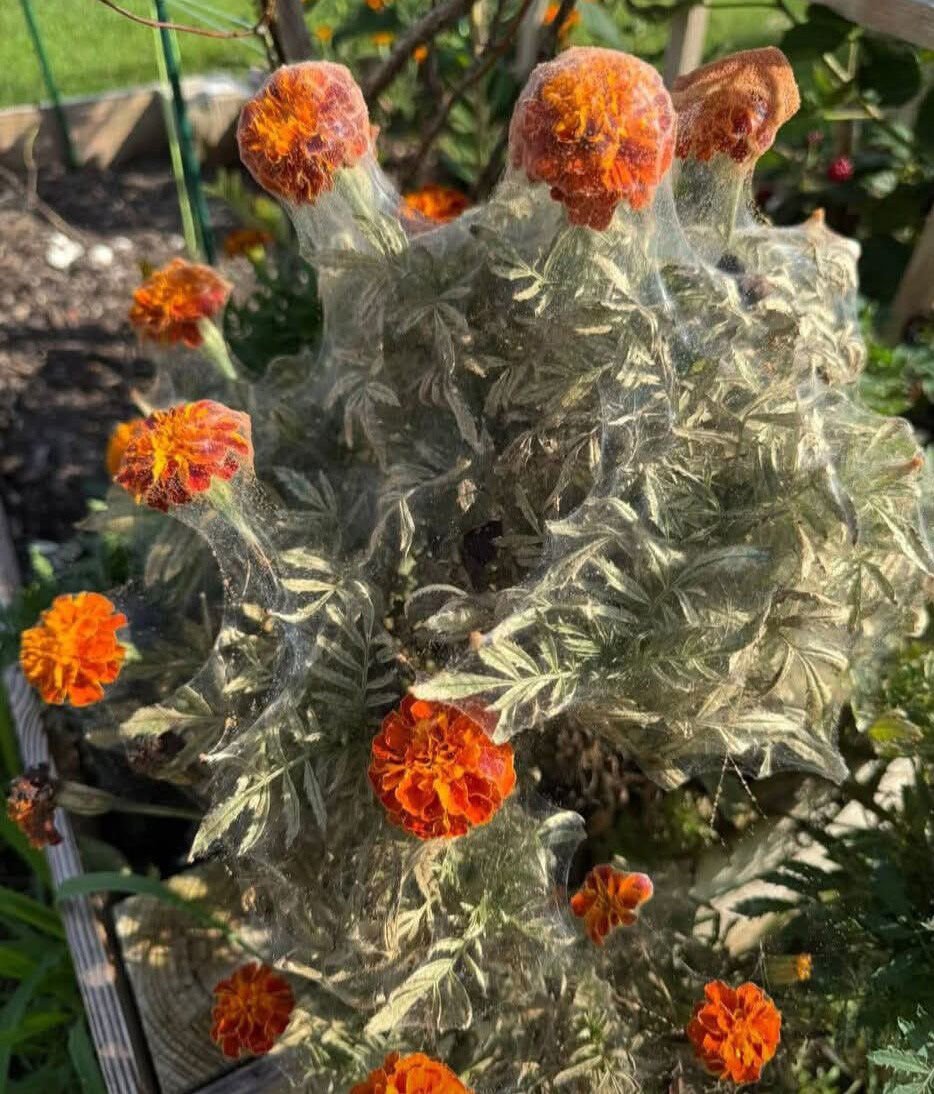
No larger than a grain of sand, spider mites have eight legs and needle-like mouthparts used to pierce leaves of host plants and suck out their fluids.
Unfortunately for home gardeners and commercial growers, they do most of their dirty work when the weather is hot and dry, particularly for long periods.
Which means, if you’re a spider mite that feeds off anything from roses and marigolds to grapevines and hops, this time of year is bliss. Rainless days with temperatures 80 degrees and higher? Yes, please.
Not only do these conditions allow spider mites to produce more offspring more rapidly, but they can inflict more harm on vegetation that’s stressed from lack of water.
Spider mites are arthropods related to spiders and ticks. They’re tiny in size; gigantic in presence.
“There are over 1,000 species of spider mites,” said Richard Zack, an entomologist at Washington State University. “Some are specific on the plants on which they feed, while others are pretty general and will feed on many different plants.”
For example, the red spider mite favors fruit trees; the clover mite feeds on clovers and grasses; the spruce mite is found on spruce and other coniferous evergreens – the list goes on and on. The most common species in our region and most of the country is the two-spotted spider mite, a generalist feeder capable of infesting several hundred types of plants, including strawberry, tomato, lettuce, garden flowers and many field crops.
In Washington, the two-spotted spider mite also can be found among hop plants, Zack said. “If you like your beer, it needs to be carefully managed,” he said.
Meanwhile, the Willamette spider mite, first detected in Washington in 2013, is now the most commonly found species in wine grape vineyards, said Doug Walsh, an entomologist and pest management expert at WSU who works closely with the state’s hop and wine grape industries.
Because they’re so tiny, spider mites can be hard to see on the undersides of leaves where they do most of their feeding. Whitish, yellow or tan speckling on leaves may be a sign that mites are causing some damage. Also, look for fine webbing, similar to spider webs. Heavy webbing – like what you see in the photograph that accompanies this column – means the plant is severely infested, Walsh said.
“Webbing has multiple uses for spider mites,” he said.
Obviously, catching prey isn’t one of them. All the food they need is inside the leaf. Instead, webbing is used to create a microclimate that promotes the mite’s development from egg to adult, Walsh said. Mites also use webbing to move around the plant canopy and also as a barrier to protect themselves from predators, he said. And talk about irony. The spider mite’s main predator is another eight-legged member of the arachnid family. Its common name: the predatory mite.
With summer only half over, how to protect your garden plants from spider mites? Keep them hydrated.
If mites are detected (leaves are speckled or appear covered with dust and you see strands of webbing), intervene quickly, as they can rapidly build up in numbers and cause severe damage to the plant and even those around it, Zack sai. The easiest approach, he said, is to blast the undersides of the leaves with forceful sprays of water, or a combination of water and mild liquid soap. Repeat the process every other day for a week or so.
Plants with extensive discoloration and webbing are signs of severe infestation, which means it’s probably too late to remedy. If so, dig up the plant and throw it away. Then, wait for a good rainfall.