
RFK Jr. contradicts Trump, talks salmon preservation at Nez Perce Tribe Hatchery
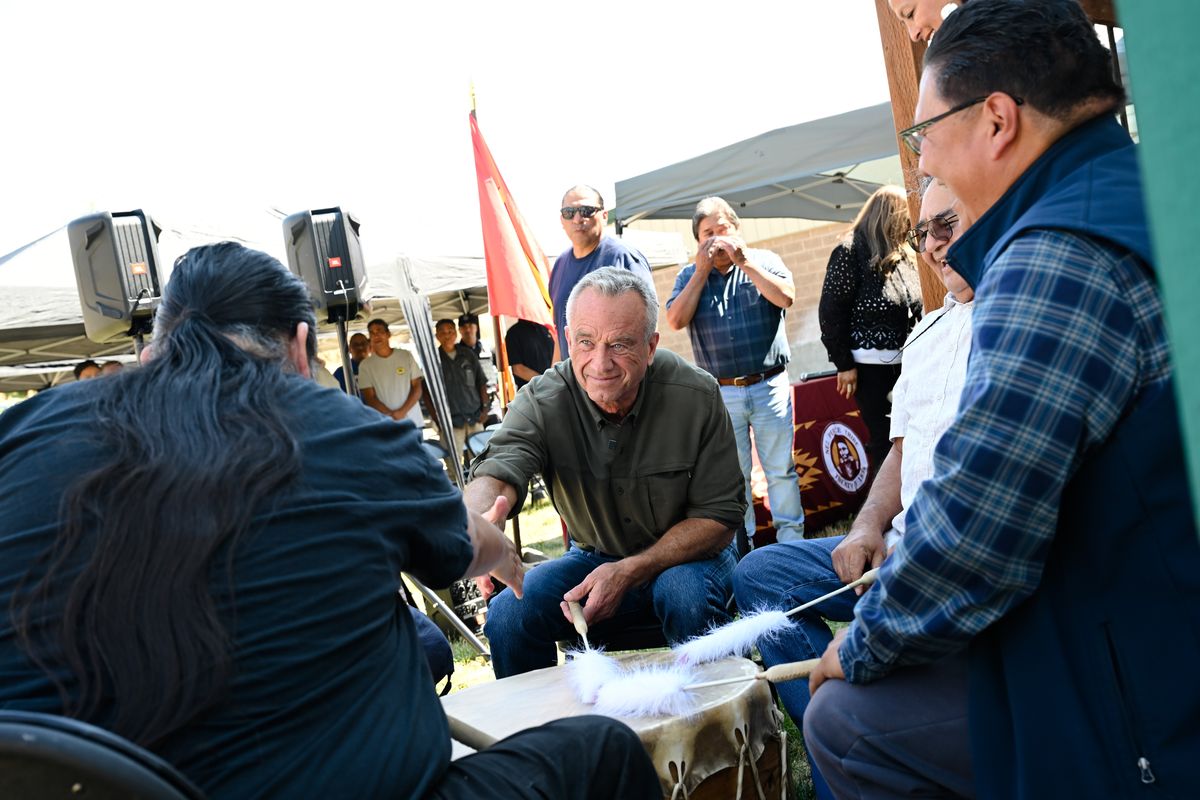
LENORE, Idaho – If the saying, “You are what you eat,” is true, the people of the Nez Perce Tribe would be salmon – at least they would have been a century ago.
But the number of salmon that traditionally coursed the Snake River has significantly dropped in the 50 years since the federal government built Lower Snake River dams. It’s a problem that U.S. Secretary of Health and Human Services Robert F. Kennedy Jr. is invested in solving, he told a group of tribal leaders Thursday during a visit to the Nez Perce Reservation.
Kennedy met with them to discuss their work to preserve traditional foods such as salmon through hatcheries like the one located in Lenore. During his remarks, Kennedy told tribe leaders and hatchery employees that he wants to work together and help tribes like Nez Perce in any way, including their work to bolster the salmon population.
“I want to do everything I can to be the best secretary for the tribes, to actually solve problems and to listen to what your needs are, and then to try and do everything we can to make the federal government finally live up to its obligation to the Indian people,” Kennedy said.
His comments were a departure from President Donald Trump’s announcement that he was withdrawing from the Biden administration’s agreement to restore salmon populations and invest in clean energy production with four Northwest tribes, conservation groups and the states of Oregon and Washington.
Kennedy said America needs to address its genocide of the American Indian, which continues today with a food system that is poisoning tribes, which Kennedy said have the highest diabetes and obesity rates in the country.
“What we’re doing here today is trying to re-establish high-quality food for places in our country,” Kennedy said.
Salmon is a big part of that equation.
Salmon, traditionally, made up 50% of the Nez Perce caloric needs, said Joe Oatman, director of the Nez Perce Department of Fisheries Resources Management. Now, salmon make up around 1% of the Nez Perce caloric needs, Oatman said, which is why the hatchery takes its responsibility to produce fish seriously.
“Your quality of diet directly impacts your physical and mental health,” Oatman said. “… We call ourselves the salmon people because that is what we eat. That is what we do. So, our health, both physical and mental, comes from eating our foods as well as going out there, harvesting our foods, processing them and feeding ourselves.”
Part of the challenge is that most reservations are in food deserts, where it’s nearly impossible to access traditional foods, Kennedy said.
“Part of my objective as health secretary is to increase the availability of traditional foods on reservation lands,” Kennedy said. “… for the West Coast tribes, it’s salmon.”
The Nez Perce Tribe Hatchery helps bolster the salmon population, Oatman said. The hatcheries operated by the Nez Perce Tribe produce 2.1 million steelhead and 2 million spring chinook (a type of salmon), said Becky Johnson, production division director for the tribal hatchery. The fish are released into the Snake River Basin to support the wildlife population and tribal fisheries.
The Nez Perce Tribe Hatchery was built in 2002, but planning for it began in 1983 after the Power Act passed, giving Bonneville Power the direction to mitigate the hydroelectric system’s effect on fish and wildlife, Johnson said. It was one of the first tribal hatcheries to be built, Johnson said.
The dams have been controversial since their conception, as fish advocates voiced concerns about how the dams would affect salmon survival. The dams are barriers to migration and disrupt the spawning cycles of salmon and steelhead , according to the Northwest Power and Conservation Council. More than 40% of the spawning and rearing habitats that were once available to salmon and steelhead in the Columbia River Basin have been blocked by dams.
Salmon is something that the Nez Perce Tribe needs back, Tribal Chairman Shannon Wheeler said. And to Wheeler, that means breaching dams.
“We are looking for solutions, we’re not looking to place band aids or triage our people through this, because that doesn’t get to the root of the problem,” Wheeler said.
To Kennedy, the salmon problem is tied to chronic disease.
When John F. Kennedy was president, 6% of Americans had chronic disease, but now it’s 60%, Kennedy said during his remarks, citing data from the Centers for Disease Control and Prevention and the National Institutes of Health.
There’s no foolproof way to track chronic conditions such as diabetes and obesity afflicting American children in the 60-plus years to which Kennedy referred, especially since diagnosing, tracking and defining conditions has changed over the years. As of April 2024, however, about 20% of American children are obese, according to the CDC – something that Kennedy called a crisis for the U.S.
For now, it’s not clear what Kennedy plans to do to help salmon and the Nez Perce Tribe. But after the secretary’s visit, Wheeler was optimistic.
“We just hope that this visit with Secretary Kennedy is actually something that will resonate with the administration and the work that we’re doing out here that really is meaningful work,” Wheeler said. “We’re trying to keep species alive, and we’re trying to recover a species. It takes the partnership that we’ve come together. I think it will reach the president, and I think that the president will at least understand the position that the United States of America has with the First Nations.”