
Washington born and raised, comedian Todd Royce returns to home state to deliver jokes at Spokane Comedy Club
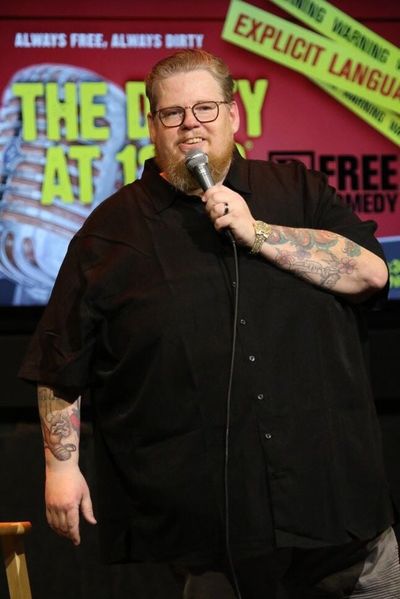

Comedian Todd Royce might call Las Vegas home, but he’s still a proud Washington native.
Royce was born in Bellingham and raised in Oak Harbor on Whidbey Island. He’s also lived in Anacortes, Vancouver and Tacoma, where he started his comedy career.
Getting used to Las Vegas’s triple-digit summer temperatures has taken a toll on Royce, though, who joked he might have to bring a jacket for his show at the Spokane Comedy Club on Saturday, when it’s likely to be in the mid-80s.
But that can be forgiven, as he still gets irked when people pronounce Spokane as “Spo-cane.”
Nevertheless, Royce is excited to return to his home state on the “Don’t Feed the Comic” tour. But before Royce took to the stage as a comedian, he took to the ring as a professional wrestler.
A fan of wrestling since he was 8 years old, Royce juggled dreams of the sport and comedy while growing up. The Royce household was a funny place to be, he said, with family members often roasting each other.
Royce and his grandmother would also watch comedians on “The Tonight Show with Johnny Carson,” “Late Night with David Letterman” and A&E’s “An Evening at the Improv.”
Though it brought the family together, comedy also helped in times of sadness, like when Royce’s grandfather, one of his “favorite things about living at the time,” passed away.
“Right after it happened, I remember thinking ‘Well, life’s just over now. There’s nothing going on,’ ” he said. “Then that night, something happened, and I honestly don’t even remember what it was, but something happened, and the entire family started laughing. I remember this feeling of calm, and this great feeling of ‘Oh, things are going to be OK because everyone was laughing.’ Honestly, I think ever since then, my whole thing was I was always trying to make people laugh.”
As he got older, Royce became frustrated by a lack of clarity between whether he should pursue wrestling or comedy. One day, he decided to say a prayer asking for guidance.
The next day, a friend reached out about a wrestling show in Mount Vernon. Royce did some research and found out the person running the show was wrestler Michelle Starr, who he had watched on TV growing up. At the show, Royce remembers he “overreacted” when Starr came out to the ring.
“He’s the heel, he’s the villain, he’s the bad guy, so he grabs me by my shirt and starts yelling at me,” Royce said. “I’m an adult at this point. I know he’s not going to hit me, but I’m still playing along. Then later, he came out and apologized after the show, and then we started talking.”
Royce learned that Starr had a wrestling school that was open three days a week, the same three days Royce happened to be off work, and started taking classes. About a year later, Starr happily told Royce that the apology was a bit of a fluke.
After the match Royce attended, the Washington State Athletic Commissioner told Starr he needed to apologize to Royce for grabbing him and shouting at him so neither Starr nor the state would be sued. That apology led to Royce signing up for classes.
“That was the beginning of my journey into pro wrestling,” he said.
Throughout his eighteen years as a wrestler, Royce never forgot about his dreams of becoming a comedian. Royce had plenty of experience performing in front of a crowd in a wrestling ring, but something about stand up kept him away.
Still, Royce put “perform at an open mic” on a list of resolutions he would make with his wife year after year and never crossed it off. In December 2017, not wanting to write it on his 2018 list, Royce took the stage for the first time.
He enjoys self-deprecating humor, so many of his early jokes were about his weight.
About a year later, while balancing open mics with wrestling matches, Royce attended “Kill Tony,” a live podcast hosted by comedian Tony Hinchcliffe, in Portland. During his shows, Hinchcliffe draws the names of comedians in the audience out of a bucket, who then get to perform a minute of stand up. Hinchcliffe and the panel of guests also interview each performer.
Royce was chosen to perform and used his minute to tell the “three good jokes” he’d written so far.
Hinchcliffe, the panel and the audience loved Royce’s performance and interview so much, Hinchcliffe gave Royce a “golden ticket,” or a pass to perform at “Kill Tony” shows in the future.
“That was the stamp of approval,” Royce said. “I was like ‘OK, I just had my last wrestling match.’ ”
Royce started to feel the impact of his “Kill Tony” appearance when he got back to his home clubs in Tacoma. One comedian, who previously asked Royce his name multiple times before ultimately introducing him on stage as “Ladies and gentlemen … I don’t remember his name,” came up to him after the clip of his appearance had been posted saying “Hey, Todd! How’re you doing? Great stuff!”
Booking wise, Royce thinks he got one show from his appearance before the pandemic shut down comedy clubs. “Kill Tony” also wasn’t as popular then as it is now. Royce said episodes used to get 100,000 to 200,000 views whereas they’re now racking in millions.
What really boosted Royce’s career was making TikTok videos during the pandemic, a few of which went viral. Once comedy clubs started opening up, he began booking headlining spots out of town.
Since his early days on stage, Royce’s material has gone from mostly autobiographical to dealing with tough subjects. He brings up comedian Sam Morril, who, when told he does a lot of dark humor, said he does light humor by taking dark subjects and making them light.
“Honestly, it brought me back to the whole thing with my grandpa,” Royce said. “When he died, it was such a dark thing, and then the laughter made everything feel lighter. I don’t want to sound like I’m so grandiose or make myself seem more important than I am. I do just tell jokes. My last set on ‘Kill Tony,’ I talked about a very sensitive matter, making jokes about it, and I’ve gotten a lot of [direct messages] from people. As a matter of fact, I got one this morning where they had similar situations happen to them when they were a child, and that resonated with them, and they said it made them feel good to see someone joking about it, so there’s that aspect of it, too.
“When you open your mind and open your set to talking about things that are different … and go into darker territory, if you can make jokes out of it, not only is it funny, but it also sometimes can help.”
In Royce’s experience, some comedians will try to tell others they shouldn’t joke about certain subjects lest people get offended or upset, but Royce said if there’s something he is sad or scared about, hearing someone make jokes about that thing takes away some of its power.
In between weekly shows in Las Vegas, Royce is developing a sitcom (“It would be a workplace sitcom, but the workplace is a criminal organization”) with his wife and a comedian friend who also moved to Las Vegas from Washington.
Royce’s “Don’t Feed the Comic” tour is also keeping him on the road through much of the rest of the year. He tries to get back to Washington every year for shows and calls Spokane a place with great comedy audiences.
“Spokane and Tacoma, they’re open, they’re ready to laugh usually, and they want to have a fun time, and they’re open to different ideas and jokes,” he said. “In Washington, the bigger cities can be a little tighter when it comes to comedy. Places like Spokane and Tacoma, I feel like they almost take pride in the fact that they’re a little more open-minded when it comes to comedy. So I look forward to it, and then, of course, there’s the nostalgia of being there and being like ‘OK, there are places in the country where it’s not 180 degrees all summer.”