
Dave Boling: MLB legend Ryne Sandberg personified greatness in his play and attitude toward life
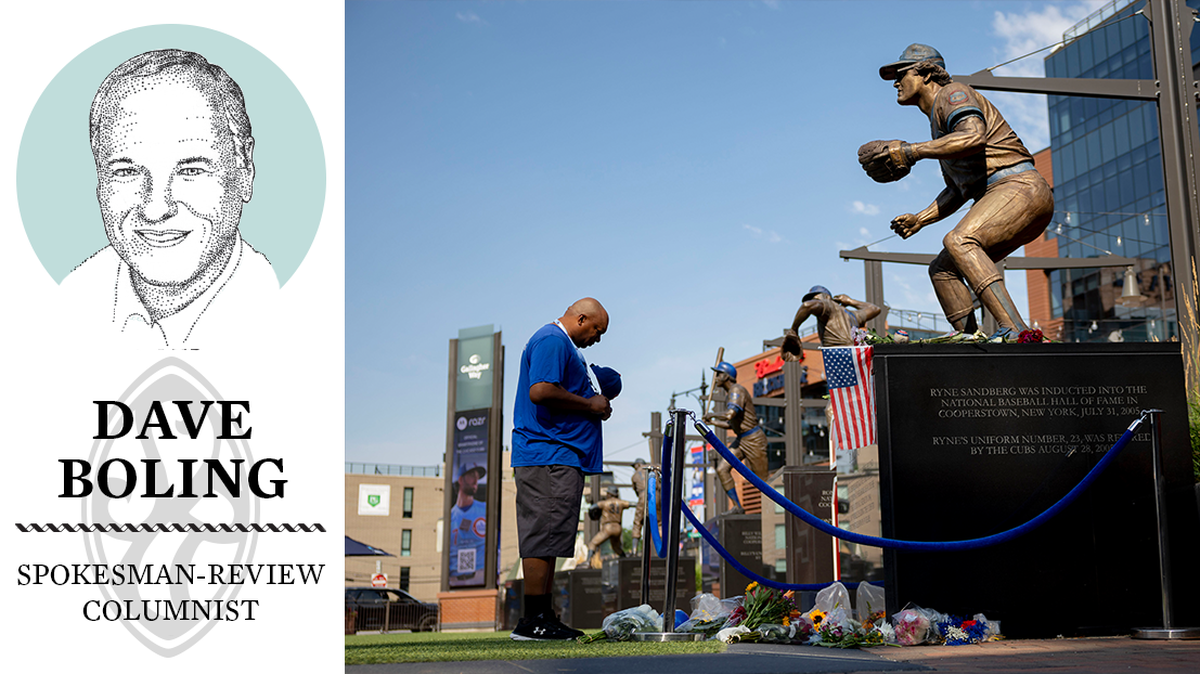
Chicago Cubs fans, a breed apart in their passion and faith, are piling bouquets at the feet of Ryne Sandberg’s statue outside Wrigley Field.
The spontaneous memorial started blossoming soon after reports surfaced Monday of Sandberg’s death, at age 65, of cancer. Fans wearing Cubs “23” jerseys clustered about the monument in grief over the loss of the Spokane native.
Sculpted tributes to the few transcendent athletes at stadiums across the country generally fail to capture the essence of the beloved star, coming off as awkwardly static, while their greatness was rooted in motion and grace.
Sandberg’s, though, is a flawless bronze depiction of balance and preparedness, the ideal posture for a second baseman – the position he revolutionized for 15 years with the Cubs.
Sculptors have noted that the toughest part of the job is getting the eyes right. How to bring life to cold metal or stone or clay? In the case of Sandberg’s statue, this unblinking readiness, and intensity of focus, is perfection.
He was an exceptional athlete at Spokane’s North Central High, so the physical abilities were always there. But it was that intense drive and level of personal expectations that elevated him to Baseball Hall of Fame status.
The first news cycle refreshed readers’ memories of Sandberg’s career with the Cubs: 10-time All-Star, nine Golden Gloves, and his remarkable career turning-point game in 1984, when he hit home runs in both the ninth and 10th innings against legendary closer Bruce Sutter to claim a win over the rival Cardinals.
Tributes now cite his class and humility, and his respect for the game. The plaque on his statue claims: “Ryne let his bat and glove and speed do the talking.”
And on his Hall of Fame plaque: “(Sandberg) dignified the game with his professionalism, quiet leadership, and tireless preparation.”
Those qualities are rooted in his upbringing, with the reticence tracing back to his father’s advice: “Keep your mouth shut, and eyes and ears open. You might learn something.”
And when the bat and glove and speed were unable to speak with the same eloquence, Sandberg’s actions spoke in a language now extinct in professional sports: When he stopped believing he was earning his paycheck, he said “goodbye.”
After signing a four-year extension before the 1992 season, amid a 1-for-28 slump, Sandberg retired. He was hitting 51 points below his career average.
“I’m not the type of person who leaves my game at the ballpark feeling comfortable that my future is set regardless of my performance,” he explained. “And I’m certainly not the type of person who can ask the Cubs organization and the Chicago Cubs fans to pay my salary when I’m not happy with my mental approach and performance.”
It just seemed wrong to him. Taking something that hadn’t been earned.
Author/sportswriter Wright Thompson made an insightful observation about some of the elite athletes: The massive drive and motivation that lifts them to the pinnacle of success are the exact qualities that often prevent them from enjoying it.
And, so, retirement for Sandberg lasted a year and a half, before a two-season return to the Cubs, 1996-97.
A few times thereafter, Sandberg defied his laconic reputation to leave fans with moving comments about the game of baseball, and his place in it.
At his Hall of Fame induction in 2005, he laid out a personal manifesto on sportsmanship.
“I was taught you never, ever, disrespect your opponent or your teammates or your organization or your manager – and never, ever, your uniform. Make a great play, act like you’ve done it before. …”
And: “… when did it become OK for someone to hit home runs and forget how to play the rest of the game. These guys sitting up here (in the Hall of Fame) did not pave the way for the rest of us so the players could swing for the fences every time up and forget how to move a runner over to third. It’s disrespectful to them and to you and to the game of baseball that we all played growing up.”
In January 2024, Sandberg announced he was undergoing treatment for prostate cancer. It then appeared to be in remission.
When his statue was unveiled, he had undergone his first round of treatments. His comments at the time were probably the most poignant and confessional in his life.
His athletic emergence in the 1984 season, he said, was nothing compared to the impact of his cancer diagnosis. “So, my thoughts today are instead about love, life, family and friends,” he said. “My teammates fall into all those categories. But until my cancer diagnosis, I guess I never fully understood that.”
His comments showed that his emotional arc had bent toward self-awareness. The sudden impermanence of life opened his eyes.
“The number of people in baseball that have reached out to me this year is astonishing,” he said. “I feel that love now. It was always there, but I was too busy grinding out an extra 60 ground balls every morning to know that it was happening.”
Last December, he informed social media that the cancer had returned and spread.
One of the grieving fans in front of Sandberg’s statue Monday night told a Chicago news crew, “You always believe your heroes are immortal.”
They aren’t. They’re human.
But sometimes, players like Sandberg can leave lessons that outlive them.
It’s a good thing there’s a statue of him, because they’re simply not making any more Ryne Sandbergs.