
Concert review: Technical, artistic synchronicity on display at weekend’s Northwest BachFest
Last weekend’s concerts of the Northwest BachFest began with a tribute to Professor Elizabeth Buxton who died recently after serving almost continuously on the governing board of the concert series since 1995, save for a seven-year break when she served as chair of Whitworth’s Department of World Languages and Culture.
As accompaniment to a photo montage of her life, Zuill Bailey performed the first two movements of Johann Sebastian Bach’s First Suite for Solo Cello. The fusion of strength with sweetness and order with fantasy that is chief among Bailey’s defining qualities seemed to mirror the life portrayed on the screen so exactly as to make us feel that the music was composed for that purpose.
As has become their custom, many in the audience at this weekend’s two concerts of the Northwest BachFest enjoyed sipping some of the excellent wines from Barrister Winery. Whether they knew it or not, they were at the same time sipping the lemonade Bailey had pressed for them from a lemon that had arrived a few weeks earlier in his inbox. It was the sort of message most dreaded by concert organizers: “The performer you have engaged for your next event will not be available. Sorry for the inconvenience. Have a nice day.”
In this case, Bailey had arranged for appearances by the brilliant Greek violinist Katarina Chatzinicolau, who was being prevented from traveling to the U.S. by unspecified visa problems. Most fortunately for us, Bailey has arranged a date next season for Chatzinicolau to play. Check her out on YouTube, and prepare to be astounded.
Bailey wasted no time in turning that sour incident into something we could all enjoy by dipping into his vast database of close friends and colleagues. Those who responded proved not only to be able to fill the gap, but to provide us with an example of a special order of musicianship that stood apart from what is commonly heard at even the finest of chamber music performances.
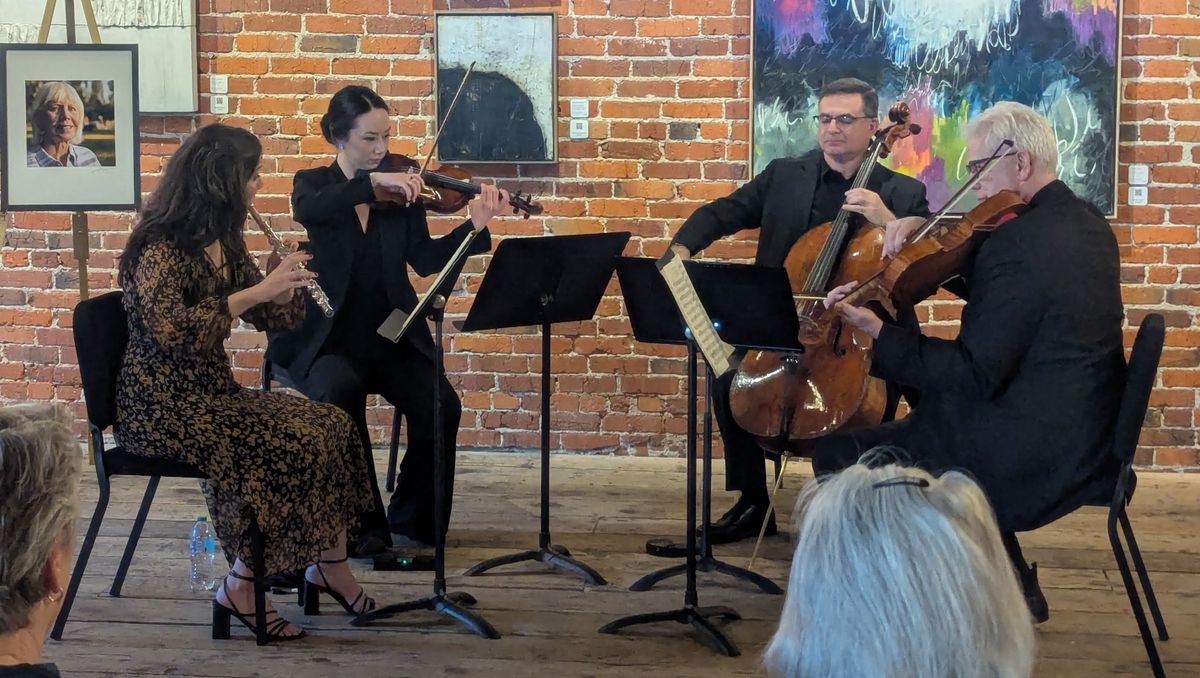
The source of this extraordinary quality lies in the fact that the four artists who appeared in these concerts – Ilya Finkelshteyn, cello; Evin Blomberg, violin; Christian Colbert, viola; and Amy Taylor, flute – are all current or recent members of the Cincinnati Symphony Orchestra. To further strengthen this connection, Finkelshteyn-Blomberg and Colbert-Taylor are marital couples.
The playing we heard when these four artists performed together achieved a degree of technical and artistic synchronicity that was utterly mesmerizing. There were long stretches during which the separation between them simply disappeared, leaving us to experience not a performance of the music, but the music itself as it might have sounded in the mind of its composers before they set pen to paper.
Though it might seem counterintuitive, this artistic effect was all the more noticeable because the six works we heard Saturday and Sunday were not great masterpieces. The program was comprised of two trios for violin, viola and cello (1798) by Beethoven, Mozart’s First Quartet for Flute and Strings (1777), the Flute Quartet in C (1778), and two serenades – that for violin, viola and flute (1912) by Max Reger, and another for violin, viola and cello (1904) by the Hungarian composer and pianist Erno von Dohnanyi. All six works are well-crafted but while two of the composers went on to create some of the most profound and important artworks in history, none of the pieces has such lofty ambitions. They were all intended to delight and entertain, rather than to plumb the recesses of the human soul.
As a result, we were free to revel in the sheer beauty of the sounds that enveloped us, and to wonder at the mastery with which they were produced.
From the opening bars of Beethoven’s Trio Op. 9 No. 2, the first work on the program, we were aware of the exceptional unity among the three players. A change in dynamics originated by one, apparently spontaneously, was mirrored exactly by the next player to pick up that phrase.
Blomberg, the violinist, never reached into the tool bag of attention-grabbing devices available to players of her instrument. She held our attention, rather, by taking care to see that each phrase make its maximum impact without interrupting the flow of Beethoven’s melos, or under-song. In the fourth movement, Colbert, the violist, initiated some important phrases before passing them on to Blomberg, and, while doing so, imparted a penetrating, lyrical quality to his playing that was more characteristic of the violin than of the viola, thus preparing us for what we were about to hear.
Both concerts were full of such moments. What we came to realize is that the years spent by these artists as symphonic (i.e. “sounding together”) resulted in an approach to chamber music performance quite different from that to which we are accustomed from the touring soloists who comprise the majority of the musicians at Northwest BachFest.
As members of a symphony orchestra, musicians exploit every resource of their chosen instruments in an effort to enhance the impact and reputation of the entire ensemble, not of their own careers. To the solo musician, on the contrary, recognition of their individuality is their Holy Grail. The last words a soloist wishes to read in a review are those that praise the performance as note-perfect, while regretting the anonymous quality of the playing. Consequently, there have been many very famous soloists who have been quite imperfect partners in chamber music, because their personalities drowned out the music.
This is, of course, not the case with Bailey, who is as celebrated for his collaborations in chamber music with such partners as Awadagin Pratt, Kurt Nikkanen and Natasha Paremski as he is for his work as a soloist. Still, these concerts provided a striking illustration of the difference between the two styles of performance. Bookending the Beethoven trio that opened Saturday’s concert was the other Beethoven trio, Op. 9 No. 1, which concluded Sunday’s program. The only difference in personnel between the two was that Finkelshteyn took the cello part on Saturday, while that chair had Bailey sitting in it on Sunday.
It must be said there is a distinct difference in character between the two trios, which is typical of Beethoven’s method of composition. Bear in mind Beethoven was composing his Fifth and Sixth symphonies – as different in character one from the other as one can imagine – simultaneously. Still, the difference between the scores that Beethoven left us to the first and second trios of his Opus 9 comes nowhere close to explaining the differences we heard. While No. 2 (Saturday) was a seamless ribbon of musical thought, each note leading inevitably to the next and no gesture drawing attention to itself at the expense of the whole, No. 1 (Sunday) was, by comparison, a roller-coaster ride of dramatic contrasts. Phrases swelled and receded, shouted and whispered, slowed as if in doubt of what was to come, only to rush excitedly forward.
Plainly, Bailey, while taking the greatest care to dovetail his playing with that of his colleagues, was having an unmistakable impact on their playing. After having striven all his life to find his own voice and then employ it to say things about great music that are true and revealing, Bailey must be expected to impart something striking and arresting to every phrase he plays. His colleagues, after decades of listening with intense focus to what everyone around them is playing, were bound to respond in kind to Bailey’s individualistic energy.
Both approaches are correct, admirable and exciting. Both bring music before us in a way that makes us hungry for more and makes us sensible of the incalculable value of the work of such people as Bailey and Professor Buxton, who deeply feel their lives to be incomplete unless they see them bringing joy to the lives of others.