
In ‘detention alley,’ a small town benefits from a big ICE facility
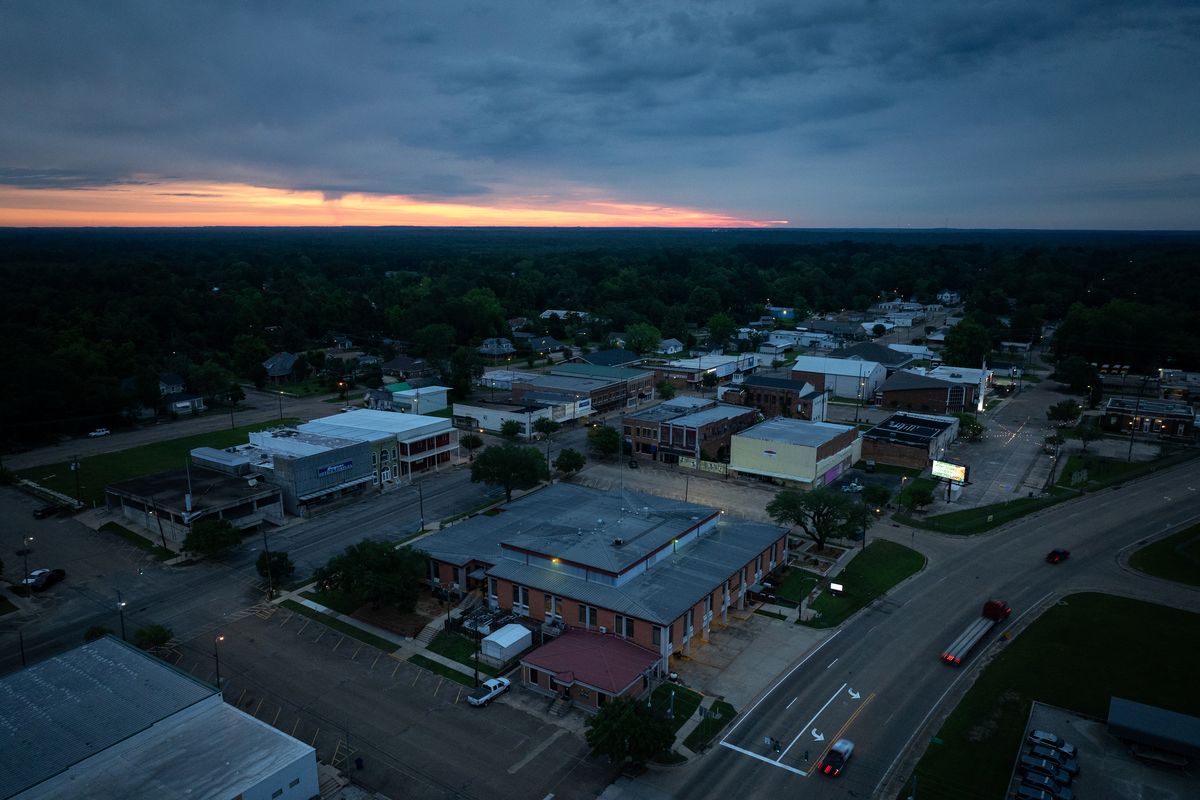
WINNFIELD, La. - The 21st century has been tough here in timber country, especially in the small town of Winnfield. Sawmills automated and jobs disappeared. An interstate extension bypassed the area. The population fell by nearly a third. Downtown storefronts emptied.
One positive: the low-slung brick complex, with razor-wire-topped fencing and a white-steepled chapel, that sprawls southwest of town amid a forest of longleaf and loblolly pines.
Six years ago, U.S. Immigration and Customs Enforcement took over this prison, contracted with the sheriff and began detaining migrants there. With them came well-paying positions, plus an infusion of money for Winn Parish’s jail, school resource officers and other services.
These days, Winn Correctional Center’s 1,600 beds make it the largest ICE detention center in this deep-red state and one of the largest in the country. With President Donald Trump’s hard deportation push, its beds are staying occupied.
The economic benefits of detention, in a rural parish where about a quarter of residents live in poverty, have muted criticism of the president’s immigration policies. Many take more issue with outsiders who accuse the administration of trying to isolate detainees by sending them to such a remote spot - in a swath of the Gulf Coast known as “detention alley” because it’s home to 14 of the country’s 20 largest immigration detention centers.
“Like Louisiana is so terrible,” said Terry Warden, a retired Trump supporter who years ago moved from Southern California for political reasons. “Yeah, we’ve got gators. And we’ve got lawyers. We’re not Gitmo.”
ICE detainee buses are now as common a sight as lumber trucks across the region. In downtown Winnfield, uniformed ICE workers can be seen getting haircuts, dining and shopping. To locals, they’re customers, relatives, neighbors.
The Rev. Russell Jones is a retired assistant police chief who leads the conservative Methodist congregation in town. Though a lifelong Democrat, he voted for Trump in 2024 and likes his immigration agenda. He considers the detention center “a necessary evil.”
“I know several people who work there. Good people,” he said.
Gerald “Scooter” Hamms, Winnfield’s first Black mayor, offered a similar perspective. “Our primary duty is public safety,” he said. “Revenue helps us do that.”
Still, some residents were opposed back in 2019 when then-Sheriff Cranford Jordan signed the ICE contract. They thought migrants should be deported immediately, sparing the cost of detention.
“They said, ‘We don’t need them in this country,’” Jordan recalled recently. “They said, ‘The federal government wastes a lot of money.’ I said, ‘I agree with you, but why not waste it here?’”
At the time, Winn Parish was housing state inmates at the prison. ICE paid almost triple the state’s rate and guaranteed the center would stay 60 percent full. Thanks to the contract, Jordan said, the parish avoided bankruptcy and paid off a new $7 million jail in four years.
The outcome changed minds. They’ve mostly stayed changed as the Trump administration launched mass deportation sweeps early this year, with support holding for the president even as international students accused of protesting the war in Gaza were detained and their legal status revoked. The parish - 61 percent White and 29 percent Black - went Republican by an overwhelming margin in last year’s presidential election.
“They realized it’s not a liability,” Jordan said of the detention center. “The benefits greatly outweigh the negatives. It’s been an asset to our community, a dying community.”
The former sheriff held forth as he waited his turn at City Barber, a shop on East Main Street that feels like a step back in time with its trio of vintage barber chairs and mirrored wall of photos and memorabilia. “No cursing,” warns one sign. “Get a piney woods cut!” suggests another, carved on a wood plank.
Rayford Riley, who opened the business in 1969, is among the locals backing the administration’s detention of foreign students. “If you break the terms of your agreement to come into this country, you’re subject to the terms of that agreement,” he said.
Jordan was ousted in a nail-biter election 18 months ago by the generation-younger Josh McAllister, scion of a logging family who has furnished his office with free pocket Bibles and art of duck hunting. Driving around town in a department SUV emblazoned with “In God we trust,” McAllister pointed out how both parish and town gain from the ICE contract.
For starters, the contract meant he could afford to add a half-dozen staffers and cameras at the jail, expand his narcotics unit, and get a drug-sniffing dog. He has other plans, too: to create a gardening training program for inmates and build kennels for a new animal control unit.
“Our office goes out and checks on the elderly. I don’t charge our schools to provide resources officers. Because of that facility, I can do that,” he said.
Yet the detention center - which a Louisiana-based company runs on behalf of the parish - has faced criticism from migrant advocates and scrutiny from federal officials. In October, just days before Trump was elected to a second term, the Department of Homeland Security’s Office for Civil Rights and Civil Liberties launched an investigation, having received scores of complaints since 2021 about alleged civil rights violations at the site.
One allegation was that ICE and facility staff members had pepper-sprayed a dorm of about 200 detainees during a January 2024 incident, then cut off the unit’s water and power.
“Winn Correctional Center has reached a point beyond reform and must be permanently closed,” said Tania Wolf, a member of the Southeast Dignity Not Detention Coalition.
Neither ICE nor Homeland Security’s civil rights office responded to a request regarding the status of the investigation. The Trump administration announced plans this spring to reduce the latter’s staff, with a spokesperson arguing it had become a “roadblock” to immigration enforcement.
Two U.S. highway routes cut through Winnfield, a dot on the map 250 miles northwest of New Orleans. The town has an outsize political history as the hometown of three governors, including brothers Huey and Earl Long. And like small towns across America, it features the discount-shopping trinity of Family Dollar, Dollar Tree and Dollar General. Along a nearby stretch of road, a sign declares, “Prayer: America’s Only Hope.”
Most residents have grown accustomed to the detention center, to the notion that their fates are intertwined.
There was no dissent, for instance, among the group of friends gathered for their daily morning coffee just past the fried catfish counter at Country Girl truck stop. The subject of migrants came up. “If they don’t like our country, get out,” said Brent Hubbard, who works for an oil company. Heads around the table nodded in agreement.
Conversations elsewhere, however, revealed unease and even opposition.
At the Rodeway Inn, where a Bible sits open in the lobby, employees have struggled to help detainees’ visiting relatives contact ICE to arrange their release. Officials “just do what they want. It’s an abuse of power,” front desk clerk Lauren Wright said.
Her family likes Trump’s policies. Wright doesn’t, but she sat out the last election because she was disillusioned with government. “‘Deport ’em all’ - no, that’s not what our country was founded on,” she said.
Melissa Trammell didn’t vote for Trump, either, and the retired school administrator, a self-described conservative independent, wants more transparency from officials about the ICE facility. “It’s so secretive,” she said while volunteering in early May at a church’s weekly food giveaway. “It’s just crazy you don’t know something about someplace that’s right beside you.”
Trammell believes Winnfield’s leaders were “seduced” by ICE’s well-paying jobs. She hears neighbors make distinctions between detainees and law-abiding immigrants who work at local businesses.
“People know them and so they’re ‘different.’ But they’re not,” she said.
That’s how some people in town felt when a waitress at the town’s Mexican restaurant disappeared for a while after her husband was deported.
Elias Vargas had lived in the United States for 27 years, according to his wife, Brigitte Coco. She said he was picked up after a traffic stop in January and held for two months at ICE’s facility in nearby Jena before being put on a plane to Mexico. He left behind three U.S. citizen children, rental properties and a share of El Patio, his family’s regional chain.
Coco visited her husband in detention and met other immigrants who had been swept up in workplace raids and separated from their families.
“That’s where I think the line needs to be drawn,” Coco said over a plate of salsa-topped chilaquiles. “These are hardworking people that are leaving their children.”
She is back to work at the restaurant, now a solo parent to two teenagers and their younger sibling. Even so, she gives the president’s approach to immigration a lot of latitude.
“It had good intentions,” said Coco, a libertarian and two-time Trump voter. “But the way he’s proceeding with wrapping it up is not as logical as it should be.”
Her customers have sympathized with her predicament - to a point.
“She knew he was illegal when she married him,” said Shonna Moss, a regular at El Patio with her women’s church group. “I’m torn there. You don’t want the flood like we had. But have certain people gotten settled and they’re law-abiding and that’s different? Yeah, I can see that.”
Moss is director of the Louisiana Political Museum & Hall of Fame, which is housed in a former railroad depot on East Main Street. She is married to a former mayor, George Moss, who worked at the detention center when it was a prison. After he became an elected official and ICE arrived, he recommended new hires.
He has seen the reports about the facility, but he also has seen its economic impact in the parish, an area “drastically shrinking.”
“These detention centers got a bad name,” he said, but “Winn Parish probably wouldn’t be here if it wasn’t for them.”