
Edward Cody, globe-trotting correspondent, Gonzaga alumnus, dies at 82
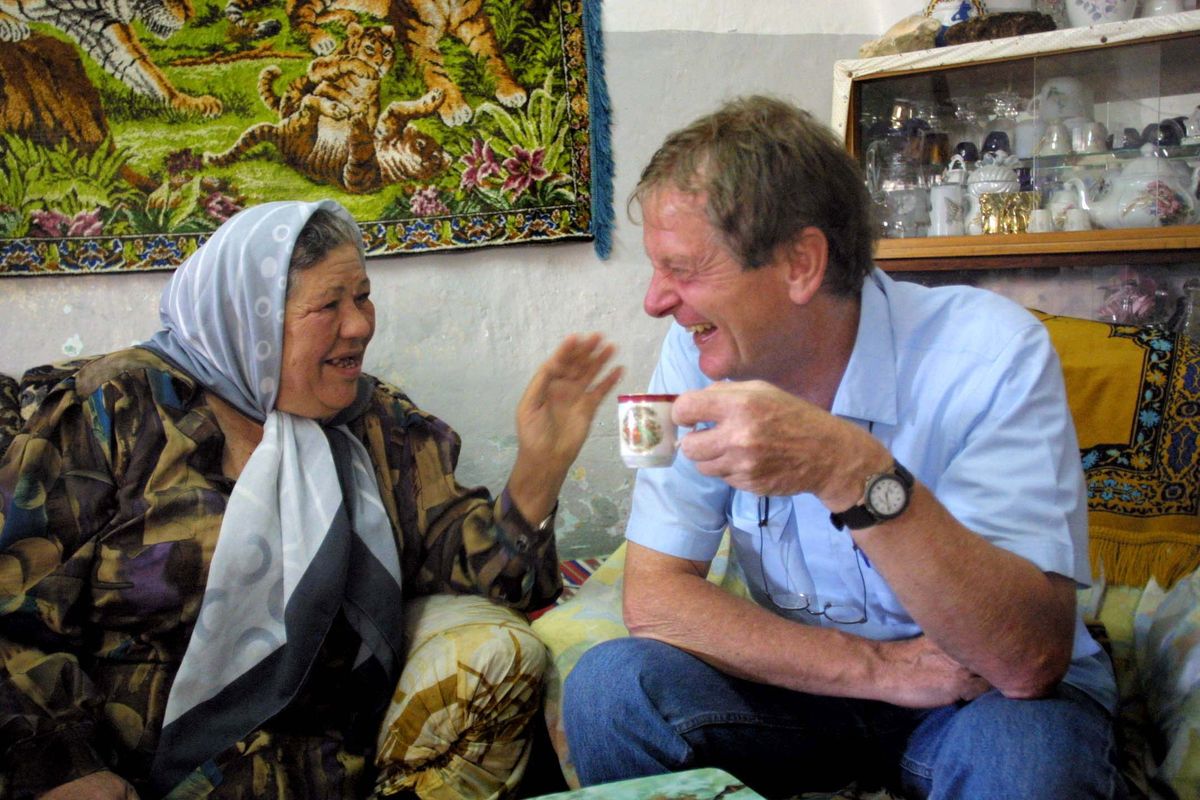
Edward Cody, a Washington Post foreign correspondent whose mastery of languages, old-school reporting and fierce independence made him a model of his craft during four decades covering conflicts in jungles and deserts across the globe, died Oct. 27 at a hospital in Canterbury, England. He was 82.
The cause was complications from a fall, according to his family. He had been living with Parkinson’s disease for more than a decade.
At ease in at least six languages and happiest when beyond the reach of editors, Cody represented a vanishing breed of foreign correspondent – one who operated in the field with near lone-wolf autonomy, often in dangerous terrain, filing vivid dispatches in an era before cellphones and the internet made instant communication (and constant supervision) routine.
“Free at last,” he wrote in a Post handbook for foreign correspondents, describing the liberation of being separated from the newsroom “by thousands of miles, multiple time zones, and chasms of languages, culture and understanding.”
Cody valued firsthand reporting above all and defied obstacles, danger and officials of all stripes to put himself in the eye of the action, often hitting the ground and taking notes before his editors knew there was news to cover. He reported on peasant revolts in China, insurgencies in Latin America and the U.S.-led invasions of Grenada, Afghanistan and Iraq, filing dispatches from natural disasters – earthquakes, hurricanes, tsunamis – in between.
“A journalistic Swiss Army knife” is how veteran Post correspondent Jonathan Randal described his range, “capable of covering Olympic Games, wars, revolutions, natural disasters, complicated French political crises with panache.” Cody, he said, “was a great practitioner of that disappearing art – foot leather reporting.”
The globe-trotting was made easier by an ear for languages unusual even among international reporters. Cody spoke fluent French, Italian, Spanish and Arabic and studied Chinese before reporting from Beijing in the 1990s and 2000s. He read mystery novels in Italian and routinely conversed with one daughter in French, another in Mandarin and his son in English. When he answered the phone – always with “Cody,” never “Ed” – colleagues never knew which language would follow.
His linguistic gifts were matched by an economy of style that bordered on the laconic. While other reporters filled notebooks with frantic scribbling, Cody would listen intently and jot down perhaps a sentence or two in a shirt-pocket notepad or bit of hotel stationery.
“The idea,” recalled journalist Guy Gugliotta, who often worked alongside Cody as a Miami Herald correspondent in Central America, “was only to listen for the quote or quotes he planned to use, write those down and forget about the rest.”
During the 1991 Gulf War, Cody got into liberated Kuwait ahead of the pack and used his Arabic to talk a Saudi air force pilot into flying him back to Riyadh, where he filed reports ahead of the competition.
In the lead-up to the 1983 invasion of Grenada, he traveled to Barbados, where he hoped to charter a flight to the nearby island of Grenada once U.S. forces swept in. But the military was blocking journalists from traveling to the conflict, leading Cody and a few colleagues to pay a local fisherman to take them to Grenada by boat. They landed in St. George’s, the capital, just as the invasion got underway.
Cody found American troops at a soccer field serving as a helicopter landing zone and asked to use their communications gear to file stories. Instead, they flew him and three other journalists offshore to the carrier USS Guam, where the commander refused to allow the reporters to file stories or contact their editors.
The Post and other news organizations protested restrictions placed on news coverage, accusing the military of trying to conduct its operations in secret. Within two days of the invasion’s start, Cody was back on the island, where he filed his first report.
“Stunned and fearful,” it opened, “the residents of St. George’s began returning to their hillside streets today to survey the damage left by a spasm of modern warfare unlike anything this little island has ever seen.”
Edward John Cody was born in Portland, Oregon, on Sept. 27, 1943. His father was a lumber mill accountant, and his mother was an artist and piano teacher.
Ed, as he was known to friends and family, grew up in Willamina and Grand Ronde, Oregon, deep logging country where many of his playmates came from the Confederated Tribes of Grand Ronde reservation.
While at Gonzaga University in Spokane, he sailed to Europe for a summer abroad program in Italy, meeting a young Parisienne student on board. By voyage’s end, he and Ariane Espinasse were in love. Cody spent much of his stay traveling between Florence and Paris to see her.
By the time Cody graduated in 1965 with a bachelor’s degree in English, he and Espinasse had married. They settled in Paris, where Cody studied law at what is now Paris-Panthéon-Assas University while working at an Avis rental car location.
“For the rest of his life, when we’d call he might answer the phone, ‘Avis at your service,’” in French or English, his daughter Melinda Cody said.
Cody moved his family to New York in 1967 to pursue a master’s degree at Columbia Journalism School. He was hired the following year by the Associated Press to cover education in Charlotte – timing that placed him at the center of a court-ordered busing program to desegregate city schools, giving the cub reporter a chance to show what he had.
By 1971, he was writing obituaries on the night shift for the AP in New York. But with a dream of covering the Middle East, he began intensive study of Arabic.
The AP first sent him to New Delhi. When one of his articles drew the ire of Prime Minister Indira Gandhi, his visa was revoked, and the wire service relocated Cody and his family to Beirut, where he began covering the Lebanese Civil War.
Cody joined the Post in 1978 and was soon dispatched to Cairo. He later worked in Miami and Mexico, covering Latin America at a time when U.S.-backed contras were trying to overthrow Nicaragua’s left-wing Sandinista government, and helped guide the paper’s international coverage while serving as deputy foreign editor.
His first marriage ended in divorce, as did his second, to Pnina Ramati, an Israeli artist and diplomat’s daughter. During an editing stint in Washington, Cody met Kun Tian, a Chinese graphic artist interning at the Post. They married in 1994.
In addition to his wife, survivors include their daughter, Fay Tian Cody; two children from his first marriage, Melinda and Frank Cody; and seven grandchildren.
While serving as Beijing bureau chief in the early 2000s, at an age when many peers were thinking of retirement, he mastered Mandarin Chinese and went on to produce groundbreaking coverage of rural protests over land confiscations, patiently reconstructing the upheaval while traveling to villages and towns at night to avoid authorities.
Cody was the first correspondent to reach Dongzhou, where paramilitary police had opened fire on protesting villagers, killing between 10 and 20 civilians, according to residents, in the bloodiest suppression since the Tiananmen Square massacre. David E. Hoffman, the Post’s foreign editor, nominated Cody’s coverage for a Pulitzer Prize, writing that it was “in the highest tradition of foreign correspondence that offers startling revelations based on first-hand observation and extensive interviewing.”
After retiring from full-time work at the Post in 2006, Cody continued to contribute reporting from Paris. He and his wife settled in England.
In the handbook he prepared for Post correspondents, written in collaboration with Hoffman, Cody captured the essence of the calling that defined his life: “Rarely in a career do you enjoy a task that is so solitary and intense, so concentrated and vivid as that of a foreign correspondent. Every day is a chance to practice the highest and best form of journalism: interviewing, reporting, witnessing and writing stories that will startle our readers, taking them to places and events they’ve never known.”