
A viral lie about spiders is really bugging cranberry farmers
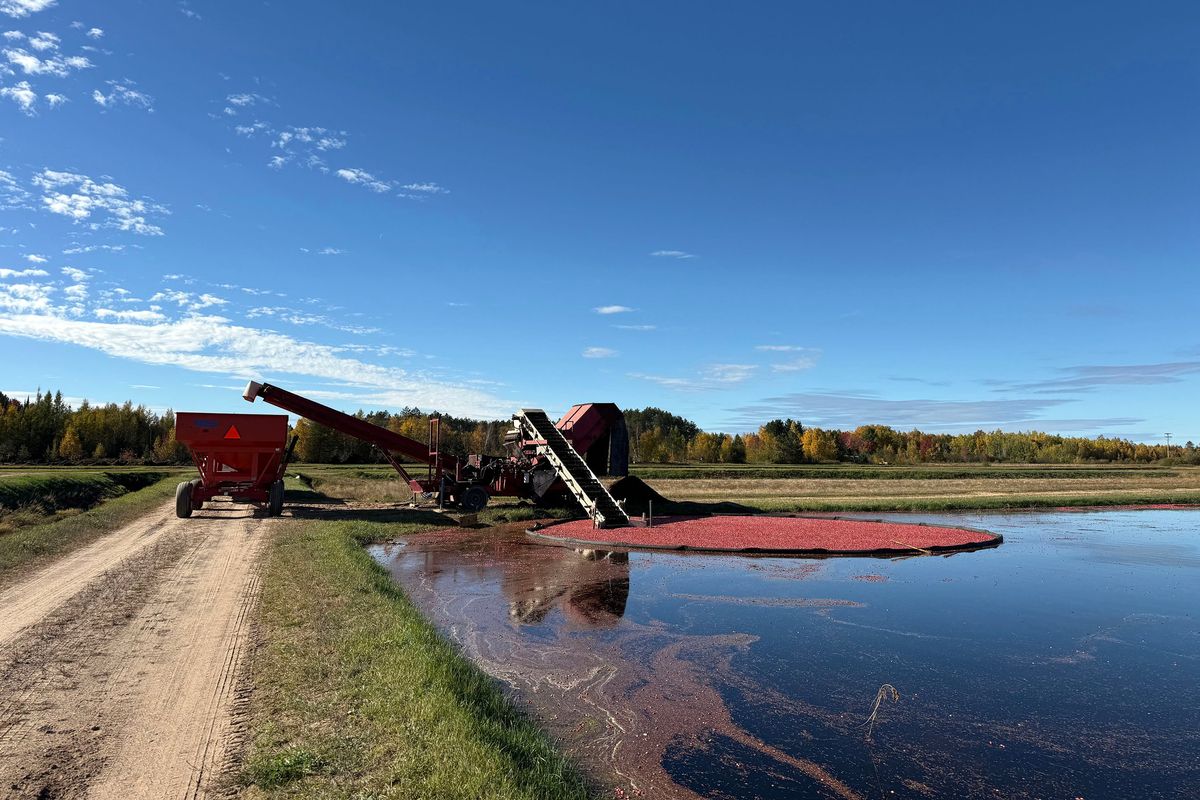
For America’s cranberry producers, autumn is showtime. That’s when the fruits of their labor take center stage on holiday tables and Instagram feeds everywhere: cranberry cocktails, cranberry-studded scones and of course, the compulsory cranberry sauce of Thanksgiving dinner.
But over the last few years, this moment in the spotlight has been dimmed by some pervasive social media rumors.
“Everybody wants to know: ‘What about the spiders?’ ” says John Stauner, who hosts tours of his Three Lakes, Wisconsin, cranberry farm every fall. “It usually comes from the young ones, the ones on TikTok.”
That’s because right around the time the leaves start falling, the spider posts begin circulating.
“If you don’t want me to ruin cranberries for you, then I would swipe away,” says one TikTok that’s been viewed more than a million times. “In every single cranberry field there could be thousands of spiders crawling all over everybody’s favorite holiday fruit.”
Another video, viewed almost 25 million times, shows a farmer wading through a ruby-red bog while a voice-over sternly intones, “This is the most terrifying job in the world.”
Things get worse for the cranberry contingent over on Reddit, where some posters allege that cranberry bogs are so hellish, potential farmhands are screened for arachnophobia and must be comfortable with hundreds of wolf spiders “trying to climb your eyebrows.” Those willing to wade into the nightmare are compensated with six-figure salaries, some say.
Most of these claims are wholesale fabrications, and others are gross exaggerations, according to Stauner, who sounds, frankly, a little exhausted by the whole thing. “Spider populations do rise in the fall – that’s the natural way of things and an indicator of a healthy ecosystem,” he says. “But is there a biblical plague of spiders? No there is not.”
“It’s fascinating how quickly this thing took off,” says Amber Schultz, a fifth-generation cranberry farmer in Warrens, Wisconsin. “Sure, we have spiders, just like we have geese, swans and white-tailed deer. But there are not monsters living out here.”
A misunderstood fruit
Perhaps it’s no surprise that the cranberry bog would provide fertile ground for misinformation. While most Americans have picked their own apples or posed for pictures in a pumpkin patch, far fewer have laid eyes on the farms that turn out the tangy fruit.
“Cranberries are a crop that’s not well understood,” says Stauner, whose 189-acre James Lake Organic Cranberry Farm contributes to the nearly 5 million barrels of cranberries Wisconsin produces every year – twice as many as Massachusetts, the state most synonymous with the crop.
Cranberries are grown commercially across nine northern states, including Oregon, Michigan and New Jersey. In the Midwest, cranberry farms are called marshes; in the Northeast, they’re known as bogs.
Perhaps the biggest misconception about cranberries is that they grow in water, but the fruit actually spends most of the year in cranberry beds, depressions of sandy land where they sprout from short, sprawling shrubs. At harvest time, the beds are flooded, causing the cranberries – which contain air pockets – to float to the surface, where they can be mechanically dislodged, gathered by floating booms and pumped into trucks.
Schultz, who started a social media account called Cranberry Chats to educate the public about the fruit’s life cycle, cultivation and culinary potential, used to devote a lot of her posts to debunking the myth that cranberries grow in water, she says. “Now my focus has shifted to debunking the myth about spiders.”
The arachnid in the room
Schultz says the trouble started about five years ago, when she came across her first spider video while scrolling on TikTok.
“I saw a green screen video of some guy’s head floating around in cranberries,” she says. Soon, everyone was asking about the millions of giant spiders that prowled her marshes. “It was like wildfire. It’s been nonstop ever since.”
Cranberry producers like Schultz are quick to allow that spiders – along with ants, snails, weevils and worms – live in their fields, but there aren’t that many spiders. “I don’t like spiders, and I couldn’t handle this job if there were that many spiders out here,” Shultz says.
The idea that the cranberry bog is a real-life “Fear Factor” set is “an internet lie,” says Marty Sylvia, an extension educator who specializes in entomology at the University of Massachusetts Cranberry Station in East Wareham, Massachusetts. “But if you say something enough times, people will buy it.”
The reality is that cranberry beds probably contain the same number of insects as any farm field, but wet harvesting the fruit can concentrate them in one place.
“When you flood the bog, you’re flooding one, two or five acres at a time, so everything in that bog is going to come up,” Sylvia says, including spiders. Most immediately head for the exit, skating across the bobbing berries to find dry land. Videos that depict multiple insects in one shot, she guesses, have been cherry-picked. On a recent October day Sylvia spent harvesting berries, “there wasn’t a spider in sight.”
Stauner says that most guests don’t notice spiders unless he points them out, usually hanging out along the wall that surrounds the bog, “but nobody has run away screaming from our tours.” As for him, the creepy-crawlies aren’t a concern. “We’re rural, we’re outdoors, we have to have a certain comfort level with insects.”
Do farmers screen potential workers for arachnophobia? Shultz says no (but she does ask about bee allergies). Do they pay harvest hands $150,000 a year as a reward for their bravery? She wishes. “If you find a cranberry farm that pays that, let me know so I can apply.”
Another internet lie? That spiders might end up in your cranberry juice.
After harvest, Shultz says, the berries go through a rigorous cleaning process. “There’s a very, very, very small chance that one would ever find its way to your table from a cranberry farm.”
Truth in agriculture
As they work to combat cranberry misinformation, producers would like help spreading true stories about their crop. Cranberries are among America’s only commercially grown native fruits, along with blueberries and Concord grapes. The self-pollinating plant used to be called a craneberry, thanks to its delicate flowers, which resemble the long beak of a bird.
“I wish people knew about the health benefits,” Shultz says. Known as an antidote for urinary tract infections, cranberries are also low in sugar, high in antioxidants and “packed with vitamin C.”
Stauner doesn’t unleash an army of mercenary spiders to protect his crop against insect pests, like some online blogs claim, but he has been working with the University of Wisconsin to raise and release native nematodes, a type of worm, for this purpose. “It’s all a part of taking care of the environment in which we grow and that we are stewards of,” he says.
If properly cared for, cranberries can live a long time. The country’s oldest vines, in Cape Cod, Massachusetts, are more than 150 years old and still bearing fruit. Cranberry farms and the families who run them can be just as enduring. One Northern Michigan farm has been in the same family since Rutherford B. Hayes was president; another, in New Jersey, has been tended by seven generations.
“There are a lot of multigenerational farms, and there’s a reason for that,” Schultz says. After a stint in sports management “out in the real world,” she felt a strong pull to get back to the farm. “It’s so beautiful and so unique that it’s hard to get away once you are surrounded by it.”
Schultz, who’s raising her two sons to be sixth-generation cranberry growers, says that most producers enjoy talking about their farms, their work and even some of the weird things you might have seen online.
“If you have questions about your food or where your food comes from, ask a farmer,” she says, “and don’t believe everything you see on social media.”