
Veterans of all ages and wars gather at Spokane Arena
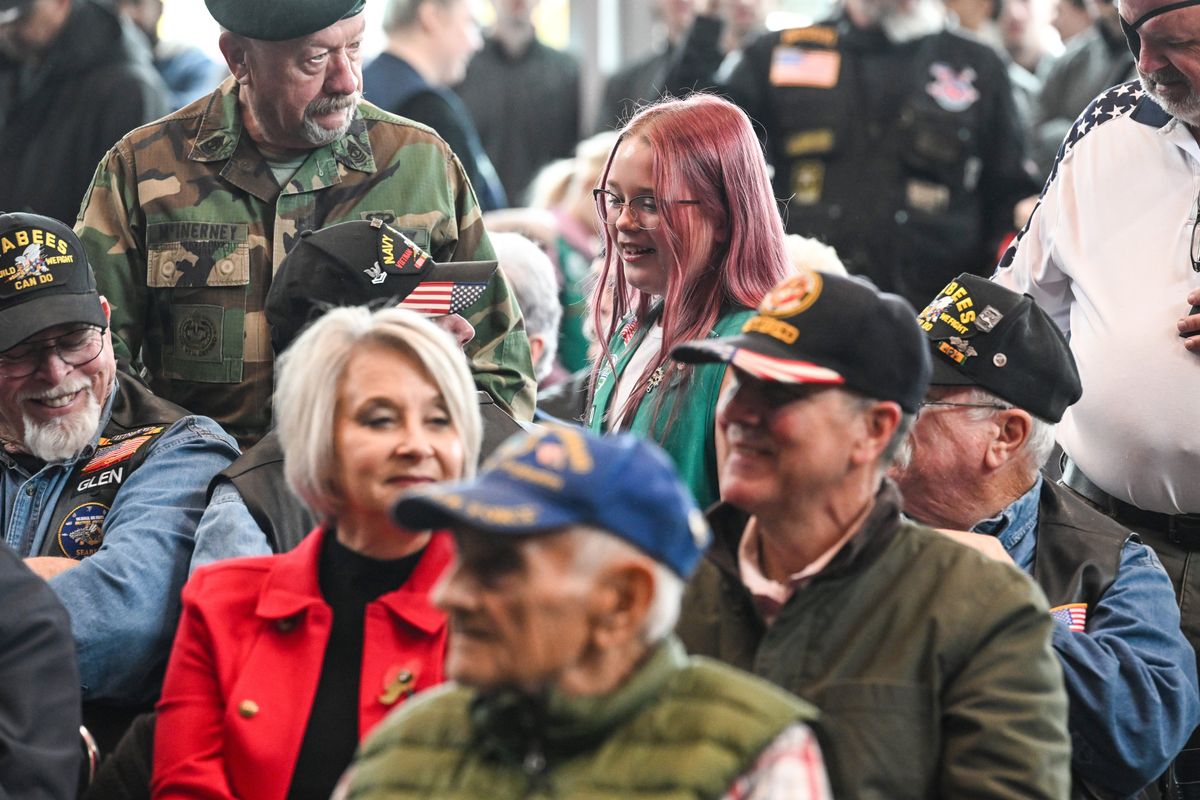
Col. Ryan Smith started by asking the crowd of 308 people something simple: What’s the definition of a warrior?
He rattled off the Merriam-Webster version that reads “one engaged in military service.” But this answer wasn’t exactly the one he was looking for on Tuesday morning at the Spokane Veterans Memorial Arena. Instead, he went with a different, more fitting description.
“To do something outside of yourself,” he said plainly. “That’s a veteran.”
Smith then spoke candidly about his career in the military and about the politics, or lack thereof, in the service. He’s said he’s served under five different presidents since he first started out in the ROTC. Black or white, man or woman, Smith said every time he got off a plane and ventured onto a military base in a foreign country he saw only American soldiers.
These soldiers, he explained, are like sheep dogs: They keep people safe. Sheep, he said, can’t disable a claymore or set up a defensive perimeter. This is exactly why keeping the flock out of harm’s way is the responsibility of a sheep dog, just as it is a soldier’s duty to keep children, the elderly and those who can’t defend themselves out of danger.
He ended his speech by urging people to continue to fight if they have something left in the tank. He clarified that the fight to which he refers isn’t about foreign enemies, or treacherous invaders. It’s about fighting for one another, for those left behind and for those who cannot help themselves.
“If somebody is struggling, needs help, that is a fallen soldier,” Smith told the assembled crowd.
Three fifth -graders from Woodbridge Elementary then walked up to the podium once Smith concluded to say praise and explain what they thought a veteran was. Their answers were met with polite applause and the occasional “oorah!” from veterans of the Marine Corp.
“Our goal was to celebrate service and say ‘thank you,’ and hopefully people heard that through our speakers today, especially through those fifth graders,” said Keirsten Lyons, the director of the Washington State Fallen Heroes Project and a Gold Star Mom. “Oh my gosh, that’s what gives us hope. When you see that younger generation that is learning that from their parents and from their teachers and in the schools (it’s inspiring). And those were unprompted. The kids volunteered to be there and just spoke with such confidence because they spoke the truth.”
Alyssa Heinrich, the current Mrs. Washington American, took the stage not long after the fifth -graders and spoke of her rich military history. Her grandfather, father and brother all served in the military. She said her family has 200 plus years of service. When her father ended his time in the military, she explained how he struggled with finding purpose and locating resources.
She then read a quote from “Slaughterhouse-Five” by Kurt Vonnegut.
The book is primarily set during World War II, specifically during the firebombing of Dresden in February 1945, but spans multiple decades. The quote she read eloquently summed up many veterans’ experiences upon returning home, including her own father: “The nicest veterans … the kindest and funniest ones, the ones who hated war the most, were the ones who’d really fought.”
Fred Stahl had a rather unorthodox military career. He began serving in 1962, but his first act of service was to learn Hungarian in the Defense Language Institute Foreign Language Center in Monterey, California.
After 48 weeks at the “language school,” Stahl was shipped off to Germany where he worked with Hungarians who opposed the Soviet Union. He was a case officer and one of his top agents, Stahl said, was an 80-year-old former finance minister for Hungary during World War II that gave him updates on Russian military movement. Stahl said he could never reach his sources in Hungary. Instead, he had to wait for them to get out of the country and meet him in Germany.
“I was so fortunate to be able to serve in such an unusual way,” Stahl said. “I never wore a uniform in Europe because of what I was doing. You don’t put on a uniform when you’re doing military intelligence. I put it on once, I have to say when I got promoted, because you have to have a picture of you in uniform.”
Tzena Scarborough, a veterans advocate, is another former army veteran who served during the Cold War in Germany. From 1976 to 1983, she worked on the electronic weapons systems in Cobra helicopter. She said her job was to make sure the missiles went where they were supposed to go when the pilot pulled the trigger.
“When you’re in the military as a woman, you’re very visible,” Scarborough said. “When you get out you’re invisible.”
At the time, Scarborough said women weren’t allowed in combat roles officially until 2013. Because she was one of the first, and often the only, woman serving in a nontraditional military job, Scarborough said she was constantly immersed in a hostile work environment.
She said not enough women are recognized for their service, and even fewer choose to be recognized. It took until the late 1990s for Scarborough to identify as a veteran.
“It took me years to identify as a veteran,” Scarborough said. “I don’t want other women to wait years to get their benefits. … So, that’s my passion now, and I have a voice now. I didn’t have a voice before.”