How WSU’s Ademola Faleye and other TEs have helped carve out space for their offense
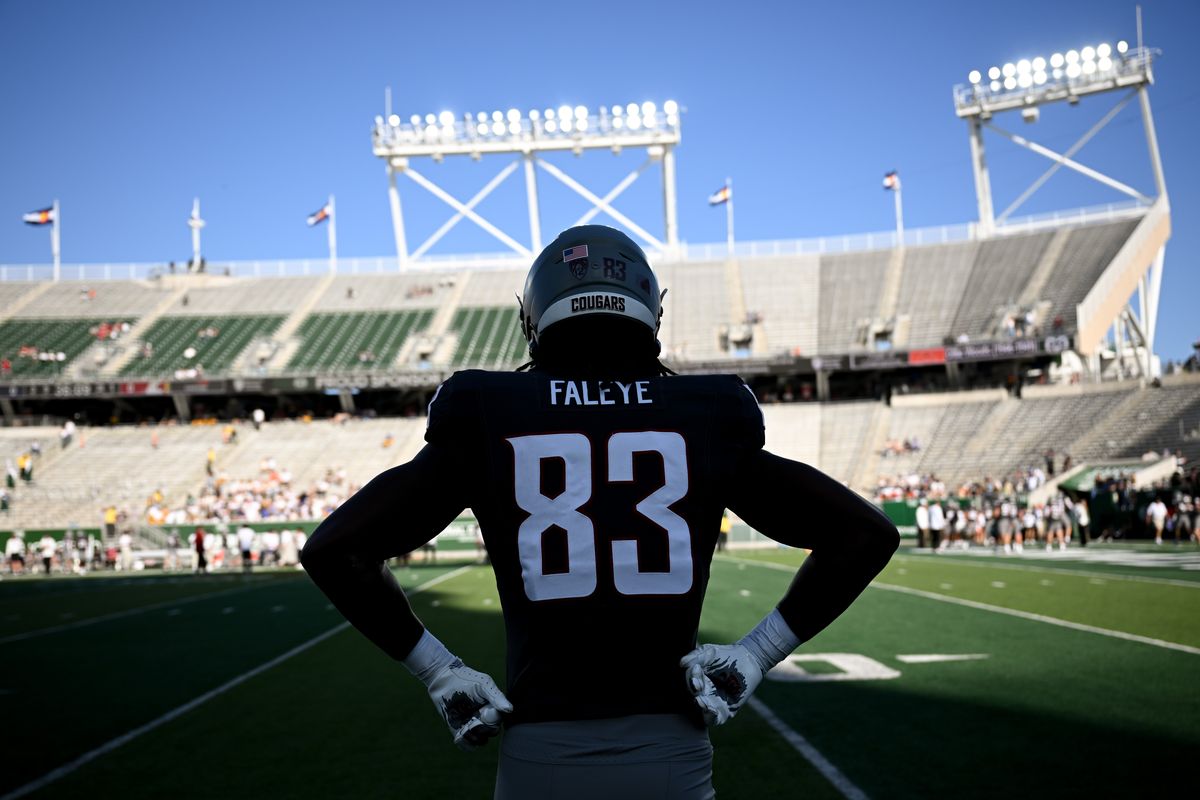
PULLMAN – Over the offseason, when Washington State coaches hit the transfer portal to look for a tight end, they didn’t need long to identify Ademola Faleye, who was looking to move on from Michigan State. Listed at 6-foot-7, he had the size they were looking for, and they figured they could develop him into a reliable pass-catcher.
The Cougars succeeded in landing him, fulfilling their vision for the position, an athletic, big-bodied player who can play all over the field, do lots of different things on offense.
Could they have predicted Faleye would play such an integral role in the blocking game? That much is unclear, but either way, Faleye is making them look wise. Through 10 games, outside of the Cougars’ offensive linemen, he has flourished as WSU’s top-graded pass-blocker, according to PFF, which has given him a grade of 74.0. He’s also the team’s second-best run-blocker, earning a PFF grade of 65.1.
So if you want to understand how the Cougars’ running game picked up as the season went on – after only hitting 100 yards rushing once in their first four games, they’ve cleared that hurdle in all six games since – you can look Faleye’s way. He scored a run-blocking grade of 80 against Toledo, and ever since, he’s finished with marks above 60, which is average.
“His biggest improvement has come in the run blocking,” WSU coach Jimmy Rogers said. “So from start to finish, from spring to now, really physical, really willing to put his face in there and drive his feet. And I showcased some of those this morning.”
The key to understanding a tight end’s accomplishments in this WSU offense, run by Rogers and offensive coordinator Danny Freund, is understanding how much they’re asked to do. In these coaches’ eyes, a successful tight end can catch passes. Run block. Pass block. Diagnose a defense and understand how to position himself accordingly. It’s stressful on the body, sure, but it’s also a test of mental fortitude and precision.
In those ways, Faleye is passing with flying colors. And the Cougs have needed it. In their loss to Oregon State earlier this month, their offensive line was seriously dilapidated, playing without two key starters and giving two more linemen their first playing time at the college level. WSU managed just seven points in a sluggish offensive showing. The group’s leading rusher was starter Kirby Vorhees, who totaled 46 yards on the ground.
A week later, when right tackle Christian Hilborn and center Brock Dieu returned from injuries, their team’s offense looked much better in a 28-3 win over Louisiana Tech. Those two played key roles in keeping the Cougars’ ground attack churning, including on an eight-minute scoring drive in the second half, which shouldn’t go unnoticed. But the same goes for the blocking from Faleye, who finished with a run-blocking grade of 63.9, including a pass-blocking grade of 70.1.
Faleye has thrived best as a pass-blocker though. Absent one sack, which he was dinged for against Oregon State, he has yet to be held responsible for any quarterback pressures. He’s consistently graded in the mid- to high 70s in that department, showing the kind of consistency and physicality that Rogers and tight ends coach Chris Meyers are looking for from their tight ends.
But he has hardly been the only tight end to help out in the blocking department. On the season, the Cougars’ third-highest graded pass-blocker is tight end Hudson Cedarland, a converted linebacker playing his first year at tight end. He’s played limited snaps – injuries have limited him to 22 total snaps in six games – but he’s cashed in on his opportunities.
On Monday, Rogers also took care to give a shoutout to third-year sophomore tight end Trey Leckner, who has also chipped in – no pun intended. Listed at 6-3 and 232 pounds, Leckner doesn’t have the size of other tight ends in the room, but he has made the most of his frame. He earned a PFF pass blocking grade of 68.7 last weekend, an improvement on earlier outings, which included grades of 16.9 against Toledo and 54.9 against Virginia.
“Trey Leckner has gotten more physical at the point of contact, and he’s done a really good job of being able to block in space. He had some critical blocks on Saturday,” Rogers said. “So those two guys combined, and Hudson Cedarland getting in there and mixing it up again, was good to see. But overall, I’m proud of ‘Mola and his growth here. He’s always been able to catch the ball. He showcased that in fall camp. Maybe he hasn’t always gotten the opportunities thus far this season, but he’s made the most of his reps, and has been really physical when he gets in there.”