
Spokane short hundreds of homeless shelter beds as winter approaches
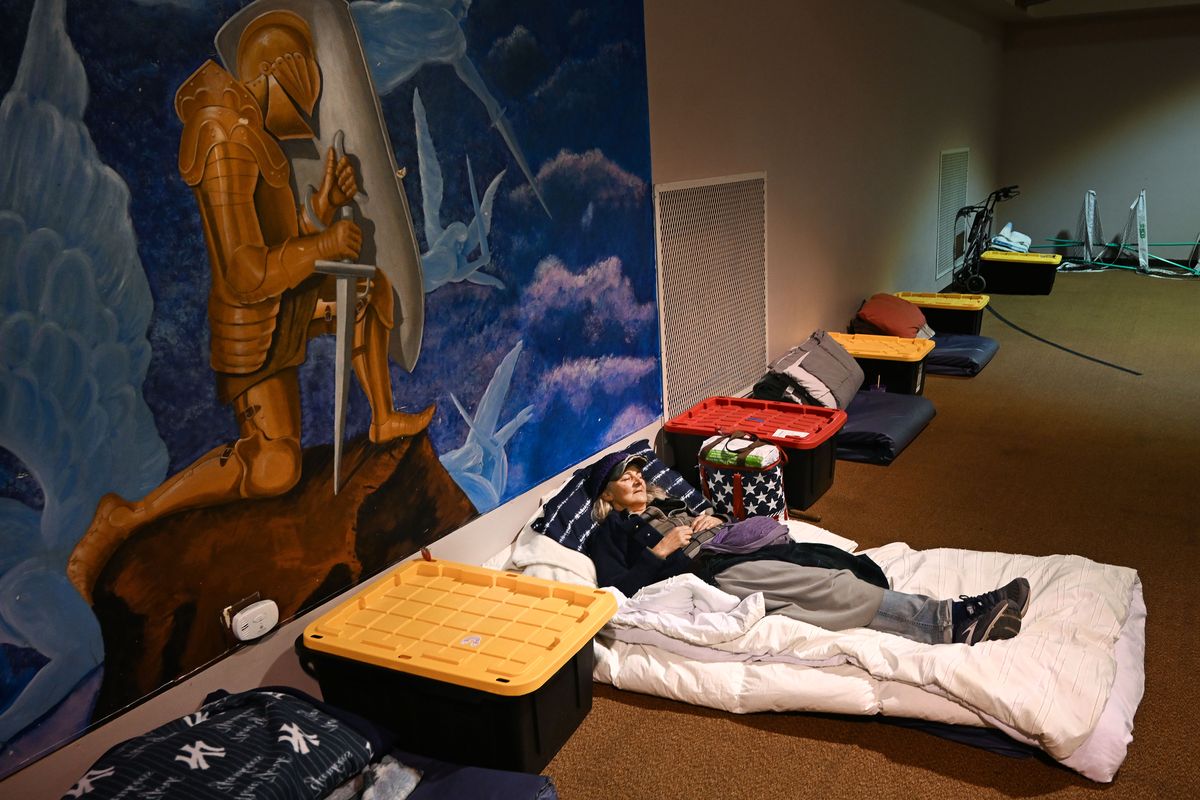
As winter looms on the Lilac City’s horizon, so too does the question of what to do with Spokane’s homeless population.
“The region is not prepared,” Mayor Lisa Brown said. “But the city is doing everything we can.”
The city of Spokane operates a daytime center on Cannon Street, which intakes homeless clients but no longer provides beds itself, and seven nighttime shelters scattered across the city, providing up to 210 overnight beds. When taken with beds supplied by other providers, the city and county together fund the majority of 867 year-round shelter beds, while the city alone funds 121 surge beds that open up during inclement weather – smoke and heat waves during the summer, and subfreezing temperatures in the winter.
Spokane Housing and Human Services Director Dawn Kinder said she expects additional beds to come online in January as the city fills contracts with providers.
Last year, there were 1,381 and 239 surge beds – a number boosted by pandemic-era federal relief that has since dried up.
Despite the loss in COVID-19 relief funds, Brown has significantly upped the annual funding for bad weather shelters and resources, from $250,000 when she was sworn in at the beginning of 2024 to the current $1 million. Year-round shelter beds are largely funded through the state.
“I think our big takeaway is we are doing a lot more with the same amount of resources that we had in ’21-22 than was happening at the time,” Kinder said.
Despite the greater efficiency with resources and comparatively high number of beds, there still won’t be a bed for every homeless individual, nor will all homeless people want to stay in a shelter come freezing temperatures, which is “a challenge for us every winter,” Kinder said. Even during the COVID-19 pandemic, when there was additional funding for shelters and more beds in Spokane, there were people “who chose to be outside or needed to be outside.”
“Our really big focus is on getting folks who are currently in a shelter bed stably housed in a more permanent location so that we can continue serving people in that emergency setting,” Kinder said. “But we know that emergency shelter is not – it’s a critical life safety measure, it’s not how we truly end homelessness for an individual.”
Every bed lost will be felt when winter comes.
“Everything’s full currently, and inclement weather beds are helpful, but we need more, lots more,” said Julie Garcia, director of Jewels Helping Hands, which operates the daytime center and some of the city’s scatter-site shelters.
“They’re absolutely imperative, especially for women, since we lack women’s beds, and our elderly population is flowing into our beds now because of our national and state policies,” Garcia added. “We have two 84-year-olds staying at one of my shelters who have never been homeless before; they don’t know what to do. We need more inclement weather beds.”
Per a January count, there were 1,806 homeless individuals in Spokane County, but only 70% of them were originally from the county.
“The city has taken huge steps in trying to create stability in that local resource to ensure we’ve got the capacity,” Kinder said of inclement weather resources. “So imagine the volume we could create if we had other partners at the table with us, financially, on that.”
Spokane County received a total of $14.3 million in funding from the state commerce department for addressing homelessness between 2025 and 2027, but it does not offer direct service to individuals. Rather, it contracts with outreach groups, emergency shelters, homelessness prevention organizations and other third parties.
The shelters funded by the county are all located within Spokane city limits, with the exception of some hotel services provided by the YWCA, the county’s development and housing administrator George Dahl said.
In an interview, Brown said she was unaware of any inclement weather beds funded by the county.
For people experiencing housing instability outside the city, Dahl said that “we try to focus more on connecting people to resources,” such as local food banks and resource centers. The county tries to have responses at the urban, suburban and rural levels.
“We’ve got our regional providers in the more rural communities that we rely on to provide those supportive services,” he said. “They just look different than they do here in the urban core.”
Dahl said homelessness prevention is a big area of focus on the county level, just over half of its total funding being poured into supportive organizations.
“We want to make sure that we’ve got a good array of how the funding is going out so that we don’t end up with any service gaps within the community for folks experiencing housing instability or homelessness,” he said. “So it’s kind of a general, universal overlook at it.
Spokane Valley, along with other small cities like Cheney and Deer Park, contracts with the county to collect and administer its share of state homelessness money, absorbing it into the total $14.3 million the county receives. So far, $3.6 million of the funding has gone towards funding emergency shelters.
The Valley receives around $300,000 per year from local recording fees, which goes towards street outreach: the part-time deployment of one city staffer, two police officers, at least one social worker and associated costs.
“Now, the truth is, we don’t have enough shelter beds in this system. We don’t have them in Spokane Valley, and we don’t have enough of them throughout the whole county,” Spokane Valley’s housing and homelessness coordinator Eric Robison said. “From the annual count, we know that our county is hundreds and hundreds of beds short, and unfortunately, that’s the reality we’re in.”
Shelters are expensive, Robison said. The Trent Avenue shelter cost around $20 million to operate for two years, averaging in at over $800,000 city dollars per month.
“We just don’t have that kind of budget. We don’t. So, we pitch in for shelters through the county consortium,” he said. “But beyond that, honestly, our budget is so small that we could spend the entire thing on one year of shelter and we wouldn’t have an outreach team then.”
The Valley has given grants to third -party groups to grow services in their area, Robison said, including a $1 million grant to Family Promise to be used in part for establishing an emergency family shelter in the city.
While acknowledging that staff work well together across the region, Spokane city officials say the lack of financial support from the county and surrounding cities make winter preparations difficult, especially with many homeless people coming from outside the city for shelter.
“It’s very difficult because I think we’re put in a position where we are responsible for the entirety of the county without having the entirety of the county’s resources to support us,” Kinder said. “And of course we’re going to serve them, but we would be able to do a lot more if other jurisdictions were willing to financially come to the table on that.”
Erin Hut, City of Spokane spokesperson, said Brown is open to a regional approach to homelessness and would support local governments investing in additional shelter capacity and opening their own scattered sites. A regional approach would include funding from the county’s mental health sales tax dollars, she said, along with financial investments from neighboring governments.
Robison said it’s true the City of Spokane contributes more to the shelters. However, they also receive more state and federal dollars due to the greater population size. But, he reiterated, running a shelter in the Valley would use all of the city’s allocated budget for homelessness response.
“That’s possible, but what are we doing for transitional housing? What are we doing for affordable home ownership and long-term upstream solutions?” he said. “Unfortunately, we’re in a reality where we have to make those kinds of hard decisions.”
Dahl said he is “really optimistic” about the work the county is doing, saying that service providers have applauded the collaboration between the county, Valley and Spokane. Policy differences between the entities make collaboration more difficult, specifically Spokane’s 32-degree threshold for emergency shelter activation .
“That’s a really expensive intervention that we just don’t have the resources to be able to support,” Dahl said. “We would consume the majority of our resources just over the winter season.”
He will “always be an advocate for continuous improvement as we have changing needs. I think there’s a lot of opportunity that exists out there,” when it comes to service delivery. The county’s homelessness outreach team is currently “kind of our gap filler as it relates to individuals that are experiencing homelessness in more rural areas.”
“We’re never going to be able to do everything for everyone all the time, but doggone it, we’re working really hard together between the city of Spokane, Spokane County, and Spokane Valley to really address the greatest needs that we can,” Dahl said.
Spokesman-Review reporter Emry Dinman contributed to this report.