
Michael Wright: Don’t be like me. Remember to pinch your barbs.
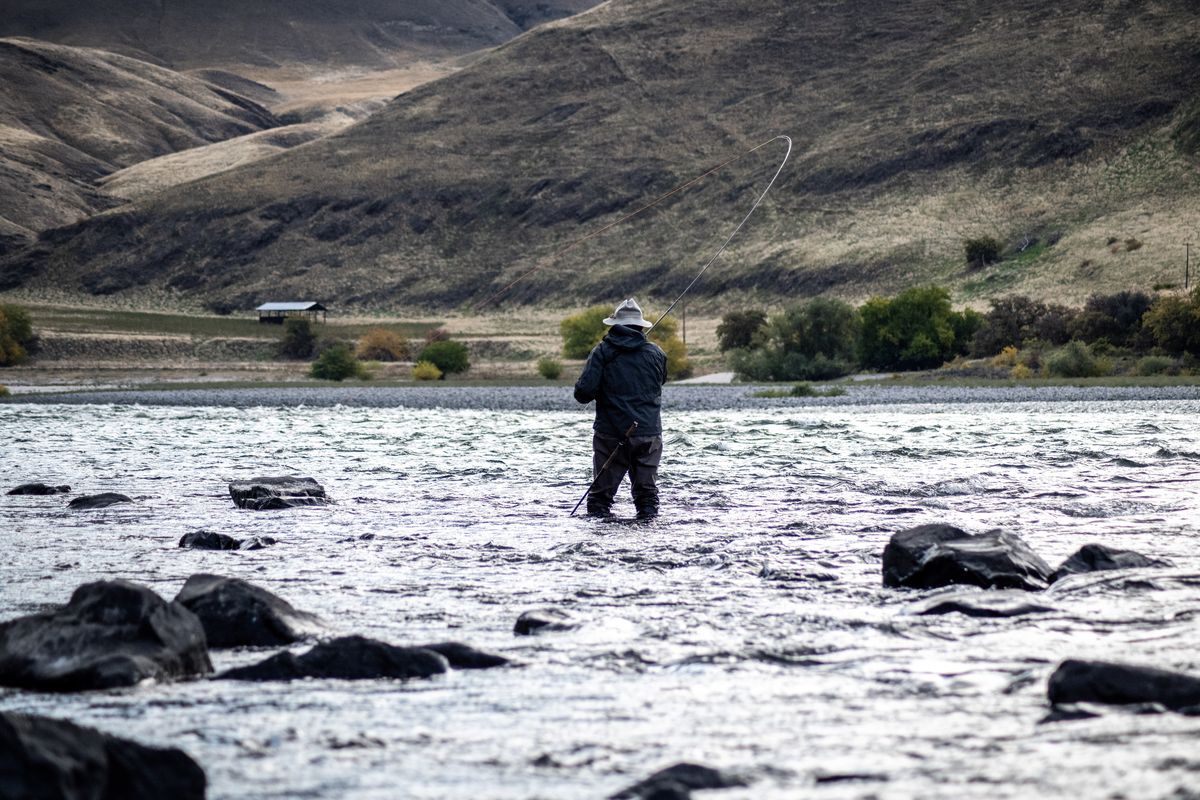
Chris Donley was fishing the Idaho side of the Snake River with a friend last Saturday when they saw a game warden talking to an angler on the Washington side of the river.
It looked like the angler on the opposite bank was getting a ticket. Donley, the Washington Department of Fish and Wildlife’s eastern region fish program manager, was pretty sure he knew what was going on.
“I go, ‘Yeah, I bet he forgot to pinch his barb,’ ” Donley said.
He was exactly right.
How do I know?
Because it was me.
I was the guy on the other side of the river who received a ticket for fishing for steelhead with a barbed hook, despite my dog’s attempts to charm the WDFW officers.
It wasn’t yet 9 a.m. when one of the wardens walked down the bank to the run I was fishing just downstream from Heller Bar. I reeled up, got out of the water and dug out my wallet.
He looked over my licenses, handed them back to me and asked to see my rod and fly.
At first, I was not sure why he was asking. Then it dawned on me. He wanted to look at the hook. I flashed back to an hour earlier, when I had tied on the fly and walked down to the river, skipping a crucial step that would have taken no more than 10 seconds.
I admitted my error. He took my driver’s license and wrote the ticket. On Wednesday, I paid $99 to the Asotin County District Court.
Worse than the fine is the feeling of utter stupidity that lingered long after the wardens drove away.
Barbless hooks are required when fishing for salmon, steelhead and sturgeon on the Snake. They are also required on the Grande Ronde, the Clearwater and an exhaustingly long list of lakes and rivers throughout the Inland Northwest.
The rule is meant to limit the damage done to fish that are caught and released. By flattening the extra point on a standard hook, the fish are less likely to have their mouths mangled and the hook is easier to remove, reducing the time an angler has to manhandle a fish before letting it go.
There is no downside to the rule. Barbs do not help anglers catch fish. The only thing they seem to be good for is getting hooks extremely stuck in all the wrong places – shirts, hats, fingers.
Truly barbless hooks are hard to find, so generally anglers are forced to mash barbs on the river. All it takes is a pair of forceps or needle -nose pliers.
And yet it’s a step that’s often forgotten.
Every angler I spoke to this week remembered a time they made the same mistake. Sometimes it goes unnoticed until the hook has already been in a fish’s mouth. My wife ended up with a barbed hook stuck in her face once – I wasn’t there, so you can believe me when I say that wasn’t my fault.
When the error is found by a game warden, anglers pay the price.
Hunting and fishing regulations exist to protect the fish and wildlife we all love and ensure we do not abuse or overuse the resource. It’s on hunters and anglers to know the rules and follow them.
Poachers and game hogs exist, but most people I know care about following the rules.
That said, it’s easy for even the most experienced and conscientious outdoors-people to become accidental scofflaws.
Pheasant hunters sometimes drop hens they thought were roosters. Great elk hunters have turned themselves in for killing illegal bull after miscounting antler tines. Salmon, steelhead and sturgeon anglers sometimes forget to record their harvest on their catch record cards.
The list could go on. Pump action shotguns need plugs. Lead ammunition is off limits in a lot of places, but allowed in others, so a bird hunter always needs to know what’s in his vest. Catch-and-release anglers in Washington have to be careful with their grip-and-grin photos – any salmon, steelhead and bull trout they plan to release must stay in the water.
WDFW Police Sgt. Tony Leonetti, based in Spokane, has seen all kinds of violations in his time patrolling the state. Among the most common is people not having their license on them.
It’s an understandable mistake, he said. A serious hunter or angler might walk away from the counter at a WDFW office or other license vendor with a stack of paper – their main license plus a catch record card and maybe a half-dozen tags. And, if they do not purchase everything at the same time, they might end up with multiple copies of their primary license, which lists the permits they have purchased.
It’s not hard to see how someone could take off for a hunt and leave the relevant tag behind.
Those who stick to fishing for trout or warm-water species might think they have it a little easier. They do not have to worry about tags or catch record cards. They do, however, have to pay close attention to how rules vary between bodies of water.
Consider a handful of lakes outside of Cheney. At Badger and Williams, fishing is open from the fourth Saturday in April to Sept. 30, and anglers can use whatever they would like.
Just a few miles away sits Amber Lake, where bait and barbed hooks are prohibited and the bag limit is no more than one fish per day. The lake also has a longer season – March 1 to Nov. 30.
The lakes offer different kinds of opportunities. Anglers who like to eat their trout spend more time at Badger and Williams, while catch-and-release fly anglers generally spend more time at Amber. It’s just a lot to remember.
Leonetti cited someone for fishing a closed lake last weekend. The angler had tried to find the rules and was led astray by the internet. Similar issues arose in Idaho and Wyoming recently.
Minor infractions stack up over time. Three in 10 years can cost someone their hunting or fishing privileges for at least two years.
Leonetti said hitting that threshold is hard to do for people who try to follow the law. Those who consistently flirt with violations, however, could get there sooner.
When it comes to a single violation, Leonetti said it’s important to keep things in perspective.
“Treat it like you got a speeding ticket,” he said. “Is that going to ruin your day?”
My ticket did not exactly ruin my day. It was hard to shake off, though. Until then, I had considered myself a religious barb crimper. Even in situations where it’s not required. Lately, when tying steelhead flies, I have been using my vise to mash them.
Last Saturday, I reached for a fly tied by someone else, the barb intact. I could use that as an excuse. I could blame the dog. I could point out that my odds of catching a steelhead were about as good as my odds of encountering a game warden.
None of that matters. I knew better, forgot and got nailed.
The next day, I combed through my steelhead box and flattened every barb I could find.