
Former NIH director Francis Collins cautions against ‘tribal alliances,’ encouraging Spokane to ‘listen and love each other again’
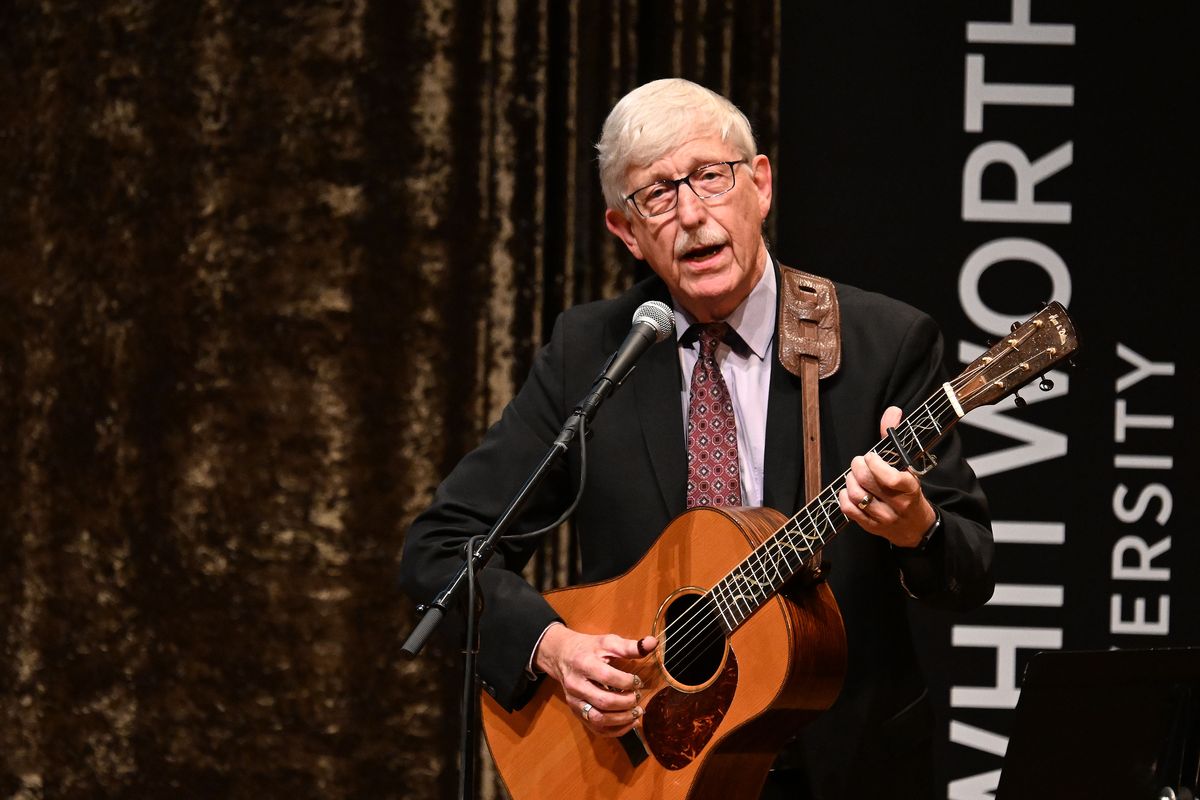
Former NIH director Francis Collins addressed more than 1,000 people at Spokane’s Fox Theater Thursday night, discussing his journeys in science and Christianity, along with a polarization and lack of trust he has noticed in American society.
Part of an annual forum held by Whitworth University and supported by The Spokesman-Review’s Northwest Passages, the talk and a brief Q&A were based on the themes of Collins’ 2024 book, “The Road to Wisdom: On Truth, Science, Faith and Trust,” a work Collins called “more relevant than ever” in a previous interview with The Spokesman-Review.
After an introduction by Whitworth President Scott McQuilkin and Spokesman-Review Executive Editor Rob Curley, Collins began his presentation by touching on the recent death of his friend, chimpanzee researcher Jane Goodall.
Collins shared photos on an overhead projector of the two of them posing on his motorcycle, having drinks together and standing with friends at his house. He said Goodall’s compassion, patience and hope made her a good person to think about “tonight of all nights.”
On science
Moving into his personal journey, Collins showed images of when he was around 7 years old, growing up on a farm. Only starting school in the sixth grade, he would go on to earn his PhD in Chemistry. It was later, in the 1980s, that he said he became interested in a particular chemical: deoxyribose nucleic acid, or DNA.
A photo of Collins as a young man wearing a lab coat while holding a needle and sitting in a haystack was taken during his time as a disease researcher at the University of Michigan, a symbol of the daunting task at hand. There, he helped in discovering the genetic cause for cystic fibrosis.
Finding the cause and subsequent treatment for cystic fibrosis was dependent on cooperation between the National Institutes of Health, the pharmaceutical industry and philanthropy, Collins said.
“All of that is in trouble right now,” he said.
In 1993, Collins began leading the international Human Genome Project and oversaw completion of the first full copy of human DNA.
“Out of that came this milestone that I think will be seen for hundreds of years as a very significant moment for humanity,” he said. “Kinda like splitting the atom or going to the moon, we read our own instruction book.”
Former President Barack Obama appointed Collins director of the NIH in 2009, a position he held until 2021. He continued as a full-time researcher until February 2025, when he was “rather abruptly required to retire from the National Institutes of Health.”
On faith
Before his major appointments, though, Collins recalls being in medical school and working with the dying. Some of his patients were at peace despite their illnesses, and those same ones were typically religious. When a woman posed the question, “What do you believe, doctor?” he said that he didn’t know and left the room.
“She looked really surprised, and that made me feel even more like I’d lost something important in my life journey.”
In true scientist fashion, Collins began to search for evidence of a God. He said that he discovered his atheism was the “least defensible of all possible choices.”
He pointed towards the existence of something rather than nothing, the precise ways that mathematics can describe the world, the big bang theory, the anthropic principle, – suggesting that fundamental, mathematical constants are set to support intelligent life – human altruism and morality, and “beauty” as evidence of a creator.
“There’s beauty in science everywhere you look,” Collins said, a comparison between a vertical view of DNA and a stained glass window overhead. “People say science is taking away the awe. They haven’t done science, if that’s what they think.”
It was at age 27, though, when Collins “made a decision for Christ on my knees in the wet grass in the Cascade mountains, not far from here,” a decision that he said has been his “anchor” ever since.
Never, he said, has he found conflict between his scientific and spiritual views.
Trust and truth
The Moderna messenger ribonucleic acid – or mRNA – vaccine for COVID-19 was designed in 48 hours in January of 2020, Collins said, with development and testing taking place in record time to allow for mass roll-out in December that same year. Estimates on how many lives during the pandemic were saved due to vaccination and lost due to vaccine refusal vary, but Collins cited the Kaiser Family Foundation, saying 3.1 million Americans were saved and 230,000 unvaccinated individuals died preventable deaths.
“People didn’t know who to believe,” he said, referencing misinformation from political and public figures. “We’re divided.”
The polarization of different “tribal alliances” has not been as strong as it is now since the Civil War, Collins said. The majority of folks sit somewhere in the middle, exhausted with the extremists, and the far end of one side sees the other as “dangerous or evil, when they’re Americans trying to find their way and come up with a different view.”
A change in the way society understands “truth” is responsible for the erosion of trust, he said. Some people get worked up talking about opinions as fact, and others dismiss facts they don’t like as they might an opinion.
“Facts don’t care how you feel,” he said. “But these days it almost feels OK to say they do.”
Distrust in science in the U.S. has led to major budget cuts to medical research, Collins said, leading to an unprecedented loss of federal support.
Collins proposes faith in the Christian God “should be an anchor in the storm,” quoting Matthew 5:44 – “but I tell you, love your enemies and pray for those who persecute you.”
Being able to engage with and listen to people with different viewpoints in a respectful way is something people in the U.S. have forgotten how to do, Collins said. He mentioned his experience going on the podcast Braver Angels to discuss public health with the conservative Minnesota trucker Wilk Wilkinson.
“I was able, gradually, to be less defensive and a better listener,” he said, adding that though the pair still disagree on a number of topics, they have become friends and “enjoy having that back and forth about issues.”
Collins said that “we need to do more of that, and that starts with each of us,” going on to encourage audience members to learn to “listen and love each other again,” address mental health issues in kids stemming from social media and demand “things” from national leaders.
Q&A
Whitworth’s McQuilkin kicked off a rapid-fire questions segment of the forum by asking about a concern for artificial intelligence-fueled mischief that Collins wrote about in his book.
AI has strong potential in the medical world when it comes to reading complicated test results, Collins said, but a bigger concern in the world of medicine is the large language models propagating health disparities because of their training materials. Hearing others talk about how AI will either end the world or everything will be fine, Collins said that “presumably, the answer is somewhere in between there.”
How, McQuilkin posed next, inspired by Mark Noll’s “Scandal of the Evangelical Mind,” can a generation of students invested in religion and the sciences make contributions going forward?
Societal issues addressed by a purely secular group of people, Collins said, will not turn out well for “things that we hold dear in terms of what is good and grace and truth and love.” Speaking to Whitworth students was refreshing, he said, going on to praise Whitworth’s mission to be a “lighthouse,” shining a light “in a world that’s kind of lost its way.”
The medical field is looking at transformative research happening in the next couple of decades, and Collins encourages young Christians to jump on the opportunity to help recover a “sense of loving each other and flourishing.”
McQuilkin wrapped up with a callback to a term mentioned earlier in Collins’ presentation: “mental immunity.” What is mental immunity, and how does one develop it?
Mental immunity is Collins’ approach to parsing “facts and fakes.” He compares it to the human immune system, noting cues in online spaces that are designed to make the viewer mad rather than convey truth can cause harm.
“You’ve got to be careful, of course,” he said. “If you become immune to everything, you have a mental autoimmune disease, and then you don’t believe anybody who says anything.”
Collins glanced over his shoulder as McQuilkin asked one final question.
“By any chance, did you bring your guitar?”
Slinging his instrument over his shoulder, “Yeah, I did.”
Designed by Collins after the Human Genome Project completed, the guitar’s fretboard was decorated with DNA’s iconic double helix pattern. The guitar has a name, too.
“So should this be named Watson? Maybe Crick?” Collins said. “This is Rosalind.”
Watson and Crick were the pair credited with discovering the helical structure of DNA, but it came out much later that they had stolen Rosalind Franklin’s data after she developed the first x-ray crystallography image of DNA and its structure. The crowd cheered at the nod to the pioneering Franklin’s overlooked work.
He led the audience in singing Pastor Thomas Troeger’s hymns for the song Hyfrydol, Troeger’s version called “Praise the Source of Faith and Learning.” Collins told people to stand partway through and ended the piece with an “amen.”
It was all a ruse, he joked with McQuilkin, to get a standing ovation.