
Judge won’t immediately block Trump troop deployment to Illinois
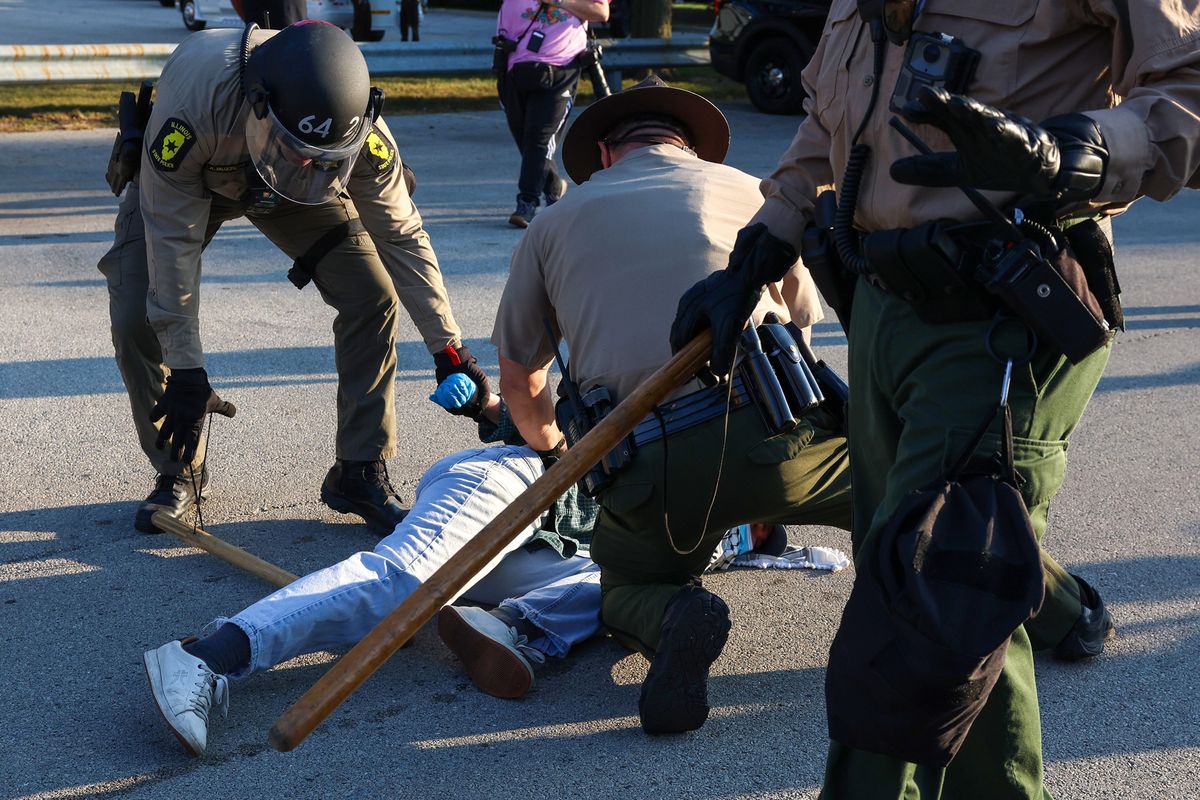
A federal judge declined to quickly issue a temporary order blocking the Trump administration’s plan to deploy National Guard members to Chicago to counter protests against the U.S. immigration crackdown, while urging the government to delay the controversial plan until she rules.
U.S. District Judge April Perry on Monday said she could not rule immediately on a request by the state of Illinois for a temporary order that would block for at least two weeks the deployment of federalized National Guard troops from Illinois and Texas. She set a hearing for Thursday for arguments on the request.
Perry, an appointee of former President Joe Biden, said she was “troubled” by the administration’s lack of clarity about where exactly the troops would be mobilizing and what they would be doing. But she said she needed to give the government time to review the filings and respond in writing before she issues a decision in the case, which was filed earlier in the day.
“In the meantime, we’ll wait,” the judge said. “If I were the government, I would strongly consider taking a pause on this until Thursday, so we are not in a position where we’re doing a full-fledged hearing with whatever has happened.”
The judge could rule on the request for a restraining order as soon as Thursday at the end of the hearing. She’ll consider later a request by Illinois and the city of Chicago for a longer lasting preliminary injunction, which would block the troop deployments until the case is resolved.
The lawsuit was filed hours after a judge in Portland issued an emergency order blocking a similar troop deployment to that state. The suit escalates a growing clash between Democratic-led states and President Donald Trump over the use of National Guard troops in cities he describes as crime-ridden and incapable of protecting federal property.
Stephen Miller, White House deputy chief of staff, told reporters on Monday that the mayor has “failed to condemn the violent obstructive acts against ICE and law enforcement.”
In a complaint filed in federal court Monday, the state of Illinois and City of Chicago accused Trump of a wide-ranging effort to use National Guard troops “to punish his political enemies.” The deployment, which Illinois said could come late Monday, infringes on the state’s sovereignty and right to self-governance, according to the suit.
“The American people, regardless of where they reside, should not live under the threat of occupation by the United States military, particularly for the reason that their city or state leadership has fallen out of a president’s favor,” Illinois Attorney General Kwame Raoul said in a statement.
The state and city have asked for a temporary order barring the planned troop deployments for about two weeks while the court considers a longer-lasting ban. A hearing is set for later Monday in Chicago federal court, though it’s unclear when the judge may issue a ruling.
The Trump administration claims the military deployment is justified because civilian law enforcement wasn’t doing enough to quell protests and protect Immigration and Customs Enforcement agents, a claim denied by Illinois Gov. J.B. Pritzker and Chicago Mayor Brandon Johnson.
“Amidst ongoing violent riots and lawlessness, that local leaders like Pritzker have refused to step in to quell, President Trump has exercised his lawful authority to protect federal officers and assets,” White House spokeswoman Abigail Johnson said. “President Trump will not turn a blind eye to the lawlessness plaguing American cities.”
Trump’s authority to deploy federalized National Guard troops to quell domestic protests is being questioned by Democratic officials across the U.S. In September, a federal judge in California ruled Trump violated federal law by sending troops to Los Angeles to aid an immigration crackdown. Washington, D.C., has also sued to block his ongoing deployment to fight crime in the nation’s capital.
The Illinois lawsuit points to Trump’s Sept. 30 Pentagon speech to hundreds of military leaders, in which the president blasted Chicago and threatened to send in troops.
“He told them that they must prioritize ‘defending the homeland’ against the ‘invasion from within’ in American cities run by ‘radical-left Democrats,’ specifically including Chicago,” according to the suit. “He stated his intention to use our neighborhoods ‘as training grounds for our military.’”
Illinois also pointed to a Sept. 6 social media post by Trump that included an image of the Chicago skyline in flames and said, “Chicago about to find out why it’s called the Department of WAR.”
The legality of Trump’s use of the troops may ultimately be decided by the U.S. Supreme Court, though it may take months for any of the lawsuits to make it there.
Chicago had been bracing for possible federal deployments, with Trump and Pritzker, a potential 2028 presidential contender, trading barbs for weeks. The president has called the billionaire governor “weak and pathetic” for rejecting federal help. The governor struck back on social media with a video showing Chicagoans running by Lake Michigan on a peaceful morning.
There have been consistent anti-ICE protests in Chicago since at least June, when the Trump administration’s enforcement activities ramped up. In recent weeks the protests have focused on the Broadview ICE facility in suburban Chicago, which have led to dozens of reported arrests amid sporadic acts of violence and alleged obstruction.
Illinois officials say the government is using those protests as a “flimsy pretext” to send in federal troops. The state says Homeland Security Secretary Kristi Noem and other federal officials are largely to blame for the mayhem, accusing them of sending a “surge of SWAT-tactic trained federal agents to Illinois to use unprecedented, brute force tactics for civil immigration enforcement.”
Federal agents have “repeatedly shot chemical munitions at groups that included media and legal observers outside the Broadview facility; and dozens of masked, armed federal agents have paraded through downtown Chicago in a show of force and control,” according to the complaint.
Tensions rose after an incident at the facility Saturday. A Department of Homeland Security spokeswoman said federal officers fired defensive shots at a woman. A dramatic mass raid on a an apartment building also captured national attention amid reports that residents, including some U.S. citizens, were dragged from their homes and detained.
‘Unprecedented Escalations’
On Monday, Pritzker said the ICE immigration crackdown in Chicago had led to “unprecedented escalations of aggression against Illinois citizens and residents,” and that “none of it was in pursuit of justice, but all of it was in pursuit of social media videos.”
Chicago’s mayor on Monday signed an executive order barring ICE agents from using city-owned properties, including parking lots or vacant land, as a “staging area, processing location or operations base.” Signs specifying ICE-free zones are being posted around the city and will be offered to private property owners, the mayor said.
It’s unclear whether Johnson’s order is legally enforceable, but the mayor said the city will pursue legal action if immigration agents violate the order.
Local officials and community leaders are “clear that we do not want or need militarized occupation of our city, and I’m going to use every single tool that’s available to me to ensure that we maximize protection to the best of our ability,” Johnson said, adding that more executive orders are being considered. “If Congress will not check this administration, then Chicago will.”
Business and civic groups including the Chicagoland Chamber of Commerce and the Civic Committee of the Commercial Club of Chicago, which includes senior executives from McDonald’s Corp., Ulta Beauty Inc. and Morningstar Inc., said the deployment of the National Guard to the streets of Chicago could hurt economic activity.
“National Guard troops on our streets, like those reportedly being ordered here by the federal government, have the potential to sow fear and chaos, threatening our businesses’ bottom lines and our reputation,” the groups said.
Trump had threatened for months to send the National Guard to Chicago, where about a third of the population is Latino. Those threats were renewed over the summer after eight people were killed and more than 50 were shot over the Labor Day weekend.
The new lawsuit argues that the Trump administration lacks authority to federalize the National Guard, and that the situation on the ground in Chicago does not justify the federalization of troops in such a manner.
The state asked the court to rule that Trump’s deployment of troops violates the Constitution as well as the federal Administrative Procedures Act, and to vacate any government memorandums that seek to deploy such troops.
The case is State of Illinois v. Trump, 25-cv-12174, US District Court, Northern District of Illinois (Chicago).