
Congresswoman-in-limbo Adelita Grijalva on the dilemma she faces
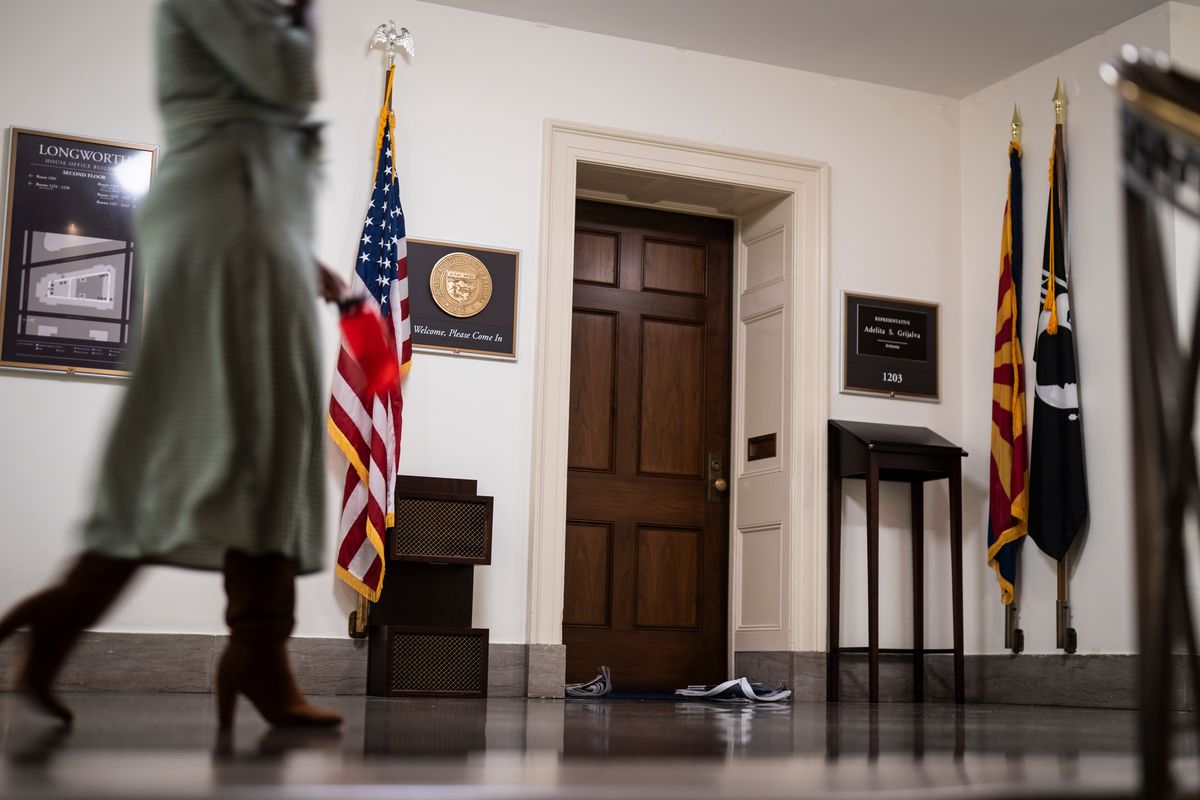
Every office along the second floor of the Longworth House Office Building looks welcoming, flags lined up nicely, most with visitor sign-in logs out front.
Except for the one where the plaque out front reads, “Representative Adelita S. Grijalva, Arizona.” Its doors are locked, with newspapers and internal mail piling up out front.
Grijalva’s (D) offices - both in Washington and back in her district - are closed, leaving the constituents of Arizona’s 7th Congressional District without representation or a single staffer who can answer questions as the government shutdown stretches into its second week.
The phone lines do not even have a courtesy message telling constituents how to reach out to Arizona’s senators for help. The voice answering the phone in the Tucson office is a recording of Grijalva’s father, the late Raúl Grijalva (D). He’s the 11-term lawmaker whose death in March prompted the special election that his daughter won by almost 40 percentage points.
Despite Grijalva’s victory more than two weeks ago, House Republican Speaker Mike Johnson (R-Louisiana) has refused to swear her in to office.
After a fleeting effort last week to get sworn in, she has decamped back to Tucson to mount a media campaign designed to shame the speaker into letting her make history as Arizona’s first Latina in Congress.
“I have the will and responsibility of almost 800,000 people to represent, and I need to fight for them. And so I’m going to make this as public as possible,” she said during a videoconference interview Tuesday. “I’m going to continue to highlight the hypocrisy and the fact that this is dangerous. It’s dangerous for our democracy.”
It’s unclear why Grijalva has not been sworn in, though she has a hypothesis: that it has to do with her stance on the federal investigation into convicted sex offender Jeffrey Epstein and her identity.
The former explanation has been offered by at least two Republicans and many Democrats. They claim that Johnson has shut down the House to block a vote on a bill requiring the release of federal investigative files into Epstein’s crimes.
Along with four renegade Republicans, all 213 Democrats have signed a petition to release the files. If the petition reaches 218 signatures, that would trigger a process ultimately forcing a vote on a matter that President Donald Trump has dismissed as a “Democrat hoax.” Grijalva has said she would bring the number of signatures to the magic number of 218.
“It has nothing to do with Epstein,” Johnson said Wednesday, when he crashed a news conference that Arizona’s Senate Democrats, Ruben Gallego and Mark Kelly, held outside his office in hopes of pressuring the speaker into swearing Grijalva in.
“I think that Speaker Johnson is taking the time to try to encourage one of the Republicans who signed on to the discharge petition to change their mind,” Grijalva said. “But, you know, the only other obvious [reason] is that I’m a Chicana from Tucson. And, sadly, it’s not unfamiliar for the bar to be set higher and different for me.”
Rep. Marjorie Taylor Greene (R-Georgia), an outspoken conservative who has clashed with Democrats but signed the Epstein petition, said Johnson’s logic about not swearing in Grijalva was “sketchy.” She noted Johnson told Republicans to be quiet so he could swear in Virginia Democrat James Walkinshaw, even as the chamber was fighting over how to honor slain conservative activist Charlie Kirk.
“Yet he won’t call the House back in session and swear in the new Democrat member,” Greene told The Washington Post’s Kadia Goba on Wednesday, referring to Grijalva.
Johnson did give three White male lawmakers who won special elections this year their oaths of office on the House floor less than 24 hours after polls closed in their elections. One of those lawmakers was Walkinshaw, who joined the House in early September. The other two, Florida Republicans Randy Fine and Jimmy Patronis, got sworn in during a 12-minute session in which no other real business was conducted.
Gallego, who became Arizona’s first Latino senator in January, rejected the idea that Grijalva’s identity has played a role.
“It has nothing to do with her race or her sex. I think the fact is that the speaker is more worried about all the pedophiles on the Epstein list than anything else,” Gallego told reporters Tuesday.
Johnson has given several different answers in explaining this seeming discrepancy, including a jumbled answer Tuesday at a news conference when he said Grijalva would be seated “as soon as she wants.”
Later, House GOP aides explained that “as soon as she wants” does not actually mean as soon as Grijalva wants.
By lunchtime Wednesday, when he engaged Kelly and Gallego, the speaker gave his clearest answer on the subject: Grijalva would not be sworn in until Senate Democrats vote to open the government.
“I am anxious to administer the oath to her as soon as you guys vote to open the government,” Johnson told the senators.
This leaves Grijalva, who turns 55 this month, a hostage in a political fight over funding the government. And that also leaves her constituents in southern Arizona, including several tribal nations that depend on federal resources, without any representation in the House.
“The longer the shutdown continues, the more and more people are going to need help navigating any resources that are available. And there literally is no one answering the phone. The offices are closed and completely empty,” she said Tuesday.
When a lawmaker resigns midterm or dies while still in office, the standard procedure is for the Clerk of the House, a nonpartisan office, to take over. A small amount of staff remain working for the district, helping with questions on Social Security, other benefits and Capitol tours.
A few days before the special election to choose a new member, those staff turn in all their congressional electronic devices. At close of business the day before the election, Clerk of the House officials collect the keys and lock the office doors, assuming the new member will be quickly sworn in after a winner is declared.
Sometimes, if Congress is not in session, House leaders will wait to swear in the new member, as happened in 2022 when Rep. Pat Ryan (D-New York) won a special election during the long summer recess. He waited three weeks for the House to come back into session to formally get sworn in to office.
But that’s not an ironclad rule. The day after they won April special elections in Florida, Fine and Patronis took the oath from Johnson.
The House wasn’t in session that day, because an internal GOP revolt left Johnson incapable of moving that week’s agenda. Johnson said Wednesday those oaths, which were given during what is known as a pro forma session, were justified because the House was supposed to be in session and the new lawmakers were here with their families.
That almost exact same scenario occurred early last week, when the House was supposed to be in session, Grijalva was there asking to be sworn in, and Johnson was a short walk away from the House floor.
But Johnson had canceled votes for all of last week and told rank-and-file lawmakers to stay home as part of a shutdown leverage play against Senate Democrats, trying to force them to vote for the GOP plan to fund the government.
During a brief open-and-shut session Sept. 30, Democrats shouted for her to be sworn in, but were not recognized. The same scene has played out in three other pro forma sessions, leaving Grijalva in congressional purgatory.
Last week she walked over to the Longworth building to poke her head into her father’s old office, only to discover that her name had already been placed on the door.
“I just wanted to go see what was up. And I was surprised that my name was up there already,” she said, recalling a flood of two different emotions landing at once. “It was sort of like, wow - and then, like, sad. It was both of the things, all of the things.”
The next day, the government shutdown began and Grijalva was no longer allowed into the Capitol unless she had an official escort. So she returned to Tucson and her three children.
Her father launched his political career in the early 1970s as a rabble-rousing member of Arizona’s Mexican American community. In Congress he honed an image as a fighter, chairing the Congressional Progressive Caucus.
Grijalva said she suspects that in the political afterlife, her father is enjoying seeing his daughter in the middle of a big fight.
“I think he would be laughing a little bit, that his daughter is causing so much stress to so many people in power,” she said.