
On Montana’s Big Hole River, a search for bugs
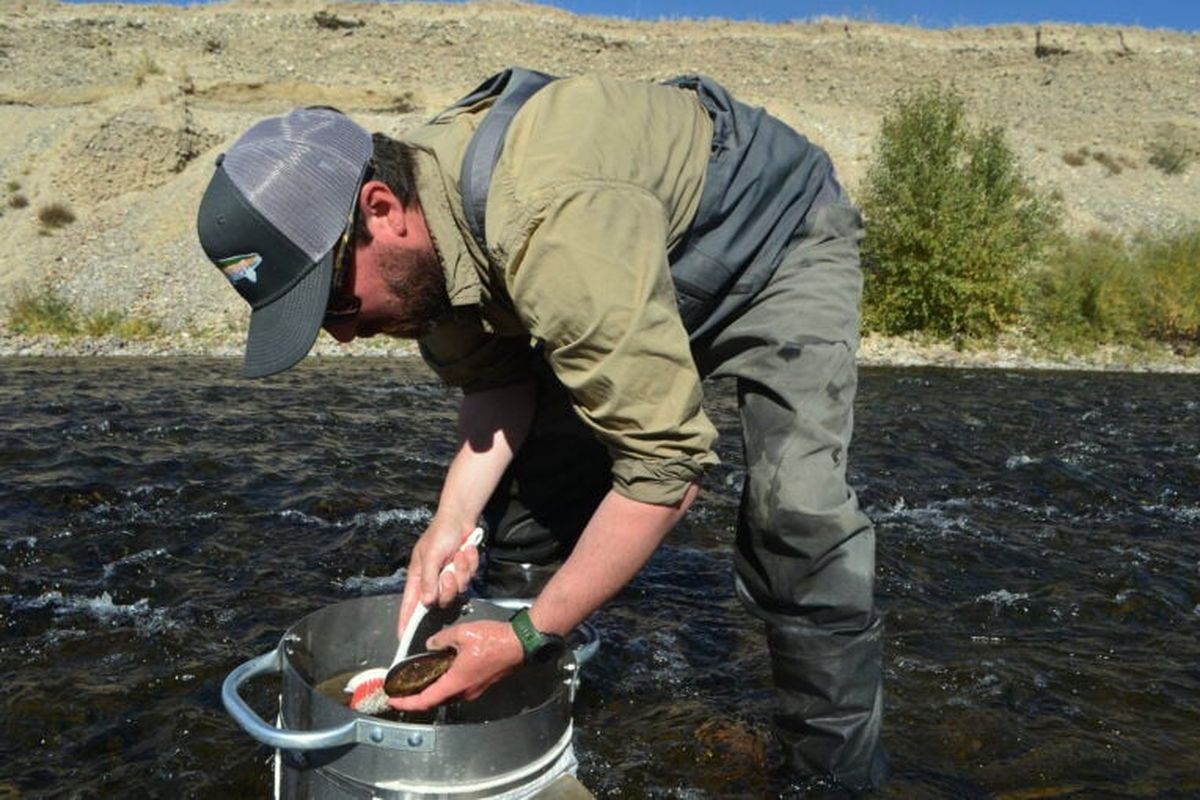
TWIN BRIDGES – Brian Wheeler has spent a fair bit of the last six years wearing waders in the middle of the Big Hole River documenting river conditions and collecting samples of macroinvertebrates.
Put simply, the river guide and conservationist has spent a lot of time scrubbing rocks and collecting bugs in small sections of the Big Hole River. Their relative abundance helps show river health, he said in late September while crouched over his sampling gear at a site near Twin Bridges.
Fish populations have been declining in some of Montana’s most famous rivers, and Wheeler is part of a growing number of people trying to figure out why. The undammed Big Hole River is one of Montana’s precious gems, known for its renowned fishing and breathtaking beauty.
“If we’ve learned anything across the nation with resource destruction, it’s these places aren’t just automatically gonna stay that way forever,” Wheeler said. “They take active work to preserve.”
Wheeler is Save Wild Trout’s program director, an organization that merged with the Big Hole River Foundation earlier this year. His organization also works with Upper Missouri Waterkeeper, and Wheeler got into the work with Trout Unlimited in Dillon, where he lives.
Save Wild Trout and its partner organizations have a fairly straightforward goal: Find out what is behind declining trout populations in southwestern Montana. Their method is to try and collect data state agencies aren’t and then give that data to those agencies.
More importantly, they want to give the state data it can accept as scientifically valid.
“We researched like, ‘OK, what are their protocols? What lab do they use? What are the scientific metrics that we have thresholds for, like nitrogen, phosphorus, dissolved oxygen?’” Wheeler said.
He added: “You can’t manage what you don’t measure, and there’s some serious measurement gaps.”
Wheeler said their organization – which includes scientist Kyle Flynn – works with the Department of Environmental Quality on standards for their data. Flynn formerly worked for DEQ and has more than a decade of water quality experience.
This summer, Save Wild Trout released a report showing warm temperatures and low oxygen levels in the Jefferson River Basin. Water temperatures at 77 degrees can kill fish within hours and the river reached 80 degrees in the summer of 2024, the report noted. Low oxygen levels at night, which can be caused by algae blooms, are also a concern – most plants don’t photosynthesize at night.
They observed four rivers (The Big Hole, Beaverhead, Ruby and Jefferson rivers) during 2023 and 2024 for the study, efforts that included hundreds of miles of overhead flights with thermal imaging equipment mounted on a helicopter.
The data collection is not always glamorous. Wheeler did a quick estimate with his phone calculator, saying he’s done about 200 bug samples since the project began in 2019.
At sites along the Big Hole, he goes out to a spot in the water, trying to keep it as random as possible. Once he’s picked a site, he puts down his sampling contraption. There’s multiple types of macroinvertebrate sampling, and he does his work with a Hess stream bottom sampler.
The sampler is about as large as a chili pot and is connected to a net that funnels into a sample cup. He puts the device in the water, crouches down and holds it in place.
He then uses a brush and begins to scrub rocks, and the current of the river pushes anything that comes off into the net. Tiny creatures, including midges and salmon flies, live on, around and under those rocks. They all play a part in the food web, Wheeler said, and their abundance is information that might help explain problems with larger aquatic organisms.
And it’s not just fish impacted by warmer temperatures and less oxygen in the water; other creatures are too.
“A healthy river for aquatic life is a healthy river for the rest of us,” Wheeler said. “Like, it’s why we collect bugs. This is, like the foundational health indicator of a river.”
Once the large rocks in the area he’s sampling are cleaned off he makes sure anything crawling inside the net is knocked into the sample cup. He likes to joke the clean rocks are creating spawn habitat for trout, which brush off rocks in efforts to create better areas to lay their eggs.
“I also like to think that if I scrub rocks, I did half the work for them creating their spawning redds,” Wheeler said.
With the contraption over his arm, he trudges back to shore and prepares the samples in several meticulous steps.
“Man, it’s not sexy, dude,” Wheeler said of the work.
An alcohol solution is used to preserve the samples, which are later sent to entomologists at River Continuum Concepts in Manhattan. Wheeler, who does not trust shipping companies to deliver the samples, drives them over to Gallatin County himself.
The research has already netted a 178-page report on macroinvertebrates in the Big Hole River, covering 2019 to 2022, authored by Brett Marshall with River Continuum Concepts. The hope is to put out a 10-year report in a couple years, Wheeler said.
The sampling process at any one site can take multiple hours, especially when driving time is included. Wheeler puts hundreds of miles on his Tundra truck every year, often along Montana’s many backroads.
In September, Wheeler was also picking up what they called “data loggers,” which record several river conditions and were one of the main data collection tools for the report Save Wild Trout released in the summer.
They aren’t cheap, and Wheeler has resorted to camouflaging the loggers, which have been vandalized and in one case stolen.
“If you’ve got a resource that’s struggling because people make their living on it, people appreciate it beyond the economic value or the ecological value,” Wheeler said. “So I mean, it’s kind of hard to avoid getting a bit emotional.”
There is very real tension and frustration over the river.
Ranchers have water rights and need water for their cattle. Extended drought has caused agricultural producers across the country trouble rebuilding their herds. Some ranchers have voluntarily put water back in the river, Wheeler said, but others don’t and that’s their legal right.
Guides and outfitters, who rely on the world-renowned trout fishing in the area to support their livelihoods, have a major stake in the river, too.
Some communities, like Butte, also pull water out of rivers in the area, Wheeler said. Irrigators – there are some crops near the river – are also part of the puzzle.
The fish population issue caught the attention of the Governor’s Office in 2023, which resulted in Gov. Greg Gianforte holding a summer meeting in Wise River with various river stakeholders.
A lot of ranchers and irrigators showed up to that, Wheeler said, and not as many anglers. He kept his comments short on the whole thing.
“I thought it was a lost opportunity for some broad representation,” Wheeler said.
That meeting did result in a yet-to-be-released study into fish mortality on the river.
This is an effort through Montana Fish, Wildlife and Parks, which is coordinating with researchers at Montana State University. Researchers at the school are expected to submit annual fish mortality reports until 2028, when three doctoral students at MSU are expected to finish their dissertations, Montana Fish, Wildlife and Parks spokesperson Morgan Jacobsen wrote in an email last month.
“In addition to the dissertations, MSU is expected to provide a final report including the raw data and analysis code as well as submit three manuscripts for peer-reviewed publication,” Jacobsen wrote.
It is an ongoing project and Save Wild Trout, which meets several times per year with FWP, is coordinating their work with that state agency, too. Those meetings, along with the organization’s work with DEQ, allow conversations to take place on the issue between the state and organizations like Save Wild Trout.
As part of the fish mortality effort, FWP is also tagging fish. Similar efforts have been undertaken in Idaho to study effects of hatchery-reared sturgeon on the Snake River.
“Ultimately, tagging allows biologists to track individual fish, which provides insight into movement, survival, and growth throughout the life of a fish,” Jacobsen wrote.
That is often done by electrocuting and stunning fish, which can kill fish on occasion. Recently, a tagging effort by FWP apparently killed some fish in the Big Hole River.
“While we didn’t see any immediate mortality during this fish sampling effort, clearly there was some impact,” Jacobsen wrote. “Moving forward, conditions and population abundances will need to be significantly better in the next year or two for us to consider a fall sampling event on the Big Hole.”
FWP is also actively working with irrigators to improve efficiency, work with power companies on things like the Madison River Drought Plan and identify areas ripe for restoration. FWP is also closely working with Montana State researchers on the trout issue.
“Although those efforts are not considered research, they address some of the issues associated with the MSU research,” Jacobsen wrote. “Other FWP staff and partners are working with existing data and past environmental conditions to better understand exactly how water temperatures and flows influence recruitment of juvenile trout and adult survival, which will complement the ongoing MSU studies.”
The Department of Natural Resources and Conservation, along with DEQ, is part of what Wheeler called a “three legged stool” of government oversight of Montana watersheds. There’s also only so much money and manpower, with Wheeler saying resources can only extend so far.
That’s where organizations like Save Wild Trout can help fill in gaps, he said. The organization receives some state grants, but most of its work is funded through donations. Reports, even with some volunteer hours working on them, are still expensive, Wheeler said.
The sampling device Wheeler uses is not cheap either, which is why the organization only has one. Gas is pricey too, and between running people down the river as a guide and collecting data, he does not have a ton of free time in the summer.
But this work is important, he said, and he sees a lot of value in the data they’re gathering. Even if it comes at cost to his knees and back.
“We started this program, we didn’t know if the river was better, worse or the same as it has been 20 years ago, because there was no data to show that,” Wheeler said. “And so I think about the next person, you know, the next iteration of me in this role, at least that person will have a historic record to compare against.”