
Getting There: Spokane’s Parkade becomes one of few parking structures on state’s historic register
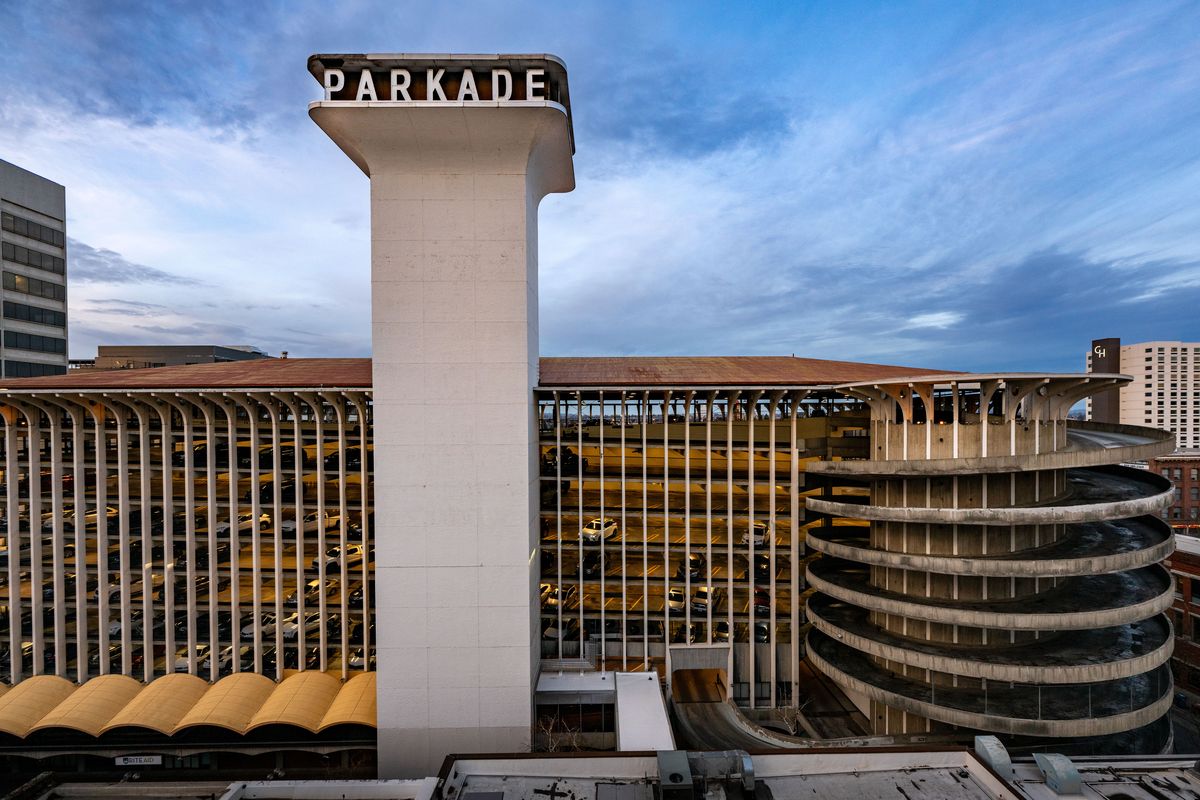
Spokane’s most iconic parking structure has been listed on the Washington Heritage Register and may soon receive national recognition.
In March 1967, amid an effort to revitalize the downtown core, a towering, concrete parking garage with a spiral entry known as the Parkade made its debut. It was lauded as an attractive, modern marvel, and a crucial piece in driving shoppers back into the heart of the city, said State Architectural Historian Michael Houser.
“In the post-World War II period, there was the flight to suburbia, and all the malls coming online,” Houser said. “And it was kind of a, ‘Hey, we need to do something downtown to make it easier for people to shop down here.’ ”
That “something” came in the form of a $3.5 million, 10-story parking garage made possible by a group of Spokane business leaders with a vested interest in the success of the city’s center.
Recognition of the structure’s success, and unique design, quickly followed. A year and a half after its opening, the Parkade graced the cover of the Journal of the American Institute of Architects.
“A bright spot and a fun place, that’s the new parking garage in Spokane, Washington,” reads the opening line of the article inside, entitled “The Gala Garage.”
Flash forward, and the Parkade continues to receive acclaim. Earlier this month, it was listed as a significant local historical landmark on the state’s registry, meaning it’s now under consideration for the National Register of Historic Places.
Houser, a coordinator for both the Washington and National Register of Historic Places, said the Parkade is just the second parking structure in the state to receive the honor.
The first would be the art deco City Ramp Garage located at 430 W. First Ave., which houses the Satellite Diner on the ground floor. The 1928 structure was listed on the National Register in 2012, following a renovation.
“There’s some interesting kind of history in terms of parking garages and the various types of parking garages that have been sort of experimented with downtown,” Houser said. “Some pretty innovative kinds of systems that started in Spokane, oddly enough.”
Innovation and the Parkade have gone hand in hand since a group of Spokane business leaders pooled the money to construct it.
On the day the Parkade opened, The Spokesman-Review referred to its use of external concrete half-arches as “futuristic,” writing that it was one of the few modern parking facilities with a roof and noting the “striking” tower extending above the garage that housed the elevator mechanisms.
The concrete behemoth encompassing much of the block between Howard and Stevens Street was designed by Warren Cummings Heylman, a prolific mid-century architect behind a number of Spokane landmarks.
As of his passing at 98 years-old in 2022, Heylman’s contributions to the Spokane skyline included a number of South Hill homes, the Spokane International Airport, The Spokane Regional Health District building, the Riverfalls Tower on downtown’s west end and the Burlington Northern rail bridge over Hangman Creek.
“It also will be a beacon for motorists,” Heylman said of the central tower in the Parkade, upon its opening, “and serve as a landmark for drivers seeking parking space.”
The year after the Parkade opened its 1,000 stalls to commuters, Heylman received an award by the Washington Aggregate and Concrete Association for “excellence in the use of concrete.” He later opened an office on the ground floor of the Parkade, where he practiced architecture along with his daughter, Ann Martin, for 35 years.
The lower level remains a commercial space occupied by Spokane Exercise Equipment and the record and vintage shop Entropy. A large retail space on the building’s southwest corner has remained vacant since Rite-Aid closed its downtown location in 2023.
The Parkade also serves as the origin of the city’s skywalk system, another revitalization effort of years past that can now be seen crisscrossing downtown. The first piece stretched from the 1967 Parkade parking structure across Main Avenue to the Bennett Block, then over Howard Street to the Bon Marché department store.
“That’s another pretty cool aspect of its history as well, that’s come and gone over the years,” Houser said. “Back in the ’80s, kind of at its peak, I remember walking through there as a kid. It was bustling.”
The Parkade and the half block it sits on was purchased by the Seattle-based company GT Mukilteo in 2020 and is operated by Parkade Investors. It was added to the city’s historic register in 2023, a designation that brings some incentive for preserving the structure for years to come.
Spokane County and Spokane Historic Preservation Officer Megan Duvall said that while a property’s addition to the National Register of Historic Places is an honor, being listed to Spokane’s local register carries a bit more teeth. The local register allows for some oversight to ensure the building is preserved for years to come.
“Getting something on the Spokane register is what we really aim to do, because we want these buildings protected and around for the next 100 years or so,” Duvall said.
The local recognition allows some modern building codes to be relaxed on a case-by-case basis for certain historical aspects of a building, and there are modest local grants available to owners of historic properties for facade improvements. The real incentive to be added to the Spokane register comes in a property tax break.
Starting this year, the ownership group will receive reduced tax bills for a decade to help offset the costs of rehabilitating historic properties. The property had an appraised value of more than $10 million for 2026 taxes, but will only be taxed for $1.6 million, the balance left from subtracting the owners’ rehabilitation costs over the past few years.
If it is listed nationally, the Parkade owners will also be able to access federal tax credits.
Duvall said those nearly $9 million in improvements are not “flashy,” and did not necessarily occur to elements of the building that would make someone go “‘Oh, wow, that was really derelict before.’”
Spokane County property records include a number of building permits dating to April 2021, including concrete repair, electrical work and upgrades to the commercial spaces on the ground level.
“It’s stuff like rebar that was rusting out,” Duvall said. “They improved it so that it is going to be around for a lot longer, but it was a super expensive endeavor to do that.”
A member of the ownership group reached for comment declined to be interviewed by The Spokesman-Review, but shared that the group is hoping the multilevel historic recognition and rehabilitation are an impetus for revitalizing that section of downtown.
Houser said properties identified at the state level often reach national recognition as well, but a final word on the Parkade will not happen until the federal government shutdown comes to an end. It typically takes around 45 days to process.
Duvall said she’s excited to see another Spokane landmark receive the recognition it deserves. The Parkade is an iconic piece of the Spokane sky line, and represents one of the first major investments in the city’s core ahead of the transformations brought about by Expo ‘74.
“It’s an important part of Spokane - telling part of the story of how business people got together and tried to save downtown,” Duvall said. “And that’s kind of a story for today too. Different problems, different solutions, but people rallying together to try to figure out how to improve our downtown.”
Editor’s note: This article has been updated from it’s original version to correctly identify Parkade architect Warren Heylman’s daughter, Ann Martin.