
‘You don’t have hope, but what you do need is help’: Spokane Valley uses ‘co-deployment’ model to help homeless
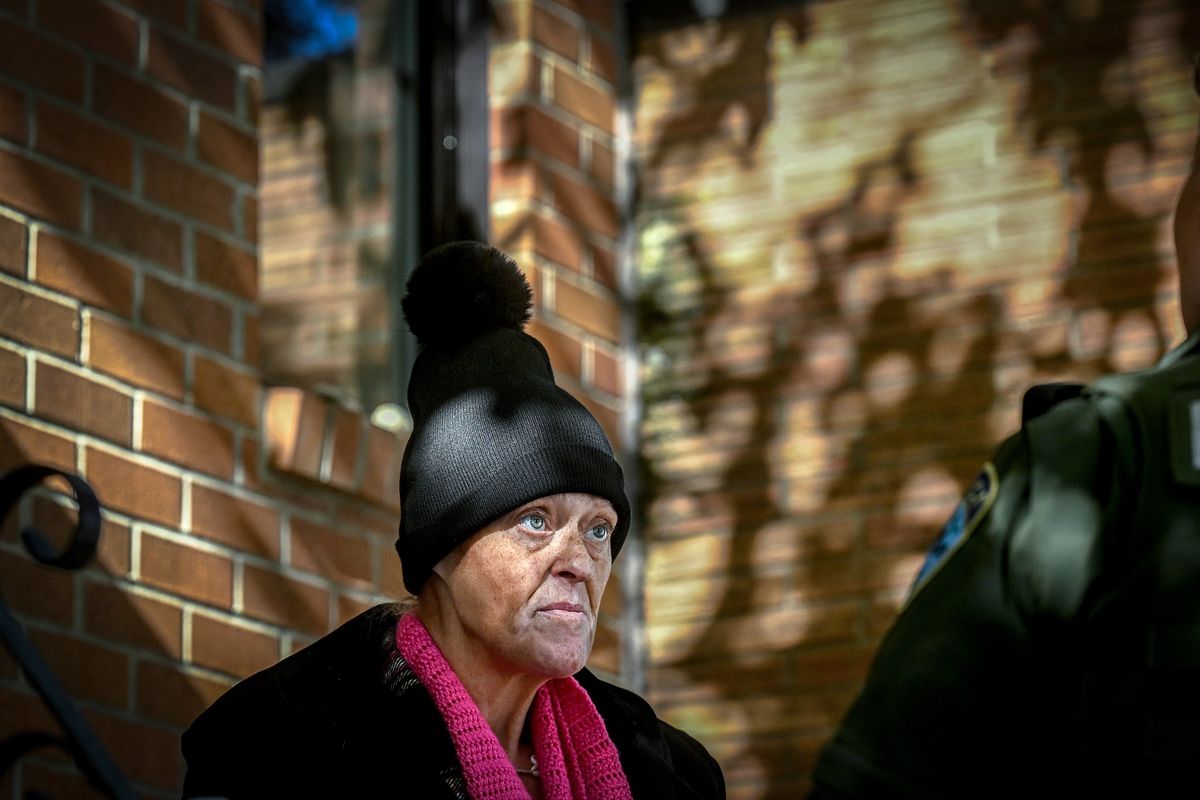
Dawn Sherman and Gary Adams were both clad in winter coats and beanies, trying to keep warm in Tuesday’s frigid autumn air.
Adams smiled at Cat Horton, a Spokane Valley Homeless Outreach Officer making a routine trip to Spokane Valley Partners. Horton immediately asked Adams how he was doing.
“Good,” Adams said, then asked Horton if she had any gloves in her truck.
With a quick tug, Horton’s trunk opened and revealed two drawers, full of supplies.
Horton spends her shifts driving around in a big Ford truck loaded up with sleeping bags, canned foods, gloves, shoes, hats and other items she hands out to homeless people in the Valley.
It’s all a part of a program Spokane Valley Police Chief Dave Ellis created: the co-deployment model. Horton approaches homeless folks with a big smile, her hair slicked back into a knot at the crown of her head.
The program sends out the team with a social worker and homeless outreach officers seeking to help get people off the streets by bringing social services to them. The program debuted three years ago, but started working with Frontier Behavioral Health last year.
The team has since helped house around 50 people, said Gretchen Brown, the lead for the Valley’s homelessness outreach team through Frontier Behavioral Health. It houses an average of nine people every three months, according to Brown. Sometimes that’s individuals; other times, families.
There are thousands of homeless people that live in Spokane Valley, city housing and homeless coordinator Eric Robison said.
Life on the street
Horton spends her time talking with folks who live out of their cars, packing everything they own into the backseat. Those are the lucky ones.
Others spend their days outside, getting colder every day, making trips to the food bank in hopes of getting something in their bellies and maybe even clothes to keep warm. They pack what they have into things like grocery bags or duffels, eager to get a pair of gloves from someone like Horton.
During her shifts, Horton schedules time to meet with people who are struggling. Sometimes she meets them at a designated location, and other times they meet her at Partners in the Valley. It’s her job, Horton said, to help provide homeless people with basic necessities and to help them regain independence through sobriety, housing and employment. In the cold weather, Horton is focused on helping homeless people in the Valley stay warm.
While drugs aren’t always the reason people are homeless, it can be the reason people have difficulty getting off the streets.
The city saw a spike in homelessness after the Blake decision, Police Chief Ellis said, which legalized drug possession in Washington. That ruling determined Washington’s drug law was unconstitutional because it doesn’t require prosecutors to prove that a defendant knowingly had drugs, leaving the possession of small amounts legal under state law.
In Spokane Valley, camping or trespassing on private or public property is illegal, and officers enforce that most of the time, Horton said. But if a homeless person is engaging in services or working with the city’s homeless outreach team, officers like Horton aren’t required to make an arrest. The model does not change the law, Horton said, but does make it more lenient for those who want to get treatment.
‘Somebody that cares’
Jim Bruegeman said he’s battled drug addiction throughout his adult life, which led him to homelessness. He started using meth at 18, and went on to use heroin and fentanyl. At 53, Bruegeman has overdosed multiple times. He was given Narcan every time.
Bruegeman had been in and out of jail for years, catching charges including theft and trespassing. He ended up in Spokane Valley because it’s where he was raised.
He had been on the streets for years when he met Deputy Joshua Pratt, the first homeless outreach officer. Horton and Dan Spiewak are the two homeless outreach officers in the Valley, and Horton has taken Bruegeman to rehab several times – four times this year.
“When you’re homeless, you don’t have hope, but what you do need is help,” Bruegeman said, gesturing to homeless outreach officer Cat Horton and Ellis. “There’s nobody out there that really wants to be out there. They just don’t have the hope to change and want to live, but these guys gave me that.
“They’re like my second family. I don’t have anybody. Everybody in my life gave up on me. You need somebody that cares.”
When she sees Bruegeman, Horton gives him a big hug.
“I genuinely care,” Horton said. “When people get into treatment and sober living, we don’t start there. I’m still in contact with Jim all the time, so when he was in his sober living, he needed food. We’ll go give him food. He needed a backpack and a bicycle. We go bring that stuff to him. Those simple things that we take for granted are a huge thing for them.”
A battle every day
Bruegeman was four months sober and was working at a local landscaping company when he talked to the Spokesman-Review. He said he hadn’t been sober that long since he was 16. Relapse is a part of recovery.
“I am constantly in communication with the people working with our team,” Horton said. “As soon as somebody misses an appointment, I usually see them on the streets and ask what’s going on.”
When people leave treatment early, the team doesn’t give up on them, Brown said. Each time Bruegeman relapses, which he has several times, he has called Horton or Brown for help.
“I’m in recovery and it’s a battle every day,” Bruegeman said.
Just weeks after Bruegeman talked to The Spokesman-Review, the homeless outreach team lost contact with him. It’s unclear whether Bruegeman relapsed. The last time Horton and her team heard from him, he was staying at a hotel and ready to move into a new sober living house. Sober living homes cannot release the names of the people staying in them due to confidentiality. The only way Horton or Brown can find out where Bruegeman is, is if he responds to their calls or messages. But Horton remains hopeful.
“Good people make mistakes,” Horton said. “We understand that, but we don’t judge you for those mistakes. We want you to be better, and we’ll hold that to you.”
If Bruegeman had never met Pratt, he never would have been sober for four months.
He wouldn’t have a job.
He would still be on the streets.