
He’s cleared 35,000 pounds of trash from Miami’s mangroves and isn’t done yet
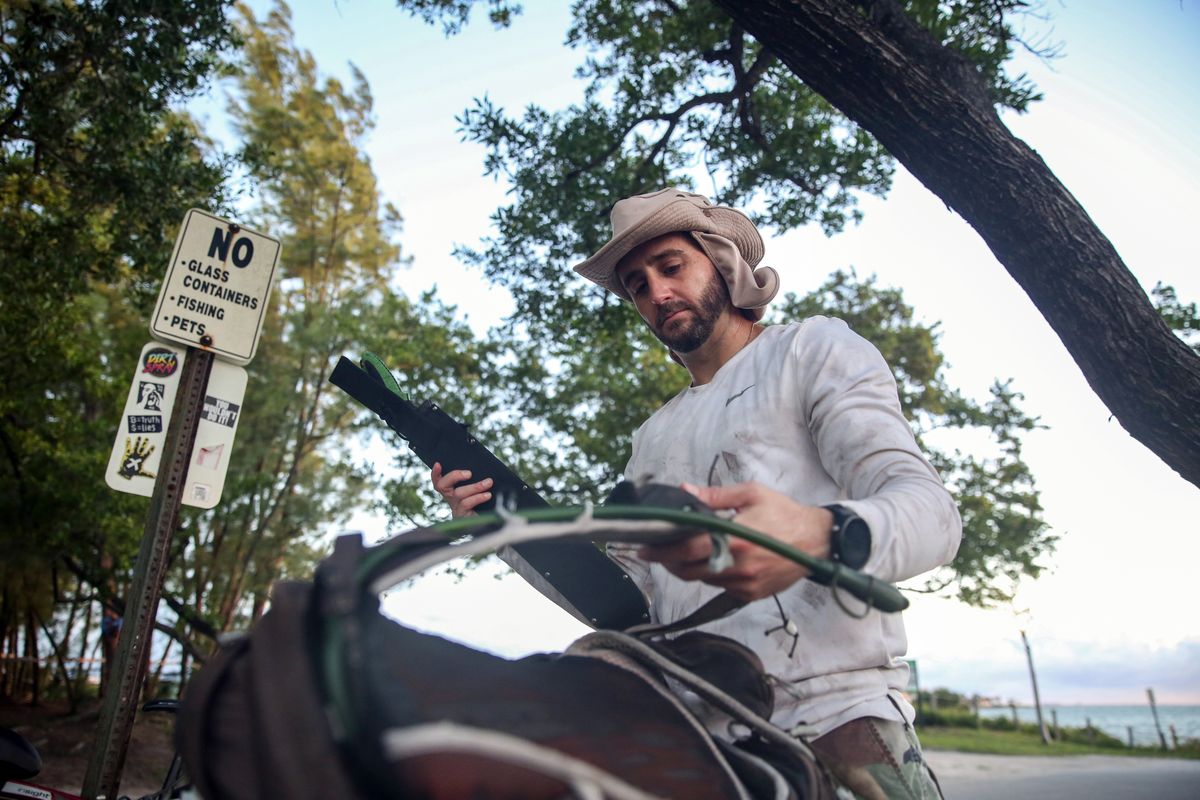
MIAMI – It’s a steep drop into a mangrove forest brimming with three feet of brackish water over thick, twisty tree roots, but Andrew Otazo has no trouble navigating the descent.
He scrambles down the craggy incline like a camo-clad Spider-Man, using branches and thick vines and footholds in the dirt.
At the bottom, Otazo finds his treasure: trash.
To date, the 38-year-old Miami man has plucked, bagged, heaved and hauled more than 17 tons of trash, mostly from the islands around Biscayne Bay.
“You name it, any item you can name, and I have found it in the mangroves,” he says. “Convection ovens, microwave ovens, mattresses, sofas, sets of plates and dishes. Used diapers. Those are really disgusting.”
But every shoe, bottle, car battery, cooler and other piece of garbage Otazo removes from the mangroves reclaims space for what should be there: bird nesting grounds and fish rookeries.
Otazo is on a quest to clear as much of that space as he can. He is also working to convince his fellow Floridians to tell their elected officials to work to cut down on plastic pollution and update antiquated waste systems that carry street trash into the ocean.
“If you’re relying on me, just one guy picking up trash, we’re doomed,” Otazo said. “But if what I’m doing shows other people the problem, and they agree we need to work toward a solution, that’s the idea.”
Otazo goes out to the mangroves at least once a week.
Lately he has been concentrating on the mangroves that ring Virginia Key, an island in Biscayne Bay that offers a gorgeous view of the city skyline. What people in the city do not see are the mounds of garbage caught in the tree roots. Earlier this month, we accompanied Otazo.
His day begins before dawn, when he packs up for hours of trash collecting. Otazo rides his bike five and a half miles from his home in Key Biscayne.
“I’m not a morning person, but if you don’t get out here early enough, the heat can get to you,” Otazo said. “It will literally kill you if you’re not careful.”
Otazo has a day job – he runs his own public relations firm, ARO Communications.
He is also an endurance athlete. In 2019, Otazo combined two of his passions when he carried on his back a 35-pound bag of trash he had picked up in the mangroves in the Miami Marathon. He struggled through all 26.2 miles, taking nine hours and 50 minutes.
“It was agony. It was the worst. It destroyed me,” Otazo recalls.
He made the local news, and his trash-filled, homemade backpack has been on display in the HistoryMiami Museum ever since.
“I never, ever in a million years thought people would pay attention to me because I’m picking up trash,” Otazo said.
It’s a mission now.
Otazo was born in Miami. His parents are both Cuban refugees.
They raised him and his twin sister in Coral Gables, running an environmental construction business and fostering an appreciation for the outdoors in their children.
Otazo remembers exploring the red mangrove forests around the island as a 13-year-old. Mangroves are a protected species in Florida because of their importance to shoreline stability and also because they provide safe havens for wildlife.
They are sometimes called “land builders” and “walking trees” because the roots can appear to be holding the trees above the water like legs. They can live in freshwater, but they thrive in saltwater and their elaborate root system can hold soil and actually build islands.
“They’re magical,” Otazo said.
Otazo earned his bachelor’s and master’s degrees in political science and international administration from the University of Miami. He spent several years working at Harvard University – for a time as assistant to Felipe Calderón, the former president of Mexico.
He also interned at the U.S. State Department and served for a time as executive director of the Cuba Study Group, a nonpartisan policy and advocacy group in D.C. He’s written a book, “Miami Creation Myth,” a satire on a city he loves but that “sometimes frustrates the hell out of me.”
“Then I came back to Miami and then lo and behold, all of my skill sets are completely irrelevant in this city. That’s why I had to keep leaving over and over again because people here were like ‘Oh cool you worked at the State Department, you worked at Harvard, I don’t care. Can you sell real estate? No? Get out of here,’ ” Otazo said. “So, you know, I had to reinvent myself.”
He went into public relations and started to revisit the environment he grew up loving – kayaking around Biscayne Bay and wandering into the mangrove forests at the edge of the islands.
“When I was a kid, I’d go out there and it was just gorgeous, it’s beautiful,” he said. “It’s unlike any other environment in the world, so I fell in love with it.”
As an adult, he noticed something else about the mangroves.
“I went in looking for peace and serenity, but I came out furious,” Otazo said. “Literally everywhere I stepped, I stepped on trash.”
So he started taking trash bags with him. A couple of bags grew into a couple dozen. Every time he went out to the beach or the islands, he would take trash bags.
Pounds turned into tons. He reached 35,265 pounds – picked up over 184 days throughout the years – in mid-October.
Otazo keeps careful track of how much trash he collects, using a luggage scale to weigh each bag.
Virginia Key is a popular park, especially for cyclists. The Virginia Key Bicycle Club helped to build mountain bike trails on the island.
Club President Nick Sabatini takes the trash bags Otazo hauls out of the mangroves to a dump site about a mile away.
“He’s doing the difficult work on the front line literally down in the muck,” Sabatini said. “We take it the last mile. He’ll send me tallies and message me, ‘I left another 400 pounds for you.’ It’s amazing.”
Otazo said he has no plans to stop.
“The trash will come back, but I’m stubborn,” he said. “I’ll keep doing this until I keel over.”