
With gun-sniffing dogs and safe rooms, workplaces tighten security
There is a waiting list for Melvin Key Sr.’s private security guard class in D.C.
Sal Lifrieri’s company is fielding far more calls about corporate “safe rooms.”
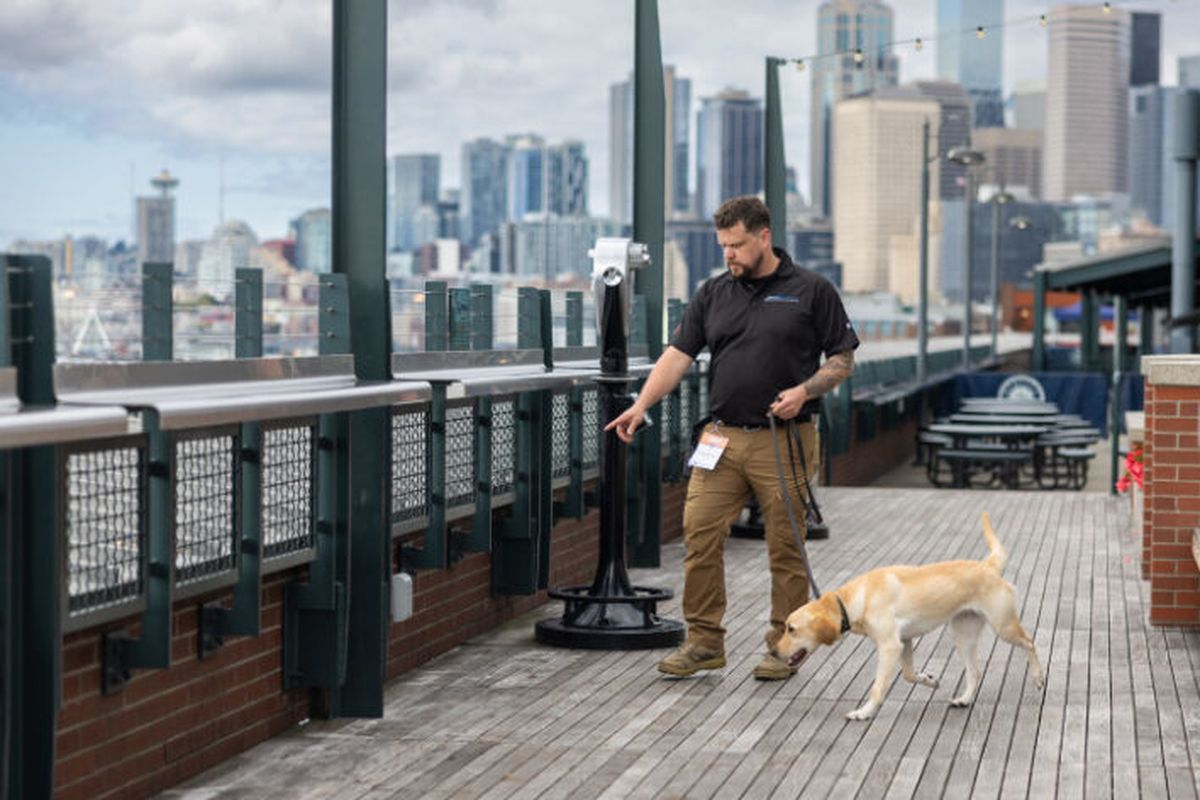
And there was so much demand for gun-detection dogs in New York City this summer that one security firm brought in 100 extra canine teams.
Companies are increasingly taking steps to fortify their offices in the wake of a pair of deadly shootings that targeted high-profile companies in bustling Manhattan, security experts say. Much like schools and houses of worship, they are going beyond visitor sign-ins and locked doors – tapping into a growing network of vendors selling sophisticated monitoring systems, panic buttons and other items – to heighten preparedness and improve safety in the event of an attack.
Security consultants and technologists who offer threat assessments and new-generation metal detectors say they’re seeing more demand. Companies are also turning to surveillance systems that utilize artificial intelligence to detect weapons and identify loiterers, and they’re hiring consultants who scour social media and obscure corners of the internet for posts that may augur an attack.
Schools, sports arenas and hospitals for years have adhered to elevated security protocols, partly driven by fears that they could be subject of a terroristic attack, or in response to shootings and patient violence. But corporate America has largely taken a more provisional tactic – bringing in security guards after a high-profile incident, for example, and then phasing them out after a few weeks – often because of the expense, industry observers say. A number of companies temporarily hired more security after UnitedHealthcare CEO Brian Thompson was gunned down on his way to an investor conference last December, observers said.
Thompson’s slaying and a July attack targeting National Football League offices in a well-secured New York office building prompted many companies to reassess what they’re willing to invest in to reassure employees, their families or insurers that their workplaces are well-protected, industry experts say.
“Reasonable costs today may not be the same tomorrow after you have an incident like this,” said John Torres, president of security and technology at global consultancy Guidepost Solutions.
The two shootings underscored how prominent companies can be at risk, said Glen Kucera of Allied Universal, a global security and facility services company that deployed dozens of canine teams in New York over the summer.
The man accused of shooting Thompson harbored resentment toward the U.S. health care system, police said, but he did not target his own insurer. “He went after the biggest one,” Kucera said. In the July attack, authorities said the shooter believed he suffered from a degenerative brain disease and blamed the NFL for his struggles; he does not appear to have played football beyond high school. He left four people dead and wounded another before turning the gun on himself, police said.
The building had safe rooms where tenants sought refuge, which may have piqued other companies’ interest, Lifrieri said; he estimates safe-room queries at his business have doubled since the July 28 shooting.
Peter Evans, CEO of Xtract One Technologies, a company that makes weapons detection systems, said clients who were once just browsing the offerings are now contacting the company with intent: “We are going to deploy a solution before December. Can we run a demo with you?”
Some workers have taken note of the demand.
Key, a retired D.C. police captain, said he’s getting more sign-ups for the 15-person classes he leads for people who want to guard VIPs. Hiring a guard can cost $150,000 or more a year, he said. “People are seeing what’s happened in the corporate landscape and they say, ‘I need to – I want to get into that profession,’” he said.
The number of security guards and security companies – as well as the slate of services such as consulting they offer – has “grown by leaps and bounds,” said Eddie Sorrells, president-elect of security association ASIS International and chief executive of DSI Security Services, a company that provides security officers, video monitoring and other services.
There were 458 workplace homicides in 2023, 373 of which were shootings, according to government data. By comparison, there were 322 shootings a decade prior.
About 28% of public mass shootings – those that weren’t at private residences – took place in a workplace, according to a 2023 National Institute of Justice report that synthesized findings from dozens of publications and research projects.
Corporate spending on executive security has jumped markedly in recent months, according to business filings.
The technology giant Intel spent $248,900 on the “incremental cost of residential security” for its then-CEO in 2024, compared with $1,500 spent on his residential security in 2023, and $1,700 in 2022, company records show.
Even before the shootings, many companies were paying more attention to online threats and aggressive social media rhetoric that has increased in recent years, some security officials said.
At Interfor International, an intelligence and security consulting firm, the volume of online threat monitoring work has tripled each year since 2020, according to chief executive Don Aviv. It scans chatrooms, social media and the deep or dark web for negative language about brands or executives and then tries to determine whether the threatening poster is “just some 11-year-old in a basement” or someone with a history of violence.
For commercial building landlords, state-of-the-art security can be a selling point in attracting tenants, said Glenn Good, vice chair of the Building Owners and Managers Association and principal of a San Francisco-based commercial real estate firm. They frequently look for upgrades.
“We don’t sit back and wait for the next crisis like a shooting to determine how we ensure that our buildings are safe,” he said.
Experts in school security – an industry that’s grown markedly in recent years, partly fueled by government grants – say the fear and demand sparked by a shooting can draw fly-by-night-operators hawking their technology as a fix-all solution.
“I call (it) the shiny object syndrome,” said Kenneth Trump, who leads a firm called National School Safety and Security Services.
Amy Klinger, with the Educator’s School Safety Network, says at times too much attention is paid to physical tools and active shooter response and not enough to training and preparation for more common disasters such as medical or severe weather events.
“If you are going to bet the farm that a metal detector is the only thing you need to keep your school safe, you’re going to be wrong,” she said.
But many in corporate security say the industry will only continue to grow as questions about liability and potential lawsuits surface, and as states adopt various workplace safety laws.
New technologies have already made security more advanced than old-school metal detectors – and far less of a hassle, they say.
Evans shared a video of schoolchildren walking through one of his company’s weapons-detection systems, a metal-detector-like structure wide enough to let multiple people pass through at a time. “I can walk through with a backpack, with a laptop, with a tablet, with a metal water bottle … and it won’t alert,” he said.
Video surveillance has also evolved beyond a guard staring at a monitor‚ Sorrells said. AI can be used to send alerts: “That car has been in that parking lot for X amount of minutes or hours. Or someone is loitering around the back entrance,’” he said.
Volt AI is one such tool. An employee receives and reviews alert notifications to filter out false alarms, said chief executive Dmitry Sokolowski. If a weapon is detected, the system will keep tracking the person even if they conceal the weapon. It can help provide their location for law enforcement, he said.
“There’s been a lot of interest, and the interest just keeps growing,” he said.