
Vandal Voyager II: University of Idaho student’s research on bacteria adhesion in water systems sent to space
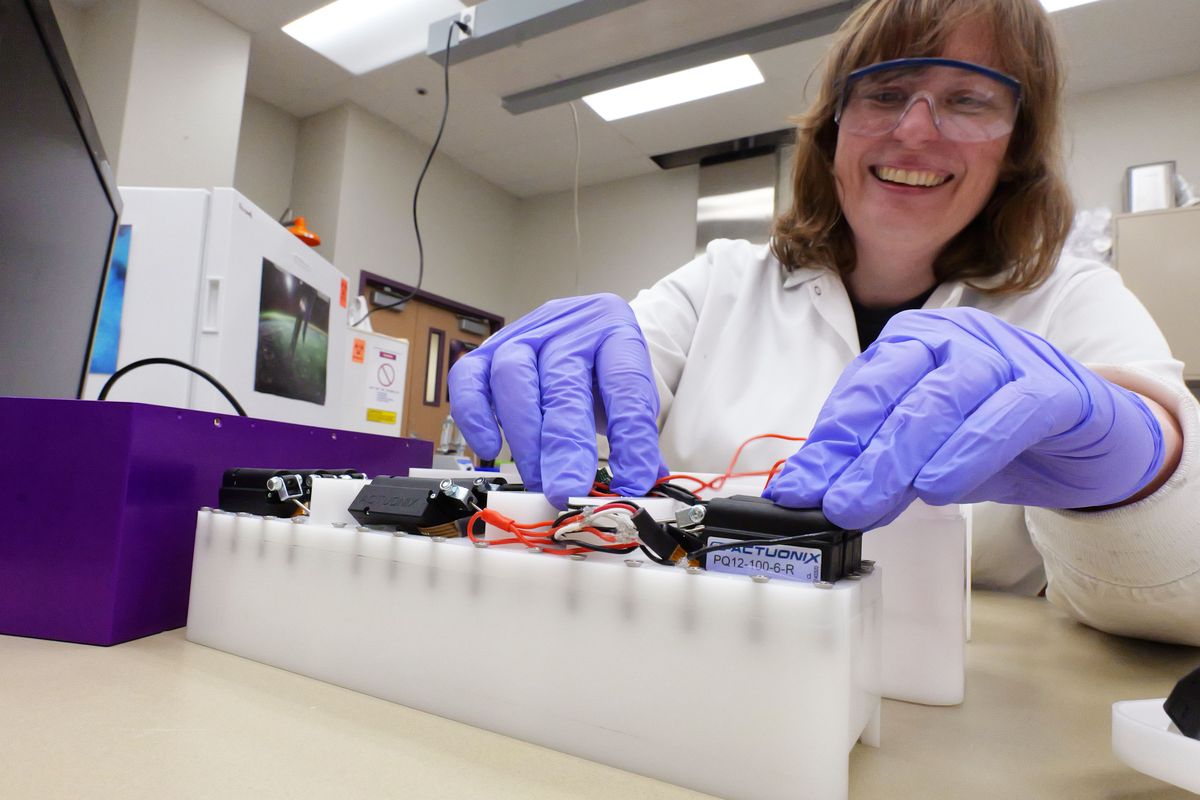
Adrienne Shea gave her 8-year-old son a launch pass from Cape Canaveral to bring to class to prove to classmates that his mom’s work was headed to the International Space Station.
On Aug. 24, Shea, a doctorate student at the University of Idaho, and Matthew Bernards, a UI professor, watched from the VIP section of a tall building at Cape Canaveral as five years of hard work blasted off into space. The experiment will remain suspended 220 miles above the Earth for 30 days in a zero-gravity environment.
Bernards and Shea’s project, nicknamed Vandal Voyager II, centers on eliminating bacteria adhesion in water systems on spacecraft.
While this experiment looks specifically at water systems aboard space vehicles, it has relevant applications on Earth. Epidemiologists from the Centers for Disease Control and Prevention estimated in 2014 that diseases spread through water in the United States caused 6,630 deaths, more than 7 million illnesses and cost the U.S. healthcare system $3.3 billion.
“We all have bacteria in our pipes, and for most of us it doesn’t matter,” Shea said, referencing what she tells her 8-year-old when he asks about her work. “But there’s some people that get sick easier, and for them it matters. So what we do is we put something inside those pipes that stops that bacteria from being in there and sticking to the pipes to help protect the people that would get sick.”
Bernards described the dimensions of their experiment as a rectangular box measuring 10-by-10-by-30 centimeters. The rectangular box, or containment chamber, houses two strains of bacteria commonly found in wastewater aboard the ISS. These strains of bacteria are automatically exposed to stainless steel samples coated in nonfouling polymers. A polymer, Bernards said, is essentially another word for a plastic, while nonfouling is a type of chemistry that prevents cells, proteins and bacteria from forming an irreversible bond and sticking to a surface. In addition, their payload also includes a controlled, stainless steel sample without any nonfouling polymer applied to compare the difference in bacteria growth.
Bernards said they refer to their nonfouling polymers as bacteria resistant because it doesn’t actually kill the bacteria. Instead it prevents bacteria from sticking and forming a colony, also known as a biofilm. But then that would mean the bacteria is still in the water system, right?
Wrong. Because all of the water aboard any spacecraft has to be recycled, as water is both heavy and expensive to move from Earth to space. Bernards believes the stringent cleaning process should remove any bacteria still suspended in the water.
“It goes through filtration steps, because they capture all of the urine from all of the astronauts and feed that into the purification system,” Bernards said. “They capture the condensate from breathing and feed that into the purification system because they want to minimize the amount of water that they have to send up to space.”
The reason why Bernards refers to this project as Vandal Voyager II is because it’s the second iteration of an experiment aimed at eliminating bacteria adhesion in space.
The first version, or Vandal Voyager I, focused on testing polymer coatings on surfaces astronauts commonly interact with, like railings and door handles. This experiment was funded by NASA’s Student Payload Opportunity with Citizen Science program and launched in December 2021.
As part of the “Citizen Science” aspect of this project, third- to fifth -grade students at J. Russell Elementary School in Moscow were given experiment kits with two random polymers, cotton swabs, a control surface and a nutrient broth to encourage bacteria growth. Then they identified which of the polymers were best at preventing bacteria development. After that, it was up to undergraduate students at the University of Idaho to design a research container to see if the polymers performed in space as well as they did on Earth.
“It’s not to discount the potential for bacteria from skin contact, but in communication with multiple astronauts and NASA, they feel that they’ve got a pretty good handle on that one,” Bernards said. “They can send up bleach wipes or something similar, and really wipe down and clean surfaces like we do in our homes. But they don’t really have a great solution for the bacteria that grows in the water processing system.”
Bernards said there is a prominent hypothesis that bacteria grows better in space than on Earth, because of the reduced gravity environment. But this isn’t a proven fact yet.
The biggest challenge for Vandal Voyager II, Bernards said, was designing the coating technique to bond a uniform, polymer coating to the metallic substrate to ensure their chemistry didn’t fail. This task was assigned to Shea to try and figure out. Shea said her first year working on the project was complete confusion and that the learning curve was quite steep.
Trichlorosilane is the chemical Shea ended up using to treat the steel to make the polymers stick. But researchers before her used a different material that wasn’t nearly as effective, which meant she had to spend considerable time figuring out what chemical worked best for what she was trying to do.
Shea, 41, said she’s not a traditional student. In the past, she worked a variety of different jobs but was never able to “get ahead.” While being a single mother of two kids, one of them only a couple of months old at the time, Shea decided it was time to go back to school. She completed her undergraduate degree in mechanical engineering from Purdue University in Indianapolis, Indiana, in just three years. While at Purdue, Shea said there were multiple instances where she felt dismissed by her peers because she was a woman. In fact, she was the only woman in her entire graduating class of about 50.
After graduating from Purdue University, she went straight for her doctorate at the University of Idaho. Shea said her experience at Idaho was night and day from her time at Purdue.
Shea got multiple offers from different schools, but it was ultimately Bernards, someone she refers to as an outstanding mentor, who gave her an offer she couldn’t refuse.
“You throw NASA out there and right away the competition falls away,” Shea said.
Shea will finish her Ph.D. remotely in spring 2026. Recently, she got a job at the yogurt company, Chobani, in Twin Falls, Idaho, where she’ll be working as a chemical engineer. Shea, who said she’s all about water, said she won’t be working on actually producing yogurt. Rather she’ll be working behind the scenes with their different water systems and their waste treatment system.
After doing an internship with Chobani over the summer, she doubts she’ll ever be bored and said the work she’ll be doing is much more complex than one might initially think. Plus, Shea said, she’ll get to stay in Idaho, which is a huge plus for her and her family. Her new job in Twin Falls is about four hours from the University of Idaho. Regardless of how far away she may be, Shea said the university will always hold a special place in her heart.
Two years ago her daughter had to be flown by helicopter to Spokane as a result of a severe illness. UI paid the bill.
“They took care of everything, down to making sure I had extra finances to help offset because her hospital bills were $10,000,” Shea said. “I mean, everything. They completely rallied behind me. So I cannot speak highly enough of all the things they’ve done for me during my time here.”