
An inside look into STA’s new double-decker buses as drivers prep for roll out
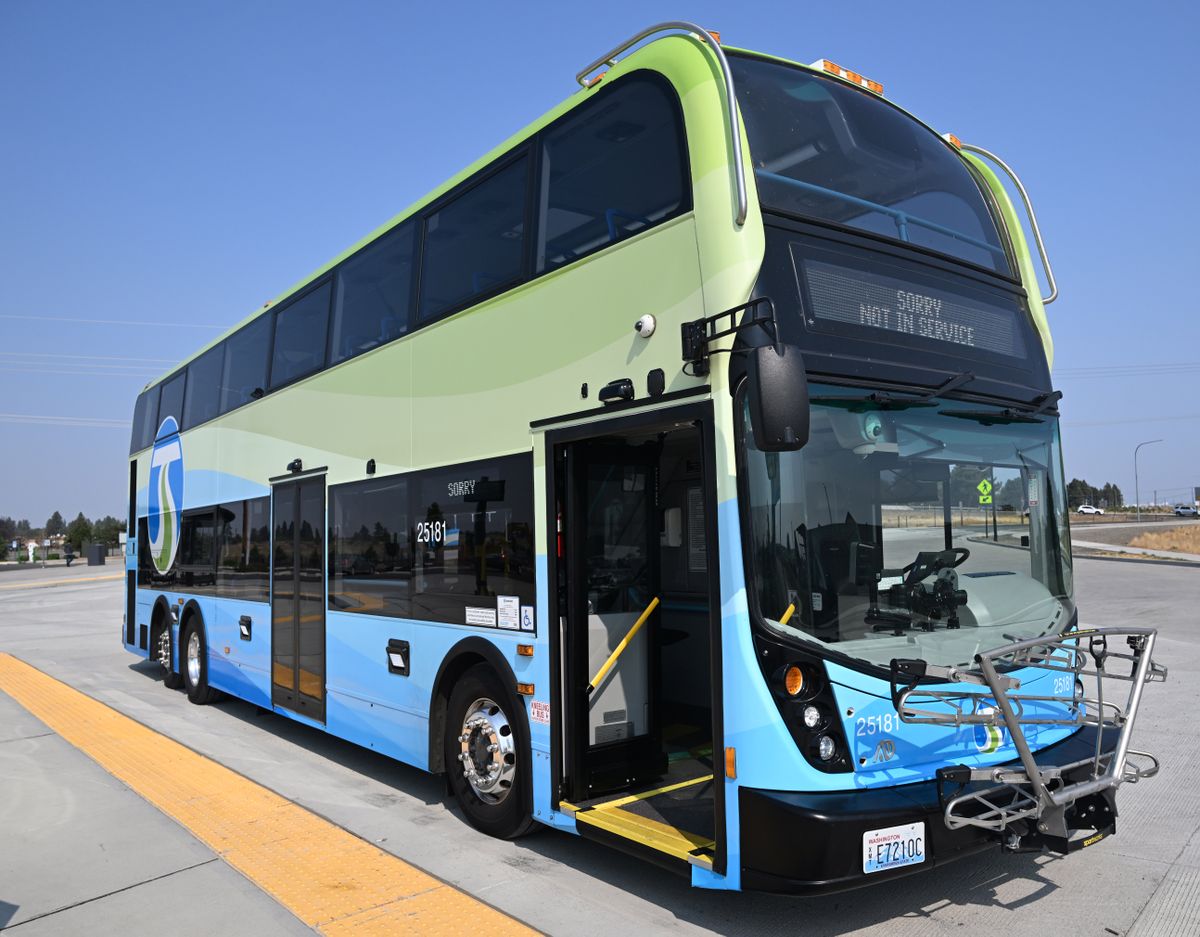
No, you aren’t seeing double – or maybe you are, if you’re looking at one of Spokane Transit Authority’s new double-decker buses cruising down the interstate.
Standing at 13½ feet tall, the new buses will be opening doors to the public at noon Sept. 20 with a ribbon-cutting ceremony at Cheney’s Eagle Station .
“I’m ready to share this with our entire community and our region, and I think that’s kind of what everyone else says as well,” STA Spokeswoman Carly Cortright said. “And you still see it when we’re doing the testing, people see them drive through downtown and people are always like, ‘Oh, look,’ – you can hear them on the sidewalks – ‘Oh, look, it’s one of the double-deckers.’”
The first two buses arrived in Spokane just in time for last Christmas. Now armed with a full seven-bus fleet, driving instructors are in the process of training over 300 STA coach drivers how to operate the vehicles.
Instructor Paul Hoffman has been with the Spokane Transit Authority for 34 years. Before that, he drove trucks for the Army for five years, bringing him to 39 years of professional driving experience – if you don’t count “farm vehicles and the usual kid stuff.” He said that there is “no comparison whatsoever” between the double-deckers and other buses.
“The accordion buses used to be my favorite bus. And, like, I talked to all the drivers, we have all established our favorite vehicles in the fleet, and when you pin in for your work in the morning, you see that bus and you’re like, ‘Yes! It’s going to be a good day,’” Hoffman said Wednesday between training drivers. “This vehicle right here started four years ago at the bottom of my heap and is now my absolute all-time favorite bus by far. It is at the absolute pinnacle of my heap.”
Hoffman rattled off feature after feature of the buses – docking lights that illuminate nighttime turns, a coolant quick-check button, the IL-6 Cummins motor offering up to 380 horsepower.
Each seat has its own airplane-style overhead vent, light and stop-request button. Over 275 vents throughout the vehicle make for a climate control system “unlike anything I’ve ever seen,” Hoffman said.
Even as far as driver comfort goes, the buses are next level, with fully adjustable seats; top, bottom and stairwell coach cameras; and 12 personal cooling fans. Hoffman said that all the operators are “gaga” over the front visor being switch controlled, rather than manual.
“The cockpit is laid out very, very thoughtfully and tastefully for the operator. Everything is within reach,” Hoffman said, bringing the fabric visor down with the press of a button. “As a matter of fact, I joke with my drivers, if you can’t get comfortable on this bus, you need a physical. There’s something wrong with you.”
The buses are the only ones on the fleet for which Hoffman has seen a 100% driver satisfaction rate.
Despite the gleaming pedestal Hoffman has built beneath the double-deckers, he, like many Spokane residents, began as a skeptic.
“About four or five years ago, when ‘double-decker’ was first whispered in my ear, I was an immediate naysayer,” he said. “Matter of fact, to be candid, my first response was, ‘Have you lost all of your mind? Because have you driven downtown? Have you seen the bridge clearances?‘ I immediately went to the negatives.”
His first time driving, though, “all the qualms that I had about the operation of the bus just gently fell away, because the bus just performed.”
Running strictly on routes 6 and 66 to Cheney, the buses only have to squeeze under the Jefferson Street viaduct – which is hardly a squeeze at all. The West Plains Transit Center along the way had to have the surface concrete raised to account for the buses’ tail swing, trees along the route had to be trimmed and an Avista powerline near Washington State University’s Spokane satellite had to be raised to accommodate the buses.
The bus has held up well in top-heavy and high-wind situations during trainings, Hoffman said – both of which he initially worried could cause tipping.
“Whatever they did in the suspension on this bus, they sprinkled magic fairy dust somewhere,” he said. “And they found the Goldilocks area between it’s soft enough to give you an outstanding ride quality, but it’s stiff enough to handle that surefootedness, and it takes care of all that lean and metronome effect and all of that.”
His final reservation concerns driving in the snow, though the vehicle’s heavy weight and permanently lowered, air-brake-equipped tag axle should provide additional traction in inclement weather.
“I came from Missouri, so I’m from the ‘show me’ state. You gotta show me,” he said, adding that he knows senior drivers using the same bus in other locations like it. “So we’ll see here, we’ll see. But I’m about 80% there that it’s going to do well.”
A double-decker driver in training, Jeff McCauley, said that after his 25 years at STA, he anticipates the new vehicles will do better in the snow than the articulated buses.
“If you’re pushing something that flexes in the snow, when you take a turn and maneuver – you know, we’ve lost them all over the place just coming up and down the street,” he said. “They just get stuck all the time, so hopefully these things will be a lot better. And I think they will.”
STA has partnered with Eastern Washington University for the Sept. 20 rollout day, which corresponds with the university’s first home football game of the season. While the bus will ordinarily come by every half-hour, it will switch to 15-minute service between 2 p.m. and 4 p.m. to get people into town for the 4 p.m. kickoff and then again from 7 p.m. to 8 p.m. to take them home after the game.
To incentivize game-goers to take the bus, STA spokeswoman Cortright said that riders that day are in for an EWU-STA cross-branded promotional gift. While she couldn’t share what the item is, she said that it will be “somewhat sports-related” and can be used “in any situation,” including for camping and sports games.
Though the increased capacity of the new buses was the main reason for the new fleet, Cortright compared the local culture surrounding the Spokane-Cheney bus route with that of Spokane’s Lilac Parade, saying that many people, even if they don’t ride the route now, have done so in the past or have kids who do now.
”That special bond we have with Eastern Washington University and that long partnership there as well – we’re really excited to share this opening day with them next Saturday,” Cortright said.