
Empathy, professionalism, and ADHD: Spokane Municipal Court election gets personal
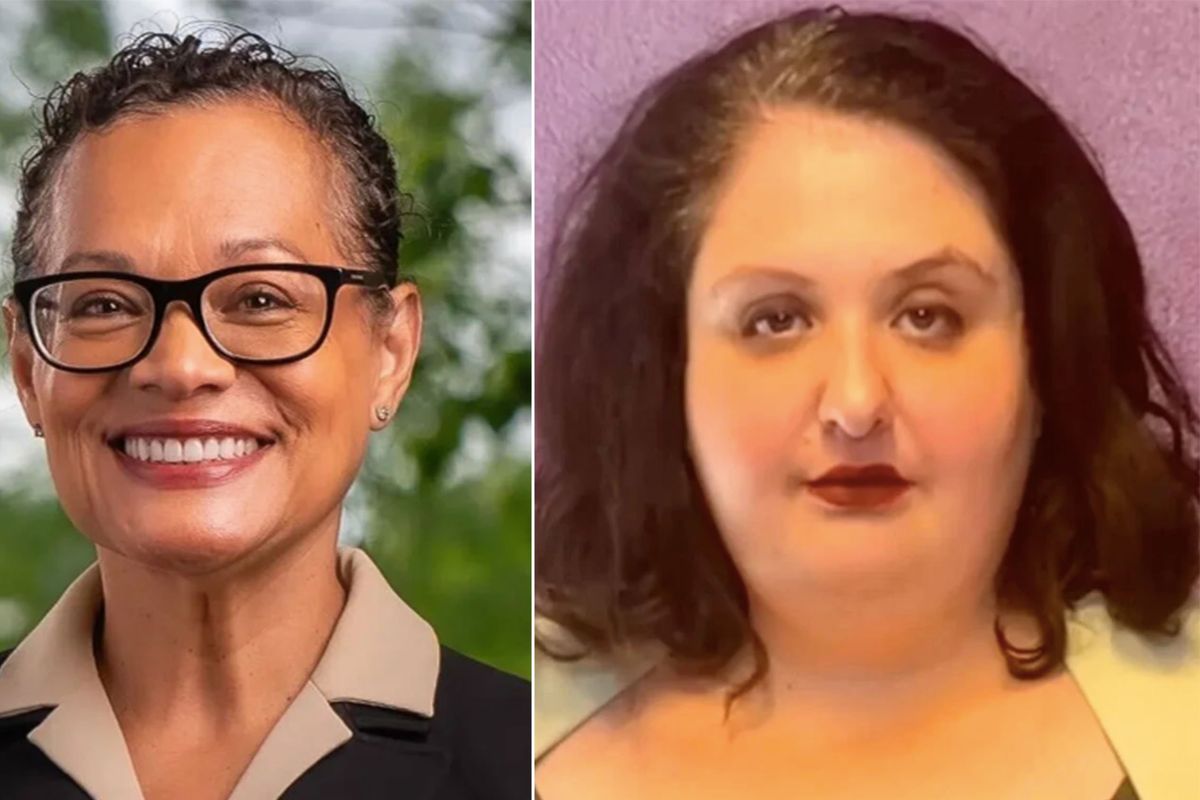
A challenger seeking to unseat a Spokane Municipal Court judge believes the incumbent lacks professionalism or professional empathy for the defendants and victims that pass through her court, accusations the incumbent argues are misguided or confusing.
Municipal judges handle cases based on city laws, which include misdemeanor criminal cases and traffic infractions, among other duties.
Gloria Ochoa-Bruck has served on the municipal court bench since 2021, after she defeated the incumbent Matthew Antush in an election. She previously served briefly as senior director of inclusion and diversity for the Kalispel Tribal Economic Authority and as a judge for the Kalispel Tribal Court, and before that worked for six years as the director of local government and multicultural affairs for the city of Spokane under then-Mayor David Condon.
Defense attorney Sarah Freedman, who previously briefly worked as a prosecutor under former County Prosecutor Larry Haskell “before I learned better,” points to both personal experiences and broader discontent from others in the local legal system as motivation for running against Ochoa-Bruck, arguing the court needs a change in leadership.
She noted a speech that Ochoa-Bruck had given at a Washington Leadership Institute presentation, claiming that the judge had said she once struggled to empathize with a defendant Ochoa-Bruck had represented. Empathy should come naturally to a judge, Freedman argued, and was not something with which Freedman struggled as a public defender or before that as a prosecutor.
Ochoa-Bruck said she did not recall making any statement along those lines and said it was “hurtful” to be accused of lacking empathy, tearing up as she responded.
Freedman pointed to a particularly personal incident as another example of the courtroom behavior that spurred her to run for the seat.
She had been asked to come on to a case in Ochoa-Bruck’s court as co-counsel to assist with striking potential jurors ahead of a trial. The judge removed the jurors from the courtroom for a part of the striking process, which Freedman said she had never seen in her time as an attorney. Ochoa-Bruck said judges can choose to remove the jury or allow them to stay, but that she consistently removed them during her time on the bench.
Freedman requested the jury be brought back in, saying she had ADHD and would struggle to attach faces to jury numbers. In an interview, Freedman said she felt disrespected and dismissed by Ochoa-Bruck,
Without prompting, Freedman pulled out her phone during an interview with The Spokesman -Review and flashed her prescription schedule to prove she has been diagnosed with ADHD. She’s used to being questioned about this, she said, because Ochoa-Bruck has told people that Freedman was self-diagnosed and angry about not receiving accommodations for which she did not go through the proper steps.
In an initial interview with The Spokesman-Review, Ochoa-Bruck said exactly this.
“I have a transcript where it clearly says ‘undiagnosed ADHD,’ ” Ochoa-Bruck said. “As we know, you have to first have a diagnosis, and then you ask for an accommodation. And this was a situation that is being blown out of proportion, where on the record, they stated they were undiagnosed.”
The transcript from this hearing does indicate Freedman said this. The transcript, however, is incorrect, due to what appears to be a scrivener’s error.
A recording shows Freedman disclosed her diagnosis and offered to share her providers with Ochoa-Bruck; the judge then turned to Freedman’s co-counsel and asked if he also had a diagnosis of ADHD, preventing him from moving forward with jury striking if Freedman was incapable. The co-counsel said he did not have a diagnosis, though he insisted that the accommodation was necessary because Freedman had been brought on to be in charge of jury striking.
Freedman said Ochoa-Bruck should know better, due to a later hearing in which Freedman said she pointed to the reluctance to accommodate her disability as evidence that the judge could not fairly preside over Freedman’s clients. She believes Ochoa-Bruck has been knowingly misrepresenting her opponent in an attempt to cast her in a bad light.
Pointed to the scrivener’s error in a follow-up interview, Ochoa-Bruck still insisted that Freedman had not gone through the proper steps to request an accommodation, noting Freedman had not formally requested an accommodation. Freedman argued she would not normally need one, but she had never seen a judge remove the jury pool in that way.
Ochoa-Bruck added that accessibility in courtrooms is important to her broadly, noting that English is her second language and that she serves on the state Supreme Court’s Disability Justice Task Force.
But Freedman argued the refusal to accommodate her disability, potentially impacting her client’s ability to be adequately represented, is part of a broader pattern of the incumbent refusing to learn or adopt courtroom norms and harming defendants as a result.
She is not the first to cast the accusation. Starting in October 2023, the Spokane public defender’s office began filing hundreds of motions to remove cases initially assigned to Ochoa-Bruck, at first without publicly providing any reason.
Both at the time and in a recent interview, Ochoa-Bruck argued the motions were personal attacks meant to undermine her. She was a relative outsider to the Spokane legal landscape when she won her election, unseating an incumbent who had not only come up through the public defender’s office, but was the brother of Public Defender Nicholas Antush.
“I’m the first outsider, and I did run against an appointee that came from the public defender’s office,” Ochoa-Bruck said in an interview. “And I came in, and I had practiced in 14 different jurisdictions, and I do things differently. And this was a weaponization of the affidavit process. … It was a political weaponization of that process.”
The public defender’s office did not respond to multiple requests for comment or clarification for this story. But at least one person who worked closely with Ochoa-Bruck concurred with the concerns raised by the public defender’s office.
Kayelee Alexander worked as a clerk assigned to Ochoa-Bruck’s court until she quit in 2023, and told The Spokesman-Review that the judge lacked empathy for defendants, regularly made technical mistakes that caused people to stay in jail longer than they should have, and argued she was uninterested in learning from those mistakes.
Last May, six months after the motions began, the public defender’s office was forced to begin providing specific reasons for the disqualification. In those motions, the attorneys alleged Ochoa-Bruck was unable or unwilling to follow courtroom norms that help low-level criminal defendants resolve their cases and had made false statements to the public about their blanket disqualification of the judge.
Antush added in a statement at the time that Ochoa-Bruck doesn’t manage cases properly.
“The protection of the rights of our clients, the underserved population in our community, is an important calling. It is not easy to stand up against a system that can be unwilling to listen and to learn,” Antush wrote last May. “Our lawyers’ sole concerns are for the rights of and fairness to our clients and so we must act to protect those.”
Ochoa-Bruck acknowledged some errors at the time. For instance, she had more than once made clerical changes to finalized orders already signed by all parties and sent them to the clerk’s office – but not to the attorneys involved in the case.
Ochoa-Bruck said at the time that she was unaware that the clerk’s office wasn’t passing those corrected orders along and said she would ensure they were in the future.
On another occasion, Ochoa-Bruck accepted a plea agreement but failed to enter it or accurately generate a judgment and sentence form, which led to a warrant being issued on a closed case, he said.
But broadly, Ochoa-Bruck noted that the public defender’s office had begun to remove her from all cases before ever meeting with her to discuss their concerns. She also later argued that their concerns seemed to regularly shift and were otherwise overblown.
“I truly do care about doing good work that makes a positive difference in the lives that come before the Court, their families, and our community,” she wrote to the public defender’s office at the time. “Regardless of how things continue to proceed, I will continue to treat all parties with the utmost professionalism and respect and be fair and consistent with all those that come before the Court.”
Antush said in his statement additional issues were neither discussed in the meeting nor mentioned in Ochoa-Bruck’s email. One is that Ochoa-Bruck did an independent investigation into a pending case and routinely failed to follow plea negotiations. He also said attorneys perceive she is biased against homeless people, that she asks clients incriminating questions and that she lacks awareness of court mechanisms to ensure a speedy trial.
There were numerous other specific concerns raised at the time, including with how she handled no-contact orders, such as those involving domestic violence.
This has become one of Freedman’s campaign pillars.
“We plan on respecting the self-advocacy of domestic violence victims who ask the court for criminal protection orders to be modified or terminated,” Freedman states on her campaign website. “By not respecting the wishes of the victims in criminal cases, we are decreasing their safety and not allowing them a voice in the process. We are not making them safer; we are simply clogging the system unnecessarily.”
Ochoa-Bruck argues domestic violence cases can be incredibly tricky to navigate and that the consequences for a misstep can be fatal. She pointed to the case of Fatimah Alghazwi, who had asked Ochoa-Bruck to terminate a no-contact order against her ex, Jean P. Kirkpatrick, which Ochoa-Bruck declined. That no-contact order was later lifted by another judge, and within weeks, Alghazwi was killed.
“And these are not isolated incidences, unfortunately, with domestic violence,” Ochoa-Bruck said. “These cases can be a tinderbox, and I am very, very thoughtful to only recall no-contact orders when it is appropriate.”
Ochoa-Bruck believes she has served the people who have passed through her courtroom well, and discounts Freedman’s campaign as personally motivated and lacking much of a platform.
Ochoa-Bruck has a wall of endorsements from judges at nearly every level of the legal system in Washington state, including seven Spokane County Superior Court judges, five Spokane District Court judges, a state Supreme Court justice. She is also endorsed by the Spokane Regional Labor Council and the Northeast Washington – North Idaho Building and Construction Trades union.
Freedman is endorsed by dozens of local attorneys, the local branch of the International Association of Machinists and Aerospace Workers, and, somewhat unusually, both the Spokane County Democrats and the 6th Legislative District Democrats. Judicial positions are elected, but nonpartisan.
Ochoa-Bruck has raised roughly $32,000 for her re-election campaign, of which more than $10,000 came from her own pocket and around $7,500 are loans made to her campaign. Other top donors include Jerry Dicker, owner of GVD Commercial Properties, Patsy Clark, LLC, which lent Ochoa-Bruck use of the Patsy Clark Mansion at no cost for an event, and local attorney Mary Wissink, each of which gave at least $1,200.
Freedman has comparatively struggled to raise any cash. She reports collecting less than $4,000, primarily from small-dollar donations that do not need to be itemized, and loaning her campaign another roughly $6,400.