
America and Britain were pillars of the world order. The world has changed.
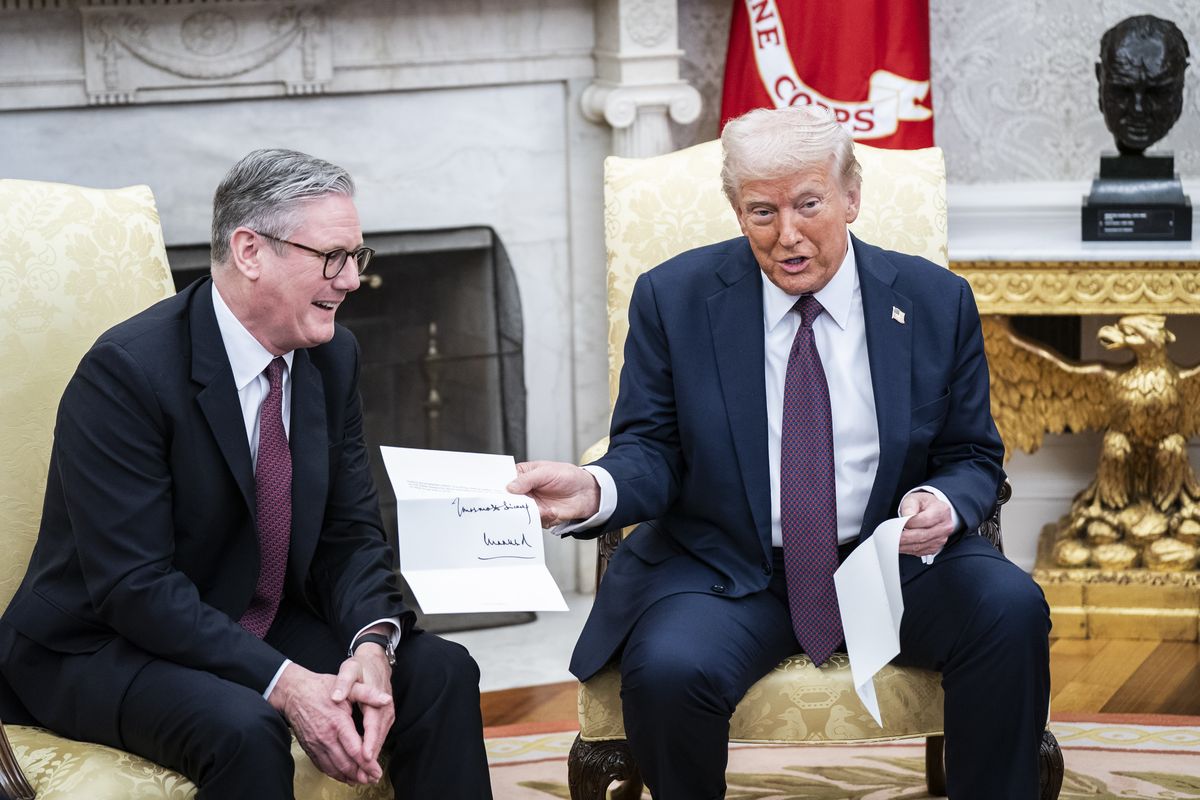
LONDON - The United States and United Kingdom were once the leaders on the global stage, the diplomatic duo tackling great crises.
Through two world wars, from Yalta to East Berlin to the Balkans, the sight of American and British leaders together signaled that a predictable order governed the affairs of nations. Self-interested, no doubt, but dependable democracies, anchored in the rule of law, whose collective power and iron will were welcome when countries were starving, freedom came under fire, or chaos claimed lives.
Now, not so much.
Donald Trump arrives Tuesday for his second state visit to the U.K. with the affairs of nations well out of his control, even more so the control of Britain’s prime minister - or its king. The pomp and pageantry of old is unlikely to reassure a world careening from crisis to crisis.
From the Middle East to the streets of Washington, from the steppes of Ukraine to the plains of Sudan, Trump’s visit is unfolding against a backdrop of global division, disarray and destruction that no amount of ceremony can mask and no historic alliance has managed to address. Trade wars, real wars, democratic backsliding, technological disruptions - some are brush fires the president is charged with setting himself, others that he seems incapable or unwilling to put out.
“I don’t think most people are putting on the kettle and thinking ‘I’m so glad they’re meeting, all is going to be well with the world,’” said Nancy Koehn, a historian of leadership at the Harvard Business School, who has written about the relationship between presidents, prime ministers and monarchs.
“I don’t think most people look at these leaders and say these are the right guys with their hands on the helm working together for the well-being of the world,” she said.
Despite Trump’s promise that he would dispatch one of the worst emergencies within a day, Russia continues to clobber Ukraine. Following a ballyhooed presidential summit in Anchorage last month that fizzled into nothing, Moscow has ramped up attacks on Ukraine and expanded its drone sorties into Poland and Romania.
Keir Starmer, the prime minister who will greet Trump at his country residence, Chequers, has led a coalition of European nations supporting Ukraine whose most urgent imperative in recent weeks has seemed to be keeping Trump onside, rather than containing the Kremlin.
Israel’s war in Gaza rages unabated, with famine declared by a U.N.-backed agency in some areas and Israeli troops renewing attacks on Gaza City. Despite Trump’s on-again, off-again efforts to broker a ceasefire, Prime Minister Benjamin Netanyahu targeted Hamas leaders in Qatar, the U.S. ally that is hosting the negotiations, apparently alerting the White House only after the attack was underway.
The strike on Doha came just under three months after Israel bombed Iran, derailing Trump’s efforts to negotiate a new nuclear deal.
Arab leaders warned Monday that Israel’s action in Qatar puts at risk the efforts to normalize ties in the region forged by the Abraham Accords from Trump’s first term. Rather than ending the conflict, Trump now faces an unraveling of his signature diplomatic achievement.
The very institutions that once provided stability - international alliances, multilateral agreements, shared democratic values - are now under strain from the same leaders who gather to celebrate them. Trump is widely seen as an agent of chaos in transatlantic relations, not so much its likely fixer.
The U.S. and Britain also have sharply divergent views on some issues. Starmer has said the U.K. will recognize a Palestinian state unless Israel meets certain conditions, which drew a rebuke from Trump that it was “rewarding Hamas.”
One thing the American and British leaders share is that they are deeply unpopular - with seemingly little benefit of being seen together.
Trump arrives with a 40 percent approval rating at home and 22 percent among the British. Starmer is mired in equally deep discontent, with only 24 percent of Britons viewing him favorably. King Charles III, who will host the visit, is just above water with a 53 percent approval rating.
Those are not the numbers that Winston Churchill, Franklin D. Roosevelt and George VI leveraged to lead the world into the fight against Adolf Hitler. (A plurality of Britons - 44 percent - told pollsters they wished the American president would stay away, vs. 40 percent who wanted this week’s meetings to proceed.)
Such disdain perhaps explains why the Trump visit will be a remarkably cloistered affair, almost entirely confined to Chequers and Windsor, far from the protests expected in central London.
Nor did 20th century leaders have to contend with social-media-age scandals swamping the carefully honed messages of their great gatherings. None of the three principals should have much hope that the diplo-theater of a royal meeting will distract viewers from the Jeffrey Epstein outrages that have affected all three.
Trump faces anger among his own base over his decision to not release Justice Department files on the convicted sex offender. The king’s brother, Prince Andrew, was exiled from public view over his connections to Epstein. And Starmer last week sacked his ambassador to Washington, Peter Mandelson, on the eve of the state visit after Bloomberg and The Sun newspaper published supportive emails Mandelson sent to Epstein even after he pleaded guilty to soliciting a minor for prostitution. Both Prince Andrew and Mandelson have said they “regret” their connection to Epstein.
“This week will see President Trump undertake a second state visit to the U.K. - a significant diplomatic event that we are now navigating without an ambassador,” lawmaker Emily Thornberry, the chair of a top House of Commons committee, said in statement Monday calling for an emergency inquiry into how Mandelson was appointed in the first place. “The public deserve answers as to why we have been left in this difficult position.”
If grand staging could once transform politicians into statesmen and meetings into history, the fractured media environment has now made such events easy to miss entirely, said David Reynolds, emeritus professor of international history at Cambridge University.
A world embroiled in the Cold War may have been glued to a Reagan and Mikhail Gorbachev summit in Reykjavik, but this week’s presidential carriage ride will largely go unnoticed unless it makes into enough Instagram and TikTok feeds.
“In the second half of the 20th Century, if you grabbed the big TV and radio outlets, the three main channels in the U.S. and the BBC here, you were getting a huge part of the population,” Reynolds said. “Now they won’t even see it. Politicians reach their audiences directly now.”
But nothing has disrupted the norms of diplomatic gatherings more than Trump himself. The president routinely reverses his own positions after the fact, draining communiqués and statements of their value as reflecting fixed, reliable positions. A Washington Post analysis in August showed that Trump had flipped his public stands on the Ukraine war 19 times and counting.
“That kind of yo-yo decision-making has no parallel in modern geopolitical history,” said Koehn, the leadership historian. “There were important conferences where important issues were discussed and decided that were not overturned a day later because [Joseph] Stalin had a bad hair day or saw his new poll numbers.”
Trump also bypasses the usual advance work that traditionally underpins the results of formal meetings, talks that can take weeks to perfect tone, details and agreed-upon outcomes. The sides expect this visit to produce carefully negotiated tech and energy agreements. But thornier issues, such as the final status of U.S. tariffs on British steel and pharmaceuticals, are still up to Trump.
“They hope they are in a good position to get the president on side, but he is the one who is going to decide when he is ready, not his team of very good people,” said a diplomat in London familiar with the talks who spoke on the condition of anonymity to describe sensitive deliberations.
Trump often prefers to make snap decisions or rely on trusted, if ill-prepared, emissaries from his business life rather than seasoned diplomats. Steve Witkoff, the New York property developer who serves as Trump’s envoy for Middle East and Ukraine issues, was blamed by many diplomatic observers for being outmaneuvered by Russian President Vladimir Putin at the Anchorage summit.
“In the past when you had these big negotiations, the sherpas would have already worked out things out and drafted a communiqué you could rely on,” said Kathleen Burk, emeritus professor of modern and contemporary history at University College London, referring to the advisers who prepare summits.
“These sorts of occasions have changed,” Burk said, “because now there is only one man that matters. Not even one country that matters, but one very unpredictable man.”