
‘Our last and best hope’: Deer Park School District asks voters for $14.5M levy to replace aging bus barn, acquire land and other projects

Deer Park School District’s bus barn wasn’t built to store any buses, let alone to maintain a fleet of three dozen.
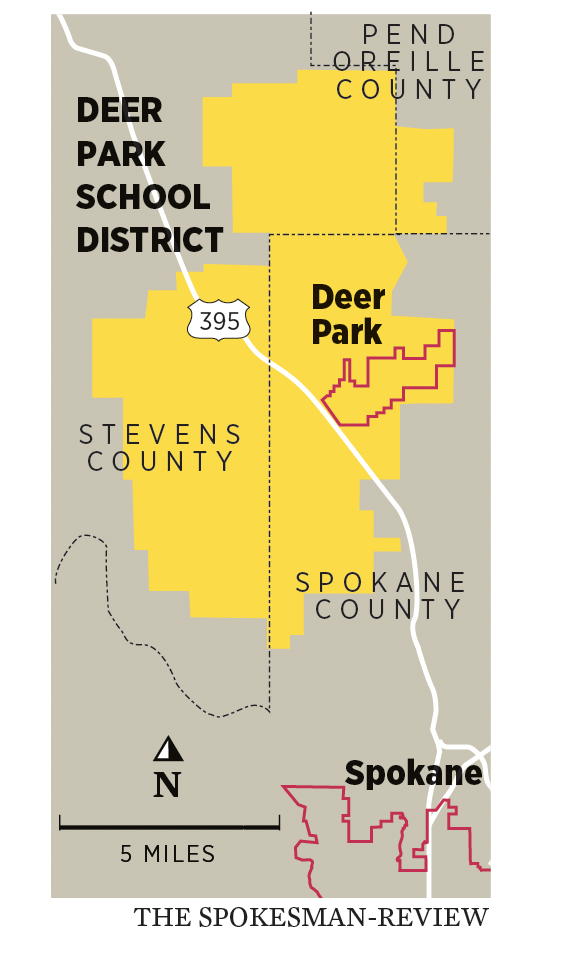
Residents of Deer Park School District will soon vote on a $14.6 million capital levy collected over four years to improve safety, acquire land and address aging facilities in the district, including the transportation center.
If passed, the levy would cost taxpayers an estimated $1.45 per $1,000 of assessed property value, replacing the previous bond that sat at $1.03. This would translate to an increase of about $168 per year for a home valued at $400,000.
Over half of the projected $14.6 million raised from the levy would go toward the transportation center in Deer Park, next to Mix Park.
Kerri Leliefeld, the Deer Park’s transportation director, started first as a bus driver in 1996. She said since she started, the district has added about 10 buses, taking the fleet to 36, to keep up with the growing population in Deer Park – a trend that doesn’t seem to be slowing down.
In 2025, Deer Park had a population of 5,226 compared to 4,405 in 2020. That represents an 18.6% population increase.
Asked why Leliefeld continues to work in her role after nearly 30 years, her answer was a simple yet resounding: “I just love the big, yellow bus.”
Leliefeld works along with 40 other employees, including 26 bus drivers, an assistant and a couple of mechanics at a facility that used to be an old lumber mill. The building is nearly 100 years old. The 2.2-acre property was bought by the district for dollar in the 1970s and was converted into the bus garage.
Today, the facility includes a six-bay garage for mechanics to work on buses, a covered carport for four SUVs, a backhoe, an office for Leliefeld and her assistant, a break room, two restrooms, 36 buses, some storage space, and an area for employees to park their personal vehicles.
The space available, or lack thereof, in the gravel parking lot of the transportation center, 4729 W. Spring Creek Road, is only exacerbated with snowfall.
“The thing is,” Leliefeld said, “we can’t fit in here.”
The nearly century-old facility can only be accessed by a pothole-ridden road that weaves its way over a creek. Expansion can not occur on the current property because the transportation center is surrounded by that creek, railroad tracks and wetlands.
During particularly snowy and rainy days, the roof of the transportation center often starts to drip. Mix that steady drip with water falling off buses along with a drain that barely works, and Leliefeld said sometimes there’s a couple of inches of water sloshing around in about a 10-by-10 foot area where mechanics should be working.
Not only does the roof of the transportation center leak, it also is so low that mechanics can’t raise a bus up if they need to work on it.
“They have figured out how to do the work,” Lelifeld said. “If they have to pull an engine and different things, they have figured it out, it’s just probably not the safest.”
In different sections inside the transportation center, insulation can be seen falling from the walls. The thin walls of the transportation center also mean that fumes and other outgases invade Leliefeld’s office and the break room when mechanics are working on buses.
A 15-to-20-foot extension was added onto the mechanic section of the transportation center years ago because buses did not fit inside the bay. Buses weren’t able to be brought in the garage and worked on without the rear of the bus or engine compartment being exposed to the elements. The addition to the bus garage was beneficial, but the strange structural design and original architecture of the old lumber mill makes accessing the buses far from ideal.
All safety meetings have to happen in the mechanic section of the bus garage, because the office and break room is too small for 40 people. Any buses inside have to be moved out of the garage. During winter time, Leliefeld said the heater makes a lot of noise, so she often finds herself talking very loudly just to be heard.
One of the main storage rooms, right next to Leliefeld’s office, is affectionately known as “the freezer” because of how cold it gets in the winter.
The confined break room outside the storage room has wires cascading everywhere to charge the tablets that contain the bus drivers’ routes. Lelifeld said they don’t have enough outlets to keep their technology adequately charged. Mix all of this, with a poor WiFi connection and the Deer Park Transportation Center looks and feels like it’s still stuck in the 1970s.
Angie McBride is a paraeducator for Deer Park HomeLink, a public alternative school mostly for homeschooled children. She’s also on the Levy Oversight Committee and plans to start dispersing “bite-size” pieces of information about the levy on social media, mostly on Facebook. She called a recent trip to the bus barn eye-opening.
She referred to the 36 buses going in and out of the 2.2-acre transportation center twice a day as similar to a game of Tetris.
“It’s just impossible,” McBride said. “So the district has this opportunity to purchase some city land at a greatly reduced market price, which would be for future needs of the district.”
As part of the proposed levy, approximately $5 million would buy and develop a 42-acre site close to Deer Park Elementary School. This location would hold the new transportation center. In the future, this 42-acre chunk of land would also ideally serve as a new elementary school. But the development of a new elementary school is not included in this year’s levy.
A property appraisal for that section of land valued that 42-acre portion of property at just over $750,000, said Steve Howard, the facilities and maintenance director for Deer Park School District. After negotiations with the city and the city council, a discounted rate of $385,000 was agreed upon. After surveys, lawyer fees and other miscellaneous expenses, Howard estimates the total cost to acquire that chunk of land would cost around $450,000. The additional $4.5 million allocated for this project comes in the form of new infrastructure.
“The part that is expensive is that we would be the first entity to develop that east D Street property, and so we would be responsible, like any private contractor, we would be responsible for developing the road and the utility infrastructure associated with the road,” Howard said.
According to the latecomers clause, future development completed within the next 10 years along that road would have to reimburse the school district an allotted amount. Howard said this portion of land is some of the only space left in Deer Park suitable for them to build school structures on. Most land in Deer Park is either about to be sold, currently being developed or not able to sustain large, commercial buildings.
In addition to purchasing new land and building a more contemporary transportation center, $1.8 million of the levy would be devoted to upgrades at Arcadia Elementary. Howard said he first started talking to the district about replacing Arcadia’s roof about 15 years ago. The roof is the original roof from 1997 and Howard said they work on repairing different parts of the roof about six or seven times per winter.
The proliferation of leaks can cause hazardous mold and mildew to grow in between walls. When leaks drip down the wall and potentially into insulation, Howard said they take the “scorched Earth” approach.
“That tends to be a very involved and very expensive process when we have a roof leak that causes that kind of damage,” Howard said. “We try to be very aggressive in our response to that, so that we’re not asking kids or any adults to spend time in a space that’s been affected.”
In addition to the roof, other upgrades to Arcadia would include replacing the old heating system with an improved design that wouldn’t allow wind-driven rain and snow to filter into the building and drip on the gym floor. Replacing worn flooring in stretches of hallways and in classrooms with a more moisture resistant vinyl composition tile and carpet is also a priority. New fencing would also be installed around the school.
In total, $7.5 million would go towards a new transportation center, $5 million would pay to buy and develop land, $1.8 million would pay for Arcadia Elementary upgrades and $300,000 would upgrade outdated intercom and emergency systems across all schools in the district.
“I do believe that if we don’t do it now,” Leliefeld said, “It’s going to be a long time waiting.”
Last year, a majority of district voters supported Deer Park’s proposed $55 million tax which would have paid for the transportation center and to build a new elementary school, but it did not meet the 60% support threshold needed to pass. Howard is hopeful that this levy, which only requires a simple 50 majority to pass will be successful.
“Deer Park hasn’t had a lot of strategic planning as a community over the years,” Howard said, “And so we find ourselves at a point where this is kind of, I think, our last and best hope for land that would be appropriate for us to use for accommodating school growth and school needs, and it would be a shame to miss that opportunity.”