How WSU WR Carter Pabst found his way from Kansas to Pullman

PULLMAN — In the visitors locker room, before Eisenhower kicked off the 2022 season, Darrin Fisher used his pregame speech to tell his players that he already had the first play drawn up. He called it six, as in six points, a deep passing play that he hoped would get the Tigers on the board right away.
In this play design, three Eisenhower receivers would run short out routes, taking their defenders with them to the sidelines. While that happened, one wideout would run a deep post route, motor past his defender and take it to the house for a touchdown.
The deep post route, Fisher explained to the team, would belong to a sophomore playing his first varsity game: Carter Pabst.
On some level, the idea might have sounded crazy. Pabst had yet to play a snap of varsity football, and besides, he was still growing into his body. Located in the Wichita area, Eisenhower competed at Kansas’ 5A level, the second-highest in the state. That meant Pabst would be matching up with solid defensive backs, the kind who might be able to match his speed.
“I was very nervous,” Pabst said. “I felt myself shaking when I was lining up.”
Instead, Pabst made his head coach look like a psychic. On the game’s first play, he jetted by his defender, hauled in the pass and cruised the rest of the way into the end zone, a 91-yard touchdown before anyone in the stands could blink. Around the area, he was hardly a name yet. With one play, he began to announce himself.
“I was like, all right, well, I don’t know about our chances in this game, so let’s try to score early, and let’s give it to our best kid,” Fisher said. “He was one we had the most confidence in, as a sophomore, to get a big, explosive play. After that, it was like, this kid’s pretty good.”
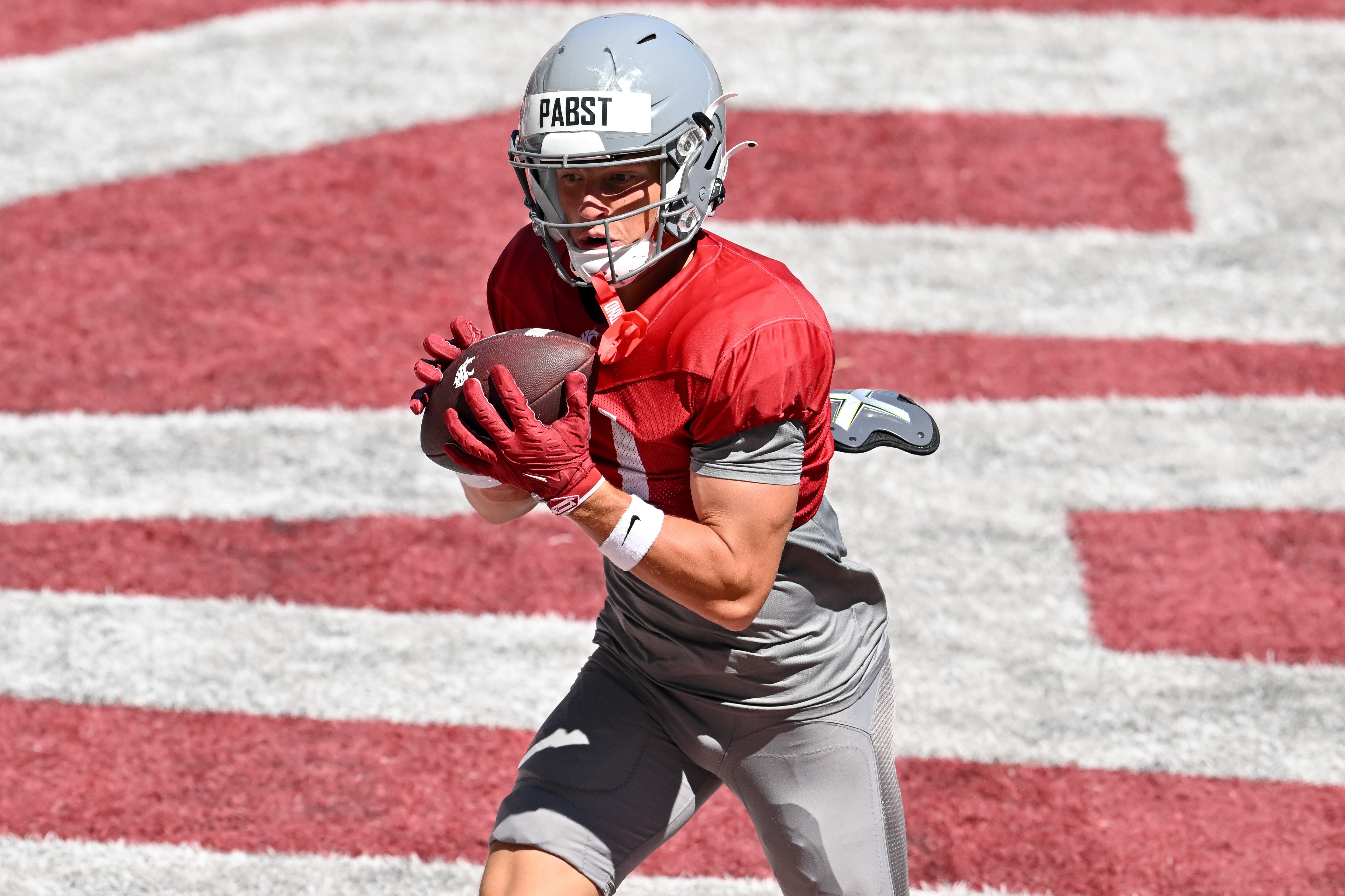
Years before making an immediate splash at Washington State, where he has already caught four passes for nearly 100 yards in his first three college games, Pabst began to pave his path to Pullman on high school fields in southern Kansas. He played baseball and basketball. He starred in all three sports, setting the state record for career touchdown receptions, with 54, plus the record for touchdowns in a single season, with 29.
Nearly 2,000 miles from home, Pabst is flourishing as a Cougar because he developed as a Tiger. The plays he has made at WSU – the 43-yard catch he hauled in last week against North Texas, the 34-yarder he hauled in against San Diego State – are the kind he made in spades back home. Even those from his background who may be surprised at how quickly he has carved out a role at WSU, his coaches from high school and youth football, are less shocked at the way he has done so.
“If I could take a lot of kids like Carter Pabst, I’d take most of them,” WSU coach Jimmy Rogers said. “His frame, his physicality, his savviness. He has a great football player. He has not afraid of competition.”
Pabst has some of the numbers. On the year, he has caught four passes for 99 yards, including three receptions for 65 yards last weekend in Texas. In total, he has played 98 snaps, including 53 on offense. In the Cougars’ season-opening win last month, he played on special teams. Since then, coaches have not been able to keep him out of the offense.
But it is not just because Pabst can catch the ball. It is also because he turns into a brick wall to clear the way for those who are.
“In high school,” Fisher said, “watching him block was almost as impressive as watching him catch and run with the ball.”
***
Not two months after Pabst scored the first touchdown of Eisenhower’s season, one of his best friends learned for himself how much more Pabst could do. Landon Kolhorst lined up to cover Pabst, expecting him to release and run a route.
“And all of a sudden he just comes up and bulldozes you,” Kolhorst said.
Kolhorst and Pabst grew up together, playing youth football from the second grade to seventh until they began middle school and attended different schools. They learned to love sports together, from football to basketball to baseball, their families intertwining along the way. They went to separate high schools, but they never separated – “still stayed connected,” Kolhorst said.
But on a fall day in 2022, when a 16-year-old Pabst delivered a crushing block on his childhood buddy in Eisenhower’s rivalry game against Goddard, Kolhorst understood how deep Pabst’s competitiveness ran. He was not expecting Pabst to throw a block, much less such a brutal one, sending him stumbling backward. “That’s when I realized how different he really was compared to everybody else growing up,” Kolhorst said.
Wherever he has gone, from youth leagues to high school to WSU, Pabst has earned his spot by wowing coaches with his devastating blocking game. In last month’s fall camp, he turned heads with several deep receptions, but he earned the opportunity by taking out defenders down the field. His coaches at every level, from Rogers to Eisenhower’s Fisher to Kyran Kolhorst, Pabst’s youth coach and Landon’s father, bring up Pabst’s blocking entirely unprompted, talking about it like Nolan Ryan’s fastball.
“I got pancaked by him plenty of times in practice,” said Colton Doll, a high school friend and teammate of Pabst’s.
“You can ask the older guys. He didn’t back down at all during fall camp,” Rogers said. “He’s one of our most physical blockers on the perimeter.”
“He wanted to block more,” Kyran Kolhorst said. “Show you what he could do from a blocking standpoint. He knew that that was just as important, if not more important, than getting open to catch that ball.”
“I feel like it’s just a want-to thing,” Pabst said. “Like, if you wanna go block, you’re gonna go do it, and if you don’t, then don’t expect to get the ball.”
It’s not the kind of thing 18-year-olds usually say, much less develop a credible track record for. Of the 26 WSU players who have a Pro Football Focus run-blocking grade, Pabst has earned the top mark, logging a grade of 74.7. Among wide receivers, that number ranks No. 50 nationwide. If it holds, it would also be the best by a Cougar wideout in three seasons.
To those who know Pabst best, it underscores the sheer competitiveness he harbors, the fire he developed as a kid. Pabst is the youngest of five siblings, including two older sisters and two older half-brothers. Growing up, he competed with sisters Mallory and Emma with everything. They chased each other around the house. They roughhoused. “The game of Monopoly was competitive,” his dad, Dan, said. “Cards were competitive.”
But because he was so much younger, Carter often found himself on the short end of the stick, losing to his siblings in all manner of competitions. “I think that has driven him to succeed,” Dan said. To his parents, Carter’s drive is partially a credit to lessons they taught him, partially a credit to the way he has stayed hungry by achieving dream after dream. To Carter himself, it is also a product of the environment he was raised in, the small-town mentality he was born into.
“We don’t have the best big, five-star DI athletes,” Carter said, “so you kinda just gotta play with more grit. You gotta learn a lot of the basics a lot better and just understand all that.”
Still, make no mistake: He has the talent to match. He was Eisenhower’s fastest receiver in his first year playing varsity football, leading the team with 496 receiving yards and six touchdowns that season. He built a reputation for reliable hands, and while he may only have four catches on six targets at WSU, he has yet to drop a pass. He might minimize his impact – “I’m just gonna execute my role, whatever that is,” he said – but the truth is he is one of the Cougs’ most promising young receivers.
The interesting part is that he wasn’t always going to take his talents to Pullman.

***
Carter was at a tattoo parlor when his phone rang and his life’s trajectory changed. He was at Wichita’s Addictions In Ink, where he was joining his sisters and mother, Christy, in getting matching tattoos: “No matter what,” an abbreviated version of the saying Christy always told her kids growing up: “I love you no matter what.” It’s tattooed in Christy’s handwriting.
“No matter what you do, good or bad,” Carter said, “she’s always gonna love you.”
It was late last winter, shortly after Rogers left South Dakota State and accepted Washington State’s head coaching job. Earlier that year, Pabst had committed to North Dakota, but he flipped to SDSU because of a coaching change in the Fighting Hawks’ program. He had grown close with SDSU’s receivers coach, Jake Menage, who had only needed to see Pabst play in one half of football before he decided to extend an offer.
When Pabst picked up the phone, he learned this: Rogers was taking several of his assistant coaches to WSU, including Menage, who wanted Pabst to come too. He admits at the time, he didn’t know much about the Cougars’ program. But he pulled out his phone and started to look up information about it. “And I was like, huh, that’s a really cool place,” Carter said.
“For Carter, it was a no brainer,” Christy added. “He committed. He liked the coaches. He believed in the coaches.”
A few days later, once Eisenhower resumed classes in January, Fisher ran into Pabst around the locker room. He had seen the news about Rogers’ move to WSU, so Fisher was curious about Pabst’s plans. Was he following him to the Cougars’ program?
Pabst had quietly given Rogers and Menage his commitment, but because he was not ready to announce it publicly, he did not want to say much. But he trusted Fisher, telling him that Rogers had asked him to follow him to WSU. So Fisher had to ask: Was he planning to do so?
“He’s like, ‘hell yes,’ ” Fisher laughed. “He was excited about it.”
Within a few months, Pabst found himself situated in Pullman, competing with the Cougars’ first-team offense in fall camp, catching passes from the quarterbacks leading the battle for starting duties. One day, after several practices, he got a text from Menage.
Menage wanted to meet with Pabst in his office, he told him. He didn’t mention the nature of the meeting, so Pabst felt a tad nervous. What did his position coach want to talk about? Was something wrong?
In fact, it was quite the opposite. Menage alerted Pabst that he would not be redshirting this season, that coaches expected to play him in more than four games. Pabst had authored an incredible fall camp, hauling in touchdowns left and right, reeling in contested catches like he was wide open. It was clear Menage and coaches felt he could do the same in game settings.
“I was definitely excited because I wanted to play as early as possible,” Pabst said, “show everyone what I can do as early as possible. So, yeah, I was definitely excited.”
Christy laughed when Carter told her that before making the decision official, they wanted him to check with his parents first, to see if they had any concerns: “What concerns would I have?” Christy said. “If they think you’re ready, then I’m gonna go with that.”

***
Christy couldn’t believe she had kept her son in the frame of her iPhone video. It was late in WSU’s loss to North Texas last weekend, and she had joined several friends and family members in making the roughly five-hour drive from Wichita to Denton, where her son led the Cougs in receiving yards, collecting 65 on three catches.
She records every play Carter is on the field, just in case the ball comes his way. In the fourth quarter, WSU quarterback Zevi Eckhaus obliged, using a touch pass to find Pabst streaking over the middle and toward the sideline. Eckhaus placed the ball in the perfect spot, and Pabst snagged it, falling out of bounds at the Mean Green 23.
One problem for Christy: Her seats were on the same side of the stadium, but because she was sitting so far away from the action, she did not have the right depth perception. To her, it looked like Carter was about to fall into the end zone.
“I was literally screaming my head off,” she laughed. “I just thought, oh my gosh, it’s gonna happen. For me to be able to see his first time on the field as a college player, his first reception as a college player, it just naturally follows – I would love to be in person for his first touchdown.”
The more he blocks, the more he pushes for playing time on offense, Pabst is giving his mom plenty of chances. He may not be the one coaches are drawing up the first play of the season for anymore, but the more the plays like he did when he was 16, he has giving himself more chances to do that too.
At least one thing is for certain: If he finds himself in that position again, he won’t be shaking when he lines up. He can only catch defenders by surprise for so long.
“Even as a sophomore, you could see the ability in him,” Fisher said. “He didn’t quite have the size and speed yet, but had all the makings of a football player, like a guy who was going to be pretty special. And he just kept getting better and better after that.”