
In the race to represent south Spokane, two council candidates ask voters what kind of Democrat they want to represent them
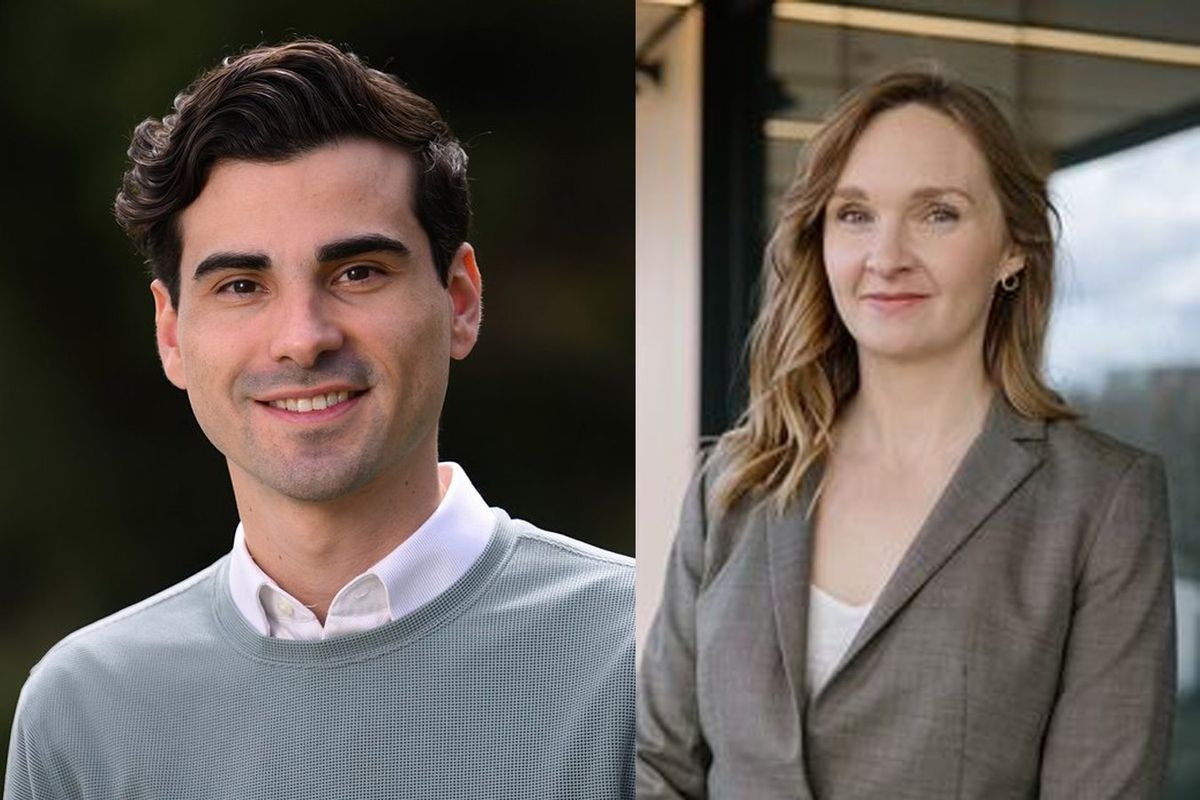
Of the three elections for the Spokane City Council this year, the race to represent the southern district is the only one where both candidates are from the same party and have the most significant policy overlap.
The race has also, at least in part, become a debate between the two candidates about what kind of Democrat the other is. Former attorney Kate Telis, closely aligned with the city’s progressive wing, has questioned SCAFCO executive Alejandro Barrientos’ Democratic bona fides and allegiance to his conservative donors; Barrientos, meanwhile, accuses Telis of being overly partisan and unwilling or unable to represent constituents on the right and in the center.
The two are competing for a seat vacated by former Councilwoman Lili Navarrete in District 2, which includes much of the city south of the Spokane River except for the downtown core. Navarrete resigned in July citing health concerns; CHAS Health Director Shelby Lambdin was appointed later that month to fill the seat until the election. The district is also represented by Councilman Paul Dillon, who was elected in 2023.
Sit both of them down for 30 minutes to talk policy, and the similarities between their goals are abundant, at least on the surface.
Both advocate for increasing resources for nonemergency personnel who can engage with the homeless and intervene in public addiction and mental health cases. Both are encouraged by the city’s recent multifamily housing development reforms – though Barrientos cautions that some, like removing requirements for builders to include parking spaces, will have unintended consequences on the neighborhoods – but both also want new policies to make it easier to build single-family housing (though Telis focuses on cheaper, smaller builds, while Barrientos talks more broadly).
Both believe progress has been slow on addressing deficient roads and other infrastructure in the Latah Valley, despite two nearly back-to-back moratoriums in that area, arguing the city needs to produce clear timetables for improving roadways and firefighting facilities. Telis argues another moratorium may be appropriate, arguing Spokane needs to weigh the potential for lawsuits from developers against the city’s liability if a natural disaster strikes the area. Barrientos is more tentative, saying he could be persuaded to support a third moratorium if the city could guarantee significant progress during that time, but he argues development and the fees the city collects may be needed to fund that infrastructure.
Both also state that downtown Spokane and some other neighborhoods continue to face public safety challenges, both real and perceived, amid lingering on-street homelessness.
It is in the candidates’ proposals on this last front where many of the starkest disagreements exist.
A centerpiece of Barrientos’ campaign has been to reinstate a 2023 voter-approved initiative that outlawed the homeless from camping within 1,000 feet of city parks, schools and child care centers, a law that effectively criminalized camping in most of the city under the auspice of protecting Spokane’s children.
In April, the state Supreme Court struck down the law on technical grounds, ruling it had overstepped the authority of local citizen initiatives, but left the door open for reintroduction by the city council. The council’s conservative minority attempted to do so, but its progressive majority instead adopted a policy promoted by Mayor Lisa Brown to outlaw camping citywide with a strong emphasis on outreach over criminal enforcement.
Barrientos has argued that the new law lacks a clear enforcement plan and argued for reinstating the voter-approved law verbatim.
“I think the (replacement) ordinance does have some good policies … but you have to understand that we’re telling people we know better and are going to do this versus what you voted for,” Barrientos said. “Whether we knew it was going to work or not, we have to adapt to what people want and communicate what works and what doesn’t to help people make something better.”
Barrientos also supports a proposal by the newly created Spokane Business Association – founded by his employer Larry Stone, who frequently has contributed to more conservative City Council candidates with an emphasis on shifting the city’s homelessness policies. The plan would shift the city’s funding from affordable housing to emergency shelters and treatment facilities.
Telis does not support reinstating the version overwhelmingly adopted by voters two years ago, arguing it “lacked clarity and enforceability” and did too little to connect people with services.
As the Trump administration emphasizes the role of involuntary detention and treatment for responding to chronic homelessness, addiction and mental illness – a call taken up by some local officials – both candidates described this tactic as a “last resort” but discussed the approach slightly differently. Telis urged caution that the government doesn’t infringe on civil rights, arguing that an expansion of involuntary treatment without a commensurate increase in treatment services “risks cycling people through institutions instead of helping them heal”; Barrientos also wants to expand other services, but argues involuntary treatment or jail would be appropriate “when someone refuses all support and continues to pose a risk …”
Both candidates maintain that enforcement and outreach are necessary, though Barrientos gives more weight to the impacts of homelessness and drug use on the wider public and is more emphatic about the use of law enforcement than Telis. When asked why he was motivated to run for office, he recalls his young child finding a used piece of foil on the Big Red Wagon and the fear he felt as a parent. Telis argues long -term improvements are most dependent on “trying to make the offers for service and help as desirable and appealing as possible, and that’s often not going to come from being offered services by a police officer.”
Two shades of blue
Two Democrats vying for election in the city’s bluest district, the pair have accused each other of being the wrong kind of Democrat for the city council.
Barrientos has struggled to attract the endorsements of local Democrats; the Spokane County Democratic Party has endorsed Telis, for instance, as have the lion’s share of local Democratic politicians.
Telis has pointed to Barrientos’ donors, many of whom are supporting Republicans running for office in the city’s other two council districts this year, including Barrientos’ employer, Stone, a developer and owner of SCAFCO who has spent more in recent years fighting Spokane’s progressive candidates and policies than perhaps any other donor – spending upwards of $250,000 in 2023 alone.
At a recent candidate forum hosted by Range Media, Telis directly questioned whether Stone would intervene to sway Barrientos’ votes on the city council. Barrientos, asked by host and reporter Erin Sellers if he would leave SCAFCO if elected, said he would not, but planned to donate his city council salary to charity if elected. The standard council positions have an annual salary of around $50,000; Barrientos reports a salary from SCAFCO of more than $200,000 in candidate filings.
Barrientos has asserted that Stone’s politics are more nuanced than has been portrayed in the media, and in any case, “he would (not) ask for me to do something that is outside of his character.”
“He’s probably the most ethical person that I know when it comes to my professional career,” Barrientos added at the forum.
Barrientos also said he believes that when voters meet him, they will know that he is a sincere believer in Democratic values, emphasizing his support for immigrants, among other social issues championed by the party. He suggested his support for local business interests doesn’t, or at least shouldn’t, position him in opposition to the Democratic Party in Spokane.
“It’s clear to me that when businesses thrive, the economy thrives and the community thrives,” he said in an interview. “And then we can have other initiatives we can work on, because we have the tax revenue to work on those.”
Telis, meanwhile, appears unwilling to meet with businesses and constituents who aren’t on the political left, Barrientos insisted. He noted her absence from a recent forum put on by the Spokane Business Association and her pending appearance at a “Leftist Town Hall” organized by the local Communist and Socialist parties alongside northeast Spokane council candidate Sarah Dixit.
“From my perspective, what she’s presented this whole time is she’s not willing to work with everybody,” Barrientos said. “I’ve made an effort to meet with her supporters, and everyone, on the left, conservatives, business owners, mental health providers …”
Except Telis will not appear at the Leftist Town Hall, she said in a Friday interview.
“That was posed to me as something far different than what it turned out to be,” Telis said. “Their questions are very fair, and I’m submitting my answers in writing, but the way the poster was portrayed was very different that it was originally suggested to me.”
She said she believed the event would be hosted by a wider variety of political groups on the left or left-leaning.
Michael Doyle, an organizer with the Spokane chapter of the Communist Party of the United States of America, disputes that Telis was misled. He shared a screenshot of an invitation that said the event would be organized by the local Communist and Socialist parties and “potentially (the League of Women Voters).”
“I feel like she might have been encouraged to push some of the details in a more favorable-sounding way for her,” Doyle said. “After the League of Women Voters told me they didn’t want to be involved, we had a poster made and I sent it to her, and she said it looked great.”
“I’m disappointed. I’ll say that,” he added.