
The century-old search for Maryland’s biggest trees
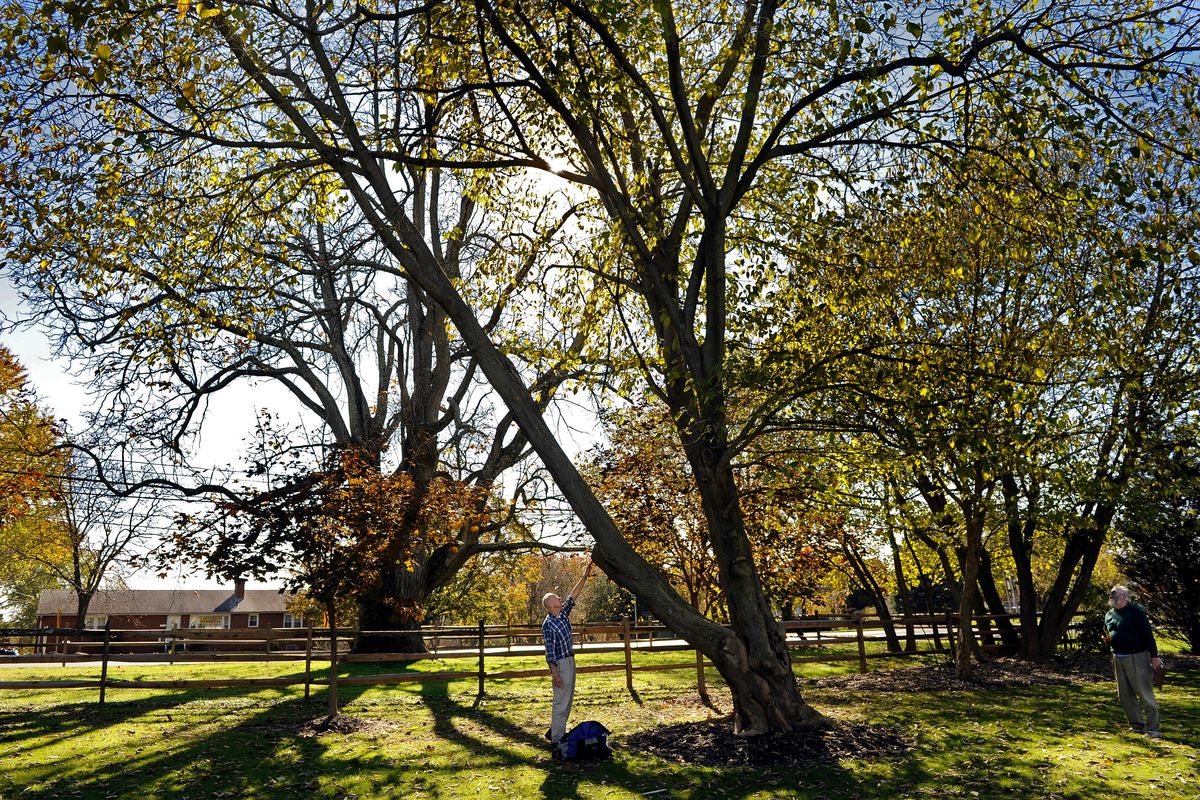
A hundred years ago, Maryland’s first state forester, Fred Besley, issued a challenge to residents: Go out in the woods and find the biggest tree you can. Then collect its measurements and send them to Annapolis, along with directions on how to find the tree. Whoever found the biggest tree would win $25.
The competition, which newspapers called the “Tree Contest,” ran from April to July 1925 and drew so many submissions that the deadline had to be extended. Out of the 450 entries that poured in from all over the state, a 124-foot-tall pecan tree in Princess Anne took home the grand prize. Its owner, a H. Fillmore Lankford, reported the tree had grown from a nut his grandfather planted in 1800.
The contest may have ended, but interest in arboreal behemoths — soon to be called Champion Trees — did not. Besley, in a bid to raise awareness about sustainable forestry techniques, helped establish the National Champion Tree Program in 1940. Today the National Register of Champion Trees includes 561 species found across the country, from a 70-foot-tall umbrella magnolia in Connecticut to a 36-foot-wide giant sequoia in California.
In Maryland, the contest has lived on in the form of the Big Tree Program, a volunteer group supported by the Maryland Department of Natural Resources that maintains a list of the state’s largest trees, accepting and evaluating the hundreds of nominations that roll in from residents each year.
“We think of it as a PR campaign selling the idea that trees are good,” says John Bennett, the group’s chair. “If people will take care of their own trees, they’re more likely to take care of the forests.”
This year, the program is celebrating its centennial by hosting another Tree Contest, focusing on trees in Maryland State Forests. This time around, the prize is $500, but the directions are the same: Go out in the woods and find the biggest tree you can.
Seeing the forest for the trees
When Besley became the state’s first forester in 1906, the woods of Maryland were in bad shape. Centuries of settlement, agricultural development and wanton logging had depleted the state’s forests and jeopardized its supply of natural resources.
So Besley, an acolyte of Gifford Pinchot, the first chief of the U.S. Forest Service, got to work introducing Marylanders to professional forestry. He established public forests and multiuse reserves and educated private landowners about the benefits of managing their woods with conservation top of mind.
But Besley’s greatest accomplishment may have been his decade-long endeavor to catalogue and map every Maryland tree stand larger than five acres. It was the first accurate and detailed forest survey of any state in the nation, and Besley did it mostly on foot, by himself. “I trampled every cow path in Maryland making it,” he said later.
During those long walks, Besley learned a lot about the age, size and species diversity of state’s forests — which he documented in 1916’s “The Forests of Maryland” — but also something important about residents’ attitudes toward the woods. While people may not have gotten excited about sustainable forestry, they often cared deeply about individual trees, especially large ones.
“The author found … a universal interest in the fine old trees around homes,” Besley wrote. “In fact, the owners were so interested in displaying their trees it was sometimes difficult to get away to inspect the forest — the real purpose for the visit.”
Hoping this interest in big trees might inspire Marylanders to develop a deeper relationship with their forests, Besley organized the Tree Contest in 1925. Fifteen years later, he worked with the American Forestry Association to create a nationwide contest, and he was proud when Maryland boasted the most champion trees in the country.
Part of the family
Bennett’s favorite tree is the 97-foot-tall willow oak that towers over the historic Rodgers Tavern in Perrysville, not too far from his home in Cecil County. But it’s only one of thousands that he’s wrapped a tape measure around during his 18 years spearheading the Big Tree Program.
Like Besley before him, Bennett has trampled every cow path, back road and hiking trail in a bid to document the Old Line State’s largest trees, recruiting his neighbor to sit shotgun in his red Honda SUV while he does so.
“We’ve had a great old time going around the state, seeing properties in Maryland I bet even the governor hasn’t gotten to see,” Bennett says.
Bennett, a retired special education teacher, says the Big Tree Project measures about 200 new trees each year. Most nominations come from private landowners who think their tree might have the stature to qualify for the state’s Big Tree List, which includes trees that are at least 70% as big as the state champion in that species.
To measure the trees, Bennett and his team of volunteers still use the system Besley developed more than 100 years ago: adding the tree’s circumference in inches, its height in feet, and a quarter of the average crown spread to calculate a point value. Bennett’s beloved willow oak, for example, is a 333-point tree. Maryland’s largest documented tree, an American sycamore in Montgomery County’s Dickerson Conservation Park, scores 499 points.
Another thing that hasn’t changed since Besley’s time: people’s pride in their big trees. Bennett says that during his travels around Maryland, it’s not uncommon for nominators to pull out a scrapbook full of photos of the tree, the setting for a picnic or the site for a wedding.
“Trees are part of the family.”
Promoting state forests
Thanks in part to Besley, more than 214,000 acres comprise Maryland State Forests. But according to Bennett, of the 4,000 trees on the state’s Big Tree List, only 11 have been found in those woods.
Sara Kramer, a recreation planner with the Maryland Forest Service, says there are probably a few reasons for that. For one thing, most state forests were set aside in areas with poor soil not ideal for agriculture - or big trees. For another, timber harvests may have already brought the biggest trees down. Additionally, the lack of infrastructure like campgrounds and trails, as well as the presence of hunters, may have scared would-be tree hunters away.
That’s why the agency is partnering with the Big Tree Program to host the Big-Tree Centennial Contest, this time focused exclusively on state forest lands. “We want to encourage people to check out our state forests,” Kramer says. As many state parks continue to fill to capacity, Kramer “hopes the contest will shed light on recreational opportunities people don’t know about,” in the 11 state forests scattered around Maryland.
Joli McCathran, co-chair of the Big Tree Program, says the group is eager to get more records on state forest land, but so far, the crush of nominations the contest has inspired are on private land, and therefore ineligible for the contest.
“We’ve got more nominations since this contest was announced than we ever have before,” McCathran says, thanks to the publicity surrounding the centennial.
The contest had been slated to end on Labor Day weekend, but Bennett and McCathran say they’ve extended the deadline through the end of the year, hoping residents will venture out once the heat and humidity of summer have faded.
Any visitor to a Maryland state forest can take part in the contest, and any tree with a circumference of 15 feet or larger (measured at about chest height) can be entered. Participants are asked to submit measurements, photos and the tree’s GPS coordinates if possible. Instructions are available on the Maryland Forest Service’s website.
McCathran has one more word of advice for big tree hunters. It won’t help them win the prize money, but it may help them tap into the inherent treasure of the woods around them: Put your hand on the tree’s bark for a long moment, “and feel the awe and the power of that living organism,” she says. “It’s just a fantastic feeling.”
Ashley Stimpson is a freelance writer in Columbia, Maryland.