
The irresistible glow of Tunis
Across the rooftops of Tunis, the day’s final call to prayer gave way to the sounds of a DJ getting started for the evening with a mix of disco and the bagpipe-infused Tunisian music known as mezwed. The contrast perfectly captured the moment in this Mediterranean city at the confluence of Europe, North Africa and the Middle East.
The capital of Tunisia feels like a city remaking itself in real time. In Sidi Bou Said, a cliffside suburb overlooking the Gulf of Tunis, cobalt doors open onto concept stores and slow-fashion ateliers. In the city center, artist collectives host film screenings in old apartment blocks. Old men sip espresso and play cards under ceiling fans just a stone’s throw from youth- and queer-friendly spaces.
I first came to Tunis on a whim about a year ago, on a $50 flight from London, expecting a sleepy seaside capital. Instead, I found a city with an addictive creative tempo. It felt raw and unself-conscious. Everyone I met was creating something: a cafe, a clothing line, a gallery show. Since then, drawn by this spirit, I’ve made many return trips.
Tourism in Tunisia is climbing back toward prepandemic levels, with about 6.4 million arrivals in 2022. Tunisia remains visa free for short-term visits by citizens of the United States, Canada and most European Union states, and a favorable exchange rate makes experimentation affordable. Direct flights connect with European hubs, and visitors can stay at beautifully restored hotels like Dar Ben Gacem in the medina (from 360 dinars, about $120, a night) or seaside hotels like the Residence in Gammarth (from 900 dinars).
This city’s current bloom feels improbable – a cultural rush happening at the same time that President Kais Saied’s autocratic rule is constricting public life in a country still feeling the aftershocks of its 2011 revolution. Yet the tension between optimism and uncertainty adds to the excitement.
Morning on the Mediterranean
Along the La Marsa Corniche, a seaside promenade, the morning air was sharp with salt and diesel. Joggers traced the seawall, and anglers tossed their lines into the surf. The Mediterranean bent around the headland toward the columns of ancient Carthage. From the seaside suburbs of La Marsa and Gammarth, Tunis marches inland, wrapping itself around two lakes. The metro area has a population of about 2.5 million, though the city proper is much smaller.
I ducked into Bleue Deli, a cafe on Rue Habib Thameur. Sunlight poured through the open windows onto the yellow-and-white tiles. Espresso hissed from the machine, and the buttery smell of mlawi, a soft Tunisian flatbread (5 dinars), floated in from the street. Fashionable Tunisian teenagers sipped smoothies and gossiped in Arabic and French.
Katherine Li Johnson and Reem Alhajjaj opened Bleue in 2021 after meeting as friends.
“We personally had this lifestyle need,” Li Johnson said. “Food that was really local, really fresh and not fried in order to taste great, because the produce in Tunisia is really incredible.”
They also run Sociale, a calm and unpretentious coworking space and community hub on the rooftop.
“You can come for coffee, stay for lunch and run into half the city while you’re here,” Li Johnson said. “It’s like the mall when we were younger. You go for nothing, but everything happens.”
Wandering into the past
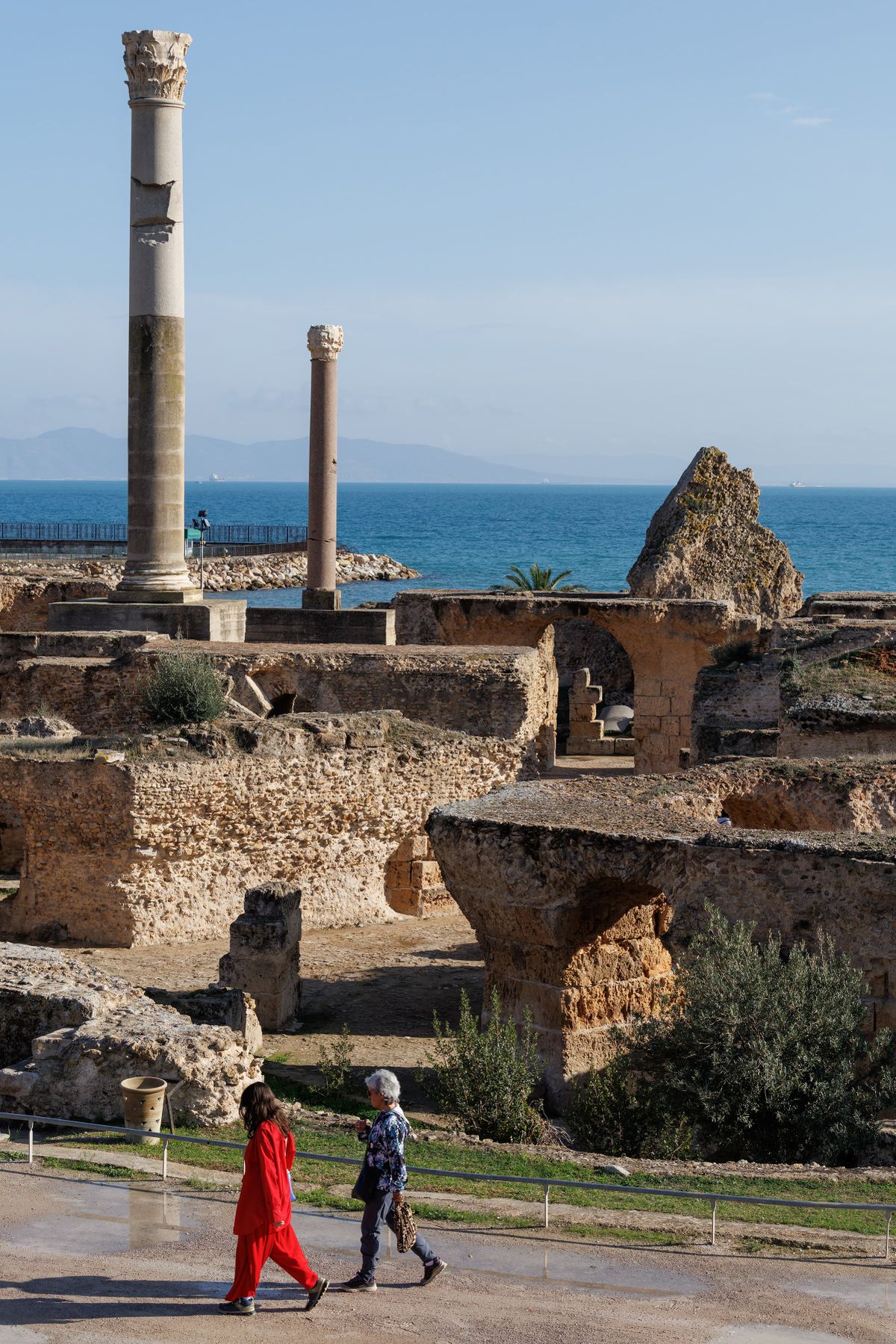
Ten minutes by taxi (5 dinars) along Avenue Habib Bourguiba, the 2,000-year-old ruins of Carthage, the capital of a civilization that once rivaled ancient Rome, stand as a counterpoint to modern Tunis. Roman baths, crumbling amphitheaters and broken columns rose from a carpet of wildflowers.
I shared the silent splendor of the Antonine Baths (admission 12 dinars) with only a few other visitors. Strangely, nothing was roped off, and I roamed the ancient site freely. Signage was sparse, leaving my imagination free to wander.
A short taxi ride away, the Bardo Museum (admission 13 dinars) was also quiet. The museum occupies a 15th-century Hafsid palace with pale sandstone facades and hand-carved cedar doors. Its galleries showcase a staggering collection of Roman mosaics so intricate they look pixelated, telling fragmented stories of conquest and centuries of upheaval.
The late-morning light poured through mashrabiya, traditional wooden lattices, into rooms empty except for the mosaics, some towering from floor to ceiling. Exploring the rooms, I lost track of time, adrift somewhere among the Punic, Islamic and Ottoman periods.
Fresh recipes and futuristic looks
At a nondescript warehouse in the Arts District, a pocket of studios and converted workshops, the scent of toasted sesame and caramelized onions hinted at lunch. Konbini, a Tunisian Japanese cafe run by Shérine Ben Salem and Chanh Vo, features concrete walls splashed with primary colors and a disco ball that dangles over a counter lined with onigiri and jars of house-fermented harissa.
“We wanted something familiar but slightly disorienting,” said Ben Salem, shifting a stack of vintage magazines.
The menu reflects that blend: bento boxes with local fish and tomatoes from Nabeul, a coastal farm region southeast of Tunis; sesame brioche; and miso-braised vegetables. A full meal runs around 40 dinars, and the crowd was a mix of skaters, architects, mothers and artists drifting in and out, switching midsentence between Arabic, English and French.
After lunch, Vo led me up a metal staircase into a kind of fashion attic filled with racks of vintage T-shirts, leather jackets and stitched-together garments that looked at once nostalgic and futuristic.
Vo lifted a “Teenage Mutant Ninja Turtles” nightgown he had reshaped into a kimono.
“Discovering the thrift shops here, I began buying clothes with the desire to transform them,” he said, “twisting them in a spirit of punk and aesthetic poetry.”
A short while later, I found myself at Frippe Bab El Falla, a sprawling secondhand market, digging through heaps of designer castoffs and everyday basics, dresses that still had tags, a tumble of leather heels and crisp men’s shirts. I found my prize, a linen shirt that cost 9 dinars, as I brushed past a group of girls digging for a perfect date-night dress and aunties bargaining over knitwear.
An afternoon reboot
By midafternoon, the city had softened under the heat. Streets emptied out, shutters dropped halfway and the hum of traffic faded, yielding to the sound of the sea.
Down a quiet residential lane, I found Maïs Luncheonette, a newly opened cafe with the familiar minimalism of local haunts from Stockholm to Brooklyn, New York – pale wood, beige walls and matcha lattes (15 dinars) served in handcrafted stoneware. As I savored a coffee, I considered the rise of such cafes, more popular with expats and visitors than with locals, as a reflection of the country’s widening class divide and the city’s growing global appeal.
I was ready for a refresh, if not quite a nap. I navigated side streets, where children streamed out of school and dogs napped on shady corners, to a neighborhood hammam – a no-frills bathhouse tucked behind an unmarked door, where women in cotton robes moved between clouds of steam. For 75 dinars, I spent an hour being scrubbed, rinsed and rubbed with jasmine oil before stepping back onto the street.
By the time I emerged, the light had turned golden over the rooftops. Shopkeepers were rolling up their awnings, and the scent of grilled sardines wafted from a nearby stall. The city felt reset from the afternoon heat.
Revving up for the evening
By early evening, music began to pulse from cafes. A crowd – young Tunisians and travelers who had heard whispers about the scene – spilled into the courtyard outside an opening at the Selma Feriani gallery. Opened in 2013, Selma Feriani is among the first privately run galleries in North Africa to champion conceptual and multidisciplinary work, showing artists from across the Maghreb and the Mediterranean.
I fell into step with a group heading toward Les Indécis, a small, trendy restaurant nestled amid the ruins of Carthage. As I sat down, I recognized many faces from the gallery. Eyeing the ever-changing seasonal menu, I ordered sea bass with preserved lemon (30 dinars), smashed burrata with pistachio (27 dinars) and a bittersweet glass of hibiscus tea (6 dinars).
The tables were close enough to catch fragments of conversations: a journalist debating the next Venice Biennale; a woman opening a Pilates studio in Tunis; another mapping out an artist residency over a shared bowl of olives. Everyone, it seemed, was building something.
Later that night, I took a taxi up the coast to Gammarth, the city’s laid-back, beach-club district. At a rooftop club, Arabic pop music throbbed from the speakers. Someone passed me a minty mocktail. From this vantage point, I could see the ruins of Carthage along with minarets and the hot-pink neon glow of a nearby club – an ancient city blurring into the future.
This article originally appeared in The New York Times.