In WSU’s pursuit of more NIL dollars, the hiring of Jon Haarlow as AD makes sense | Commentary

Before she fired athletic director Anne McCoy last fall, Washington State president Elizabeth Cantwell spoke publicly about the need to improve fundraising efforts with an emphasis on NIL.
After she fired McCoy, Cantwell doubled down on the need for NIL to fortify the talent-acquisition process.
And before she named a permanent replacement for McCoy, Cantwell returned to the issue.
The public push from the top was precisely what WSU football needed as it welcomed a new coach, Kirby Moore, and prepared for a new chapter in the Pac-12.
So what did Cantwell do when it came time to name the 16th athletic director in WSU history?
She promoted the Cougars’ chief operating officer to the post: Jon Haarlow, who spent five months running the department as the interim AD.
But much like former football coach Jake Dickert in the dizzying fall of 2021, when Nick Rolovich was fired for refusing a COVID-19 vaccine, Haarlow made the most of his trial run.
He oversaw the hiring of football coach Kirby Moore, who has been well-received across the Palouse and made several shrewd staffing decisions.
Haarlow also pushed several projects across the finish line, including a $3.4 million renovation of the football locker room and a $10 million endeavor to improve the fan experience.
And clearly, critically, he has synergy with Cantwell, the hard-driving, football-supporting, NIL-seeking boss.
But over the long haul, the Cougars won’t thrive in the Pac-12 without a well-resourced revenue-generating infrastructure designed with NIL in mind.
Put another way: Haarlow cannot execute Cantwell’s directive alone.
And on that front, too, there is progress.
As with WSU’s football program, which has employed three coaches in three years, there has been significant turnover below Haarlow with the Cougar Athletic Fund (CAF), the chief fundraising arm of the athletic department.
Last summer, Adam Ganders, who ran the daily operation, left for a position with the WSU Foundation, which handles fundraising for the university. And last month, Josh Jordan, who oversaw major gifts for the CAF, left for a position with Idaho.
Add a chief revenue officer, Brad Hutchins, who has been on the job for just seven months, and it’s not difficult to connect the dots.
Four critical links in the fundraising chain (athletic director, chief revenue officer and two CAF posts) were either vacant or breaking in new executives – all while the Cougars are so squeezed for cash they needed a one-time $20 million check from central campus to help balance the books.
But there’s reason to believe they can make it work.
In fact, with Cantwell’s blessing, the CAF is replacing Ganders’ position as the day-to-day manager and Jordan’s position as major gifts officer and is hiring additional staff to support Haarlow and Hutchins.
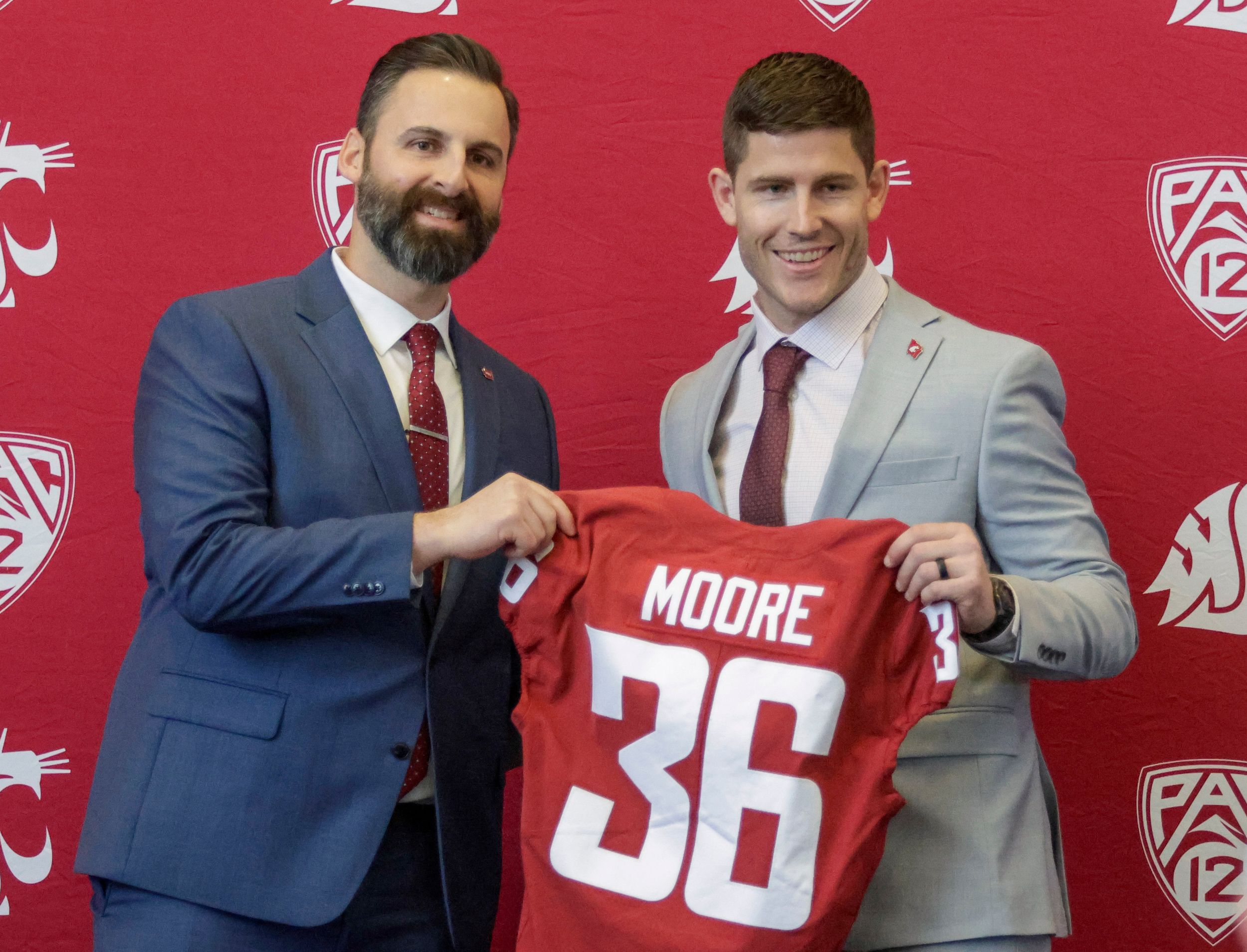
Evidence of WSU’s push for public engagement was apparent in Moore’s offseason schedule. The Cougars sent Moore to meet-and-greets in Seattle (twice), the Tri-Cities (twice), Spokane and Vancouver, Washington.
And he attended a Cougars in the Desert event in Palm Springs, California.
The collective result suggests Cantwell is aligned with Haarlow, who’s aligned with Hutchins, who’s restocking the CAF beyond previous capacity. And they are all in lockstep with Moore, who became the face of WSU athletics the minute he accepted the job in December.
Exactly how much cash WSU has generated this offseason for the football roster isn’t known – most schools are reticent to share specifics of their NIL campaigns – but it’s not difficult to spot the synergy and commitment.
Yes, there was risk associated with the Haarlow promotion. He’s a first-time athletic director who hasn’t spent a career in fundraising.
But that risk is mitigated significantly by his work as the interim AD and the support from above and below.
It’s no different than promoting an interim coach to the permanent post. With strong backing from the administration and first-rate offensive and defensive coordinators, the likelihood of success soars.
To directly equate Haarlow’s situation to Dickert’s experience in the roiling fall of 2021 isn’t entirely accurate, but the comparison works at the broadest of levels.
With his leadership skills, daily management of the program, adaptability and staffing decisions, Dickert showed he had the chops for the permanent role. Support above and below enhanced his prospects for success.
The same appears to be true with Haarlow.