
Per rebuke to their submitted plan, local governments must deliver bottled water to PFAS-impacted West Plains residents
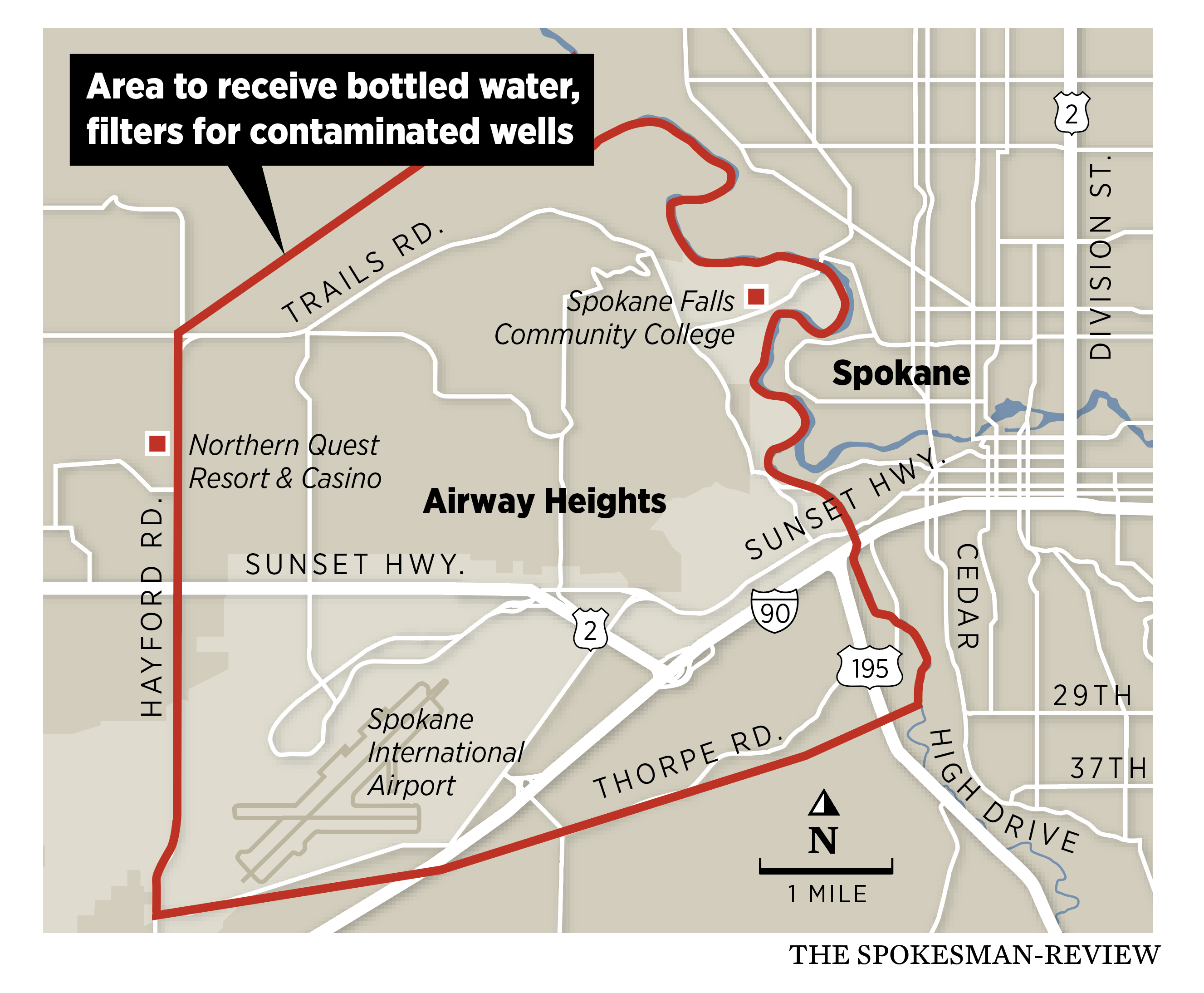
Last month, local governments proposed a plan to get clean drinking water access to West Plains residents affected by PFAS contamination. The state Department of Ecology has determined that plan is not good enough.
The agency ordered the City of Spokane, Spokane County and Spokane International Airport in February to provide uncontaminated drinking water to people affected by the airport’s PFAS contamination. The two local governments jointly own the airport, which had contaminated nearby groundwater with PFAS-laced firefighting foam.
Known as “forever chemicals,” perfluoroalkyl and polyfluoroalkyl substances are a set of human-made chemicals used in thousands of products over decades. High levels have since been linked to cancers, heart disease, high cholesterol, thyroid issues, low birth weight and other diseases. The presence of the hazardous chemicals in West Plains residential water after years of runoff from firefighting foam at the airport and nearby Fairchild Air Force Base has been the subject of an ongoing cleanup effort.
Under the plan submitted to Ecology, the local governments would provide all affected residents access to the city’s clean water fill station on Garden Springs Road and large food-grade plastic containers.
In a letter responding to the governments’ plan, Ecology site manager Jeremy Schmidt wrote the public would “express extreme dissatisfaction” if the submitted plan moves forward. According to Ecology, requiring residents to fill their own drinking containers would be too onerous.
“Many community members will not be physically capable of filling (or willing to fill) water bottles at the Garden Springs filling station and then transport full bottles to their homes,” Schmidt wrote. “The weight of carrying water, cost of gas and distance (up to 10 miles round trip for some), a lack of adjacent public transportation, bottle cleaning and sanitizing, and time needed to fill bottles daily or every other day will be significant obstacles for many residents.”
In its revisions, Ecology is requiring the governments to provide “delivered bottled water service” to all businesses and residents who find it burdensome to access the water filling station. This requirement would only be in place for homes and businesses whose water exceeds safe levels of PFAS.
Bottled water would need to be delivered within seven days of a request and would be sanitized and refilled by the water delivery services. Ecology also encouraged the governments to provide for maintenance of existing filters as part of the plan.
“The presence of existing, or installation of additional, under-sink filters would supplant the need to provide delivered bottled water,” they wrote.
Revisions to the plan were submitted to Ecology on April 3, according to Spokane International Airport, the city and Spokane County.
“SIA, the City of Spokane and Spokane County are working together to understand and respond appropriately to the requirements of the Orders issued by Ecology. As public entities, we must ensure that public dollars are spent on appropriate and allowable expenses. This issue will proceed for years to come, and we are committed to being part of the solution,” they wrote in a joint statement.
Delivered water would need to be used for drinking, cooking, washing fruits and vegetables and brushing teeth. Skin contact to PFAS contaminated water presents less risk, so the bottled water would not need to be used for bathing or laundry.
The requirement to continuously deliver water to West Plains residents would increase the cost of the interim action plan for the governments involved. On an individual basis, water delivery service Culligan, for example, charges $40 to deliver 15 gallons of water to a single residential home each month. Well testing has already identified more than 200 homes with elevated levels of PFAS, and testing is ongoing.
With the request to revise the interim action plan, it is unclear when implementation will occur. Providing clean water and testing to West Plains residents is a single part of a larger plan to clean up PFAS contamination around Spokane International Airport, which will take many years to accomplish.
In a separate letter sent to Ecology last month, Spokane International Airport pushed back against the state agency over whether they could be mandated to take any action at all. Participation is “based solely” on the airport’s “desire” for neighboring communities to have drinking water access, representatives wrote in a letter that accompanied the submitted interim action plan.
“Spokane International Airport will continue to investigate its PFAS contamination that resulted from mandatory and prescribed actions dictated by the federal government, but it will not accept responsibility for others’ use and resulting PFAS contamination, including but not limited to the Washington Air National Guard and Fairchild Air Force Base,” wrote airport Chief Development Officer Lisa Corcoran.
The airport also warned Ecology it may “cease further mandated actions” required by Ecology if the agency “continues to mandate actions without legal authority, that are not supported by facts or data and are far beyond the scope of any possible responsibility” of the airport.
In its response, Ecology officials wrote that the airport’s leaders should decide if they will refuse to comply with the agency’s mandates on grounds that it conflicts with federal legal requirements.
“If Spokane International Airport is refusing to conduct or fund the necessary interim action work, this needs to be clearly stated to Ecology so that work can commence with the City and County as lead as per the terms in their Agreed Order,” Schmidt wrote.
Ecology also pointed to a 2024 letter from the Federal Aviation Agency that states there is “no bar on an airport using its own revenue to discharge its legal liabilities or to settle cases even where liability has yet to be adjudged.”
In her letter, Corcoran wrote that conversations with the FAA are ongoing and the agency has not approved the airport’s compliance with Ecology.
“Despite Ecology’s attempts to publicly say and memorialize otherwise, no guidance has been provided by the FAA at this point that clarify Spokane International Airport’s conflicting obligations,” she wrote.
NOTE: A previous version of this article stated the bottled water needed to be used for cleaning dishes. Someone who eats of a dish that was washed with water containing PFAS has little chance of ingesting the chemical.