
Spokane company one of many Washington-based contractors playing crucial role in America’s return to the moon
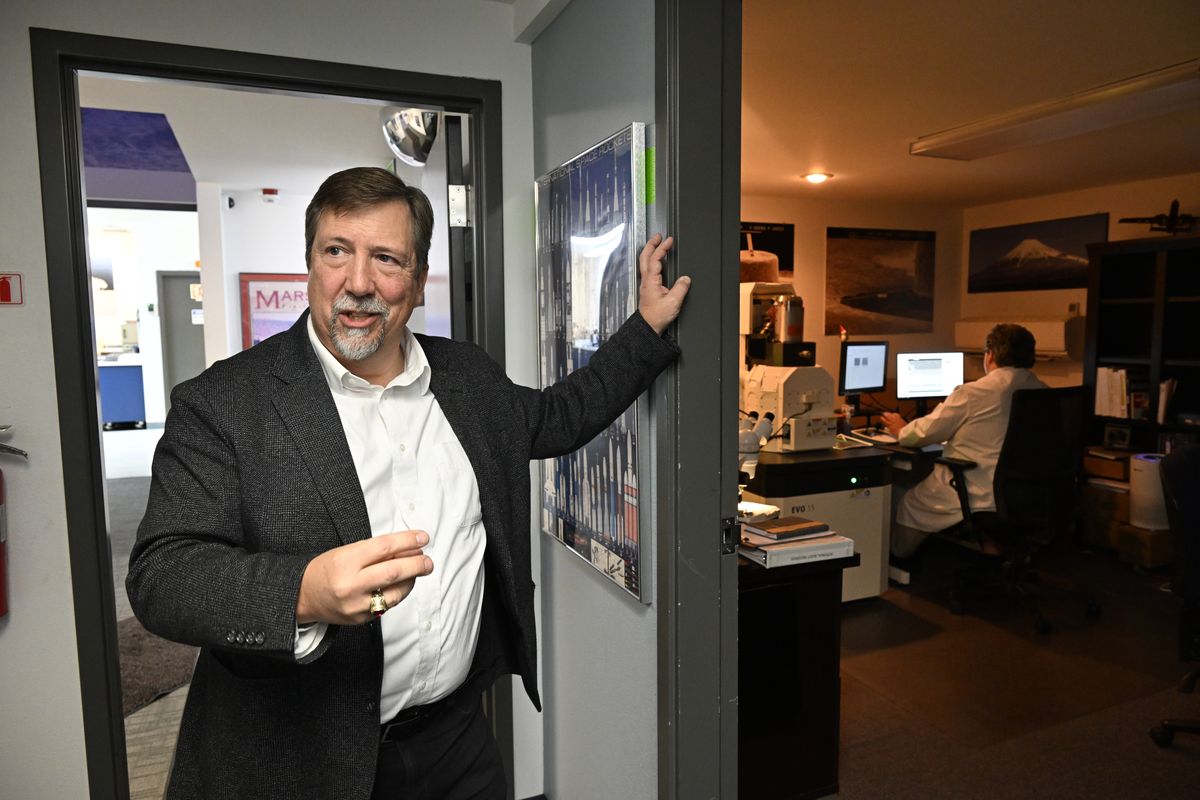
Tucked in the northeast corner of Spokane is a 45-member team dutifully working to ensure America’s return to the moon this month went off without a hitch.
The Artemis II crew, who eclipsed the record for the farthest human spaceflight Monday, is expected to splash down in the Pacific Ocean around 5 p.m. Friday. On its nearly 10-day journey from launchpad to the loop around the lunar surface and back, Spokane-based Hi-Rel Laboratories played a role.
The company is the only contractor located in Eastern Washington of the more than three dozen companies statewide that contribute to the Artemis program, doing so as the U.S. embarks on a new era of aerospace competition.
On Wednesday, Sen. Maria Cantwell, the top Democrat on the Senate Commerce Committee which has jurisdiction over NASA, highlighted the opportunity provided to those companies and the local economies.
“The Spokane to Coeur d’Alene corridor represents a next generation material science effort that all the space sector specifically will depend on, and certainly the commercial aerospace sector will depend on as well. So it’s exciting to think about how we can continue to advance that and grow it.”
Cantwell said that’s part of the push behind the Spokane Aerospace Tech Hub: to foster an environment where advancements will occur for years to come, at established companies and those drawn to the region.
Established in 1968, the origins of Hi-Rel Laboratories date back to the Apollo missions, when company president Trevor Devaney’s father, John Roy Devaney, was a member of the Jet Propulsion Lab within the National Aeronautics and Space Administration. John was a man of physics, who built a reputation specializing in failure analysis of the then-burgeoning electrical and computing components needed for spaceflight, his son said.
“He actually got to look at the moon rocks in a scanning electron microscope and evaluate the first off-world, if you will, dust samples,” Devaney said.
Today, Hi-Rel Laboratories continues to evaluate micro electronic components used in space systems, including satellites, interstellar telescopes and manned or unmanned launches. The company picks apart, tests and inspects the bits and bobs, looking for defects smaller than a human hair that could be detrimental to a NASA mission.
“Once things are in space, it’s kind of hard to repair them,” Devaney said.
Devaney said the company has been involved with nearly every NASA mission for decades, including the International Space Station’s creation. For the Artemis program, the company analyzed parts of the Space Launch System, the Orion capsule ferrying the astronauts, as well as the Gateway, which could become the first lunar base – an eventual goal of the Artemis program.
The company’s clients are part of the “food chain” of defense and aerospace exploration, Devaney said. Hi-Rel Laboratories is there to ensure those companies are meeting all requirements.
The work is divided into different teams, which have different specialities and techniques to look for errors and potential failures. The lab is full of spectrometers used to cast x-rays that can tell an engineer a part’s elemental makeup, microscopes capable of seeing within a few atoms, sanders used to get a cross section view, ultrasounds used to peer in without destroying something and a litany of other machinery to get holistic testing done.
“We evaluate that the piece parts going in there, the electronics, are built robustly so that they will perform their electrical functions as they’re designed to do,” Devaney said. “We don’t want low quality products entering into that assembly, because it just takes one weak link and your system can go down.”
Devaney said the aerospace landscape has changed, dramatically so, in the last few years. Technology is advancing rapidly, as is the approach taken by NASA, with the agency increasingly relying on commercial partners. That means more opportunities for Hi-Rel, but it also means more competition from aerospace companies, testing facilities like his own and other countries.
“This is the world we live in; there’s always going to be great powers in competition,” Devaney said.
Cantwell said Congress will need to continue to play a strong oversight role as commercialization ramps up. NASA would not be where it is today without private partners, but lawmakers need to ensure the industry remains competitive, is eliminating governmental redundancy and is up to safety standards.
“That’s why I feel very strongly about authorizing these things so that there isn’t just like appropriations, but authorization saying yes, we do want to build a moon based yes, we want to do these things,” Cantwell said. “It helps us to think about the policies in a way that continue to allow for the United States to lead in innovation.”
Cantwell remembers being a child watching the Apollo missions, and watching the Artemis II mission play out has brought those memories back. She said she’s particularly pleased by the level of analysis and information now available to the public, ahead of the launch, afterwards and as each step in the ten day journey has played out.
Cantwell said she’s excited to see a new generation interested in pushing the envelope on space travel, and the work still to come for the Artemis program.