
Cool Critters: Adopt a monarch and follow its migration to help solve the mystery of Idaho butterflies
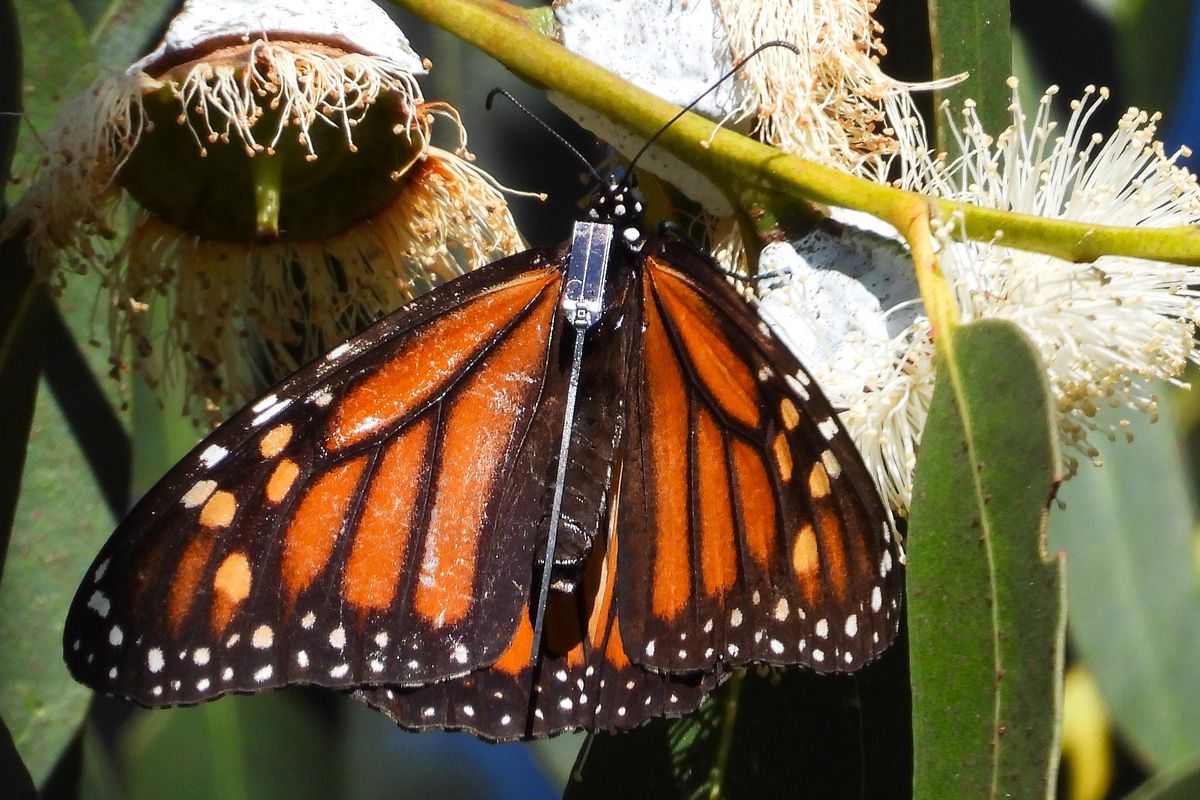
For those who adore monarch butterflies, a new research effort will make their hearts flutter.
For the first time, people may name a western monarch butterfly and track its epic journey from the Pacific Northwest to its overwintering site hundreds of miles away. It might also help researchers solve a big mystery: from takeoff to landing, what is the monarch’s exact migration route – and why?
These mysteries could be unraveled via a tiny ultralight radio tag affixed to backs of monarchs and an app that people download to their smartphone.
“This new tracking technology will allow us to follow, in real time, one of the great wonders of the natural world,” said Washington State University entomologist David James, who’s spear-heading the “Adopt-a-Monarch” project in partnership with WingsRising, a monarch conservation organization based in Athol, Idaho.
The technology, developed by Cellular Tracking Technologies in New Jersey, allows James and other scientists to track monarchs’ annual migration using small, solar-powered transmitters and a smartphone app called Project Monarch.
The transmitters weigh roughly a tenth of the weight of a monarch, according to David La Puma of Cellular Tracking Technologies. After being field tested, 400 devices were successfully deployed on monarchs in a collaborative effort launched in fall 2025 with researchers, conservation groups and citizen scientists, he said.
“The results shattered previous limitations in butterfly tracking,” La Puma explained.
Compare solar-powered radio tags to the paper and sticker tags that scientists used during the past 80 years.
“While we gained a lot of insights, it provided limited information,” said James, who in 2012, launched a long-term project of tagging Pacific Northwest monarchs and tracking their southward migration. Each small, circular stick-on label displayed the butterfly’s tracking number – C3550, for example – along with a WSU email address.
“We could only learn the point where the butterfly began migration and the point where it ended – as if the monarch had followed a straight line,” he said. “In reality, the monarch’s route is complex, with a lot of back-and-forth movement,” influenced by factors such as wind, geography and the need to refuel on nectar, he added.
“This new technology will allow researchers and the public to uncover the in-between details of an individually-named monarch’s long journey,” James explained.
So forget C3550. How about Rambler, Flapper or Flutter?
Here’s how it works: By donating $200, monarch lovers can ‘adopt’ one of these iconic orange and black butterflies, give it a name and then monitor its southward migration on their smartphones. Then, James will gather the data. The study he eventually publishes will include each monarch’s name, and how and where it traveled.
Uncovering the monarchs’ detailed flight path is only one of the mysteries James aims to crack. There’s a second head-scratcher as well.
Late each summer, monarchs east of the Rocky Mountains migrate to Mexico, while monarchs west of the Rockies migrate to the California coast, he explained.
One would assume, then, that monarchs in the Pacific Northwest end up in California, right? Based on James’ previous sticker-tag study, those from Washington, Oregon and British Columbia do migrate there.
But not the monarchs from Idaho. For some reason, they beat to a different drum.
Of more than 11,000 tagged monarchs released from Idaho over a 13-year period, “only two showed up in California,” said James. “Clearly, they’re going someplace else.”
It’s likely they’re migrating to Arizona and Mexico he added, as if pulled by some unknown navigational force.
“We don’t know,” said James. “But the new technology will help us determine where Idaho monarchs are going each year and why.”
Which is why the “Adopt-a-Monarch” project will focus exclusively on Idaho monarchs – which seems fitting, considering that the monarch is Idaho’s official state insect.
The first monarchs are expected to be tagged and released in mid-August, said Patrick Adair, founder of WingsRising, the nonprofit conservation group that will assist in tagging and releasing the butterflies in several Idaho locations.
Different adhesives were tested to ensure the solar-powered tags will remain attached to the monarchs during their long journeys.
“The tried-and-true glue that people use to attach eyelashes works best, the type that holds up even while swimming,” Adair explained.
Since the 1990s, researchers have documented staggering monarch population declines across North America. Ultimately, the new tracking technology will help guide conservation efforts to restore their numbers, Adair added.
At least 100 monarch adoptees are needed to launch the Adopt-a-Butterfly project this summer, said James, a number that will increase with a rise in public interest and donations.
And when these long-distance champions leave Idaho to migrate to their secret winter getaways, they won’t be alone. Monarch fans and researchers will be following them along the way.
To sign up or get more information, go to adoptamonarch.org.