
Ecology orders Spokane city and county to provide bottled water and filtration systems to PFAS-impacted West Plains residents
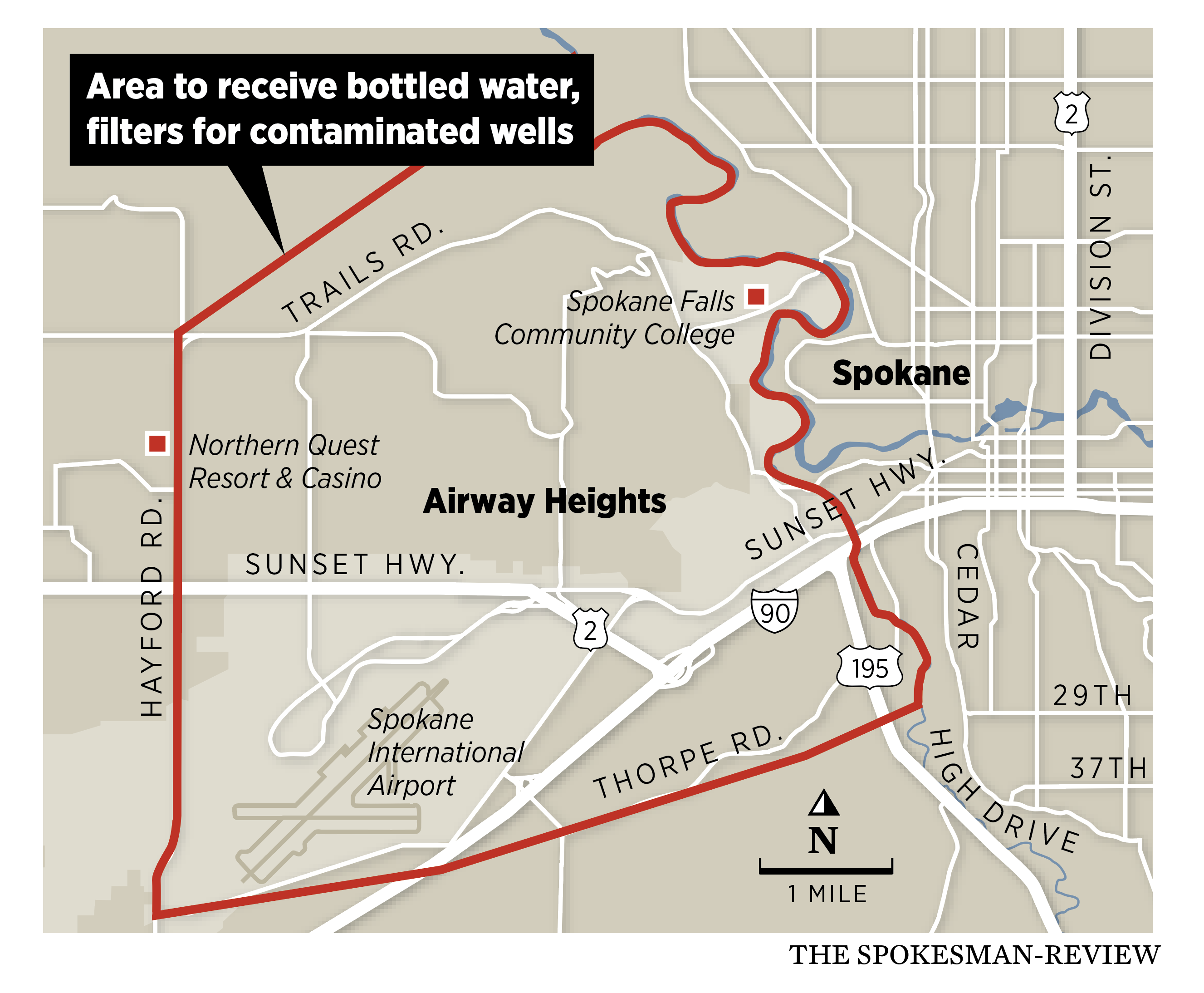
The Spokane International Airport has less than two weeks to come up with a plan to provide bottled water and filtration systems to combat PFAS contamination of drinking water for residents living across a swath of land stretching from the West Plains to Spokane Falls Community College.
The state Ecology Department order requires the City of Spokane and Spokane County, which jointly own the airport, to provide uncontaminated drinking water to those people affected by the airport’s PFAS contamination of nearby groundwater.
The presence of the hazardous chemicals in West Plains residential water after years of runoff from firefighting foam at the airport and nearby Fairchild Air Force Base has been the subject of an ongoing cleanup effort. According to the latest order, Ecology has determined the PFAS contamination had “migrated downgradient” and impacted nearby groundwater at “levels exceeding safe drinking water standards.”
Known as “forever chemicals,” perfluoroalkyl and polyfluoroalkyl substances are a set of human-made chemicals used in thousands of products over the decades. High levels have since been linked to cancers, heart disease, high cholesterol, thyroid disease, low birth weight and other diseases.
Under the Ecology order, the city and county are required to provide bottled water and install filters that remove PFAS from water as it enters a commercial building or residence whose groundwater has PFAS “above applicable drinking water standards.”
It is unclear how many homes or businesses in the area could receive bottled water or filters based on the order.
Those eligible for the water and filtration systems include PFAS-affected residents west of the Spokane river and east of Hayford Road, north of Spokane International Airport and mostly south of Trails Road.
Ecology site manager Jeremy Schmidt wrote in the order that uncontaminated water was needed to “reduce the ongoing threat to human health and the environment.”
The airport and local governments will need to submit their proposed plan by February 24. The Department of Ecology will hold a public meeting on the plan the next day.
Airport chief development officer Lisa Corcoran said it was “too early” to comment on the order during a joint meeting Thursday of the Spokane City Council, the Spokane County Commission and the airport board.
“A couple days ago, the city, county and airport were issued interim actions with a very specific scope of work. It’s too early to update what that means. We are meeting with Ecology this afternoon with all three parties to address that. But once we have clarity as to what that looks like, we will report on that,” she told the elected officials.
Spokane Public Works Director Marlene Feist said in a statement that the city shares Ecology’s concerns “about the health and safety of the water on the West Plains.”
“We’ve received the order from the Department of Ecology and are working with our partners at the County and Spokane Airport to provide a path forward,” Feist wrote.
Before the order was issued this week, the county had already started plans to provide clean water to some affected residents. Through a $7.5 million state grant awarded to the county, hundreds of West Plains residents will receive bottled water and filters in the coming years.
“Navigators will work with each of the property owners to do an assessment as to the nature of their water systems and what it would take to make them whole,” County Commissioner Al French said Thursday.
The funds could help “200-plus residents” by mid-2027, said County Health Officer Dr. Francisco Velazquez. He co-chairs the county’s PFAS task force.
West Plains Water Coalition president John Hancock said the program being implemented by the county will “do a lot” to help West Plains residents, but Ecology’s enforcement action “makes neighbors feel like the system is finally responding.”
During the meeting, Corcoran outlined the planning the airport has already done to clean up contamination at the airport for the past several years. Corcoran argued the initial site assessment conducted by the airport found PFAS contamination at relatively low levels.
“It’s been at de minimis levels compared to, unfortunately, our partners next door with Fairchild Air Force Base,” she said. “They have seen hundreds of thousands of parts per trillion, where we’re in the hundreds of parts per trillion.”
Areas at the airport with the most PFAS contamination include the current airport firehouse, a building previously used as the firehouse and a fire training area on the property. Any firefighting foam that caused contamination was used in training exercises, rather than during an emergency, Corcoran said.
The airport has “complied with all schedules” of Ecology’s cleanup order, she added.
After the meeting, Hancock called the airport’s presentation a “self-glorification project.”
“If firefighting use had been de minimis as she claimed, there wouldn’t be an Ecology investigation. That’s why I call it a coverup. Because there is a lot left out in these official presentations, and it seems like the airport is just looking for other people to blame,” Hancock said.
The Department of Ecology will hold a public meeting to discuss their latest order at 6 p.m. Wednesday, Feb. 25 at the Shriners Event Center in the West Plains.