
Betty Adams, 1947 U.S. Cadet Nurse Corps grad, marks 100th birthday with nod to St. Luke’s
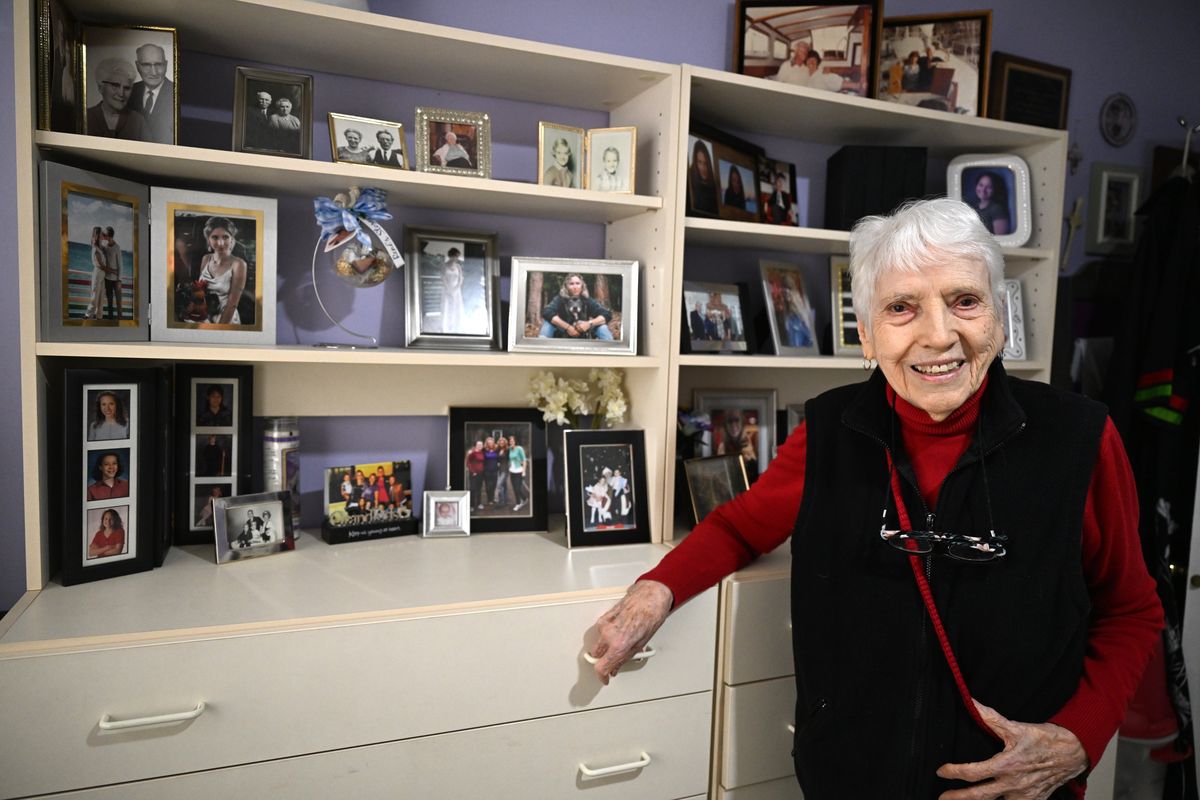
When Betty Adams planned her 100th birthday, she wanted a party in a special place, one tied to fond memories and her start in the U.S. Cadet Nurse Corps.
This past Saturday, nearly 100 people celebrated with Adams in a conference room at Providence St. Luke’s Rehabilitation Medical Center.
Adams actually became a nurse at its precursor, the original St. Luke’s Hospital, so named in 1900. Located then on North Summit Boulevard, St. Luke’s held Spokane’s first nursing education, where student nurses lived in a nearby residence hall and trained at the hospital.
“St. Luke’s was at the top of a hill where the road went down to Natatorium Park,” said Adams, who wore a red-sequined top for her party. “It was a great setting.”
She was born Valentine’s Day as Betty Hansen on a farm near Worley, Idaho. As a child, she wanted to be a nurse. Graduating high school in 1944, she had to choose.
With critical nurse shortages during World War II, Congress passed the 1943 Bolton Act to create the cadet nurse program. The government funded training, uniforms, housing and monthly stipends of $15 to $20.
Nearly 180,000 students entered, but just over 124,000 graduated by the program’s end in 1948. All three Spokane hospitals housed a cadet program, along with private-pay nurse training. Adams chose the cadets and St. Luke’s.
“You had to sign papers saying you would continue either in school or practicing nursing until the end of the war,” she said.
“It was like being in the military; they supplied everything – uniforms for summer and winter, all the books, lodging.”
She began in fall 1944. Her class of 50 spent the first six months at Washington State College in Pullman for academic classes. By early 1945, they moved into a dorm near St. Luke’s for on-site training.
As St. Luke’s, Adams trained in such areas as pediatrics, obstetrics, pharmacy, general care and elderly care. When a brother had an appendectomy, a doctor invited her to watch from an upstairs viewing room.
During the war, obstetrics was the busiest shift.
“While we were in the OB rotation, we spent one week never leaving the OB ward,” she said. “They had a bed set up for the student nurse. We were attending at each delivery – day and night – for seven days. In my seven-day period, we assisted in deliveries for 26 babies.”
Her cadet class also had fun activities, including dances at the Davenport Hotel, Natatorium and Fairchild.
“We were young, unmarried, unattached students, and Spokane was full of military,” she said. Navy members came from Farragut. Natatorium Park drew in popular bands. “We were walking distance.”
They first had to finish a 5-7 p.m. “PM care” shift, changing beds and helping patients with personal care before sleep.
“Then, we’d hurry to the dormitory and change our clothes. A bus would pick us up and take us to Fairchild, or to Geiger, where we attended a dance for a couple of hours, then they brought us back to the dormitory. We went to the USO. As a cadet nurse, if we were in our street uniforms, we had all the privileges of the regular military.”
A favorite memory is being in a downtown Spokane parade of nurses during World War II. She has a photo of the St. Luke’s group with her carrying the American flag. A copy is among other memorabilia on a history wall at St. Luke’s.
In recent years, Adams asked current St. Luke’s leader Nancy Webster for help creating that history wall.
“The only people who paraded in downtown Spokane that day were student nurses from the three hospitals wearing different uniforms – each hospital had its own uniform,” Adams said.
A local military member taught the student nurses how to march, and he assigned Adams the flag.
“I’m walking along carrying the flag, and I looked over on a street beside me. There stood my father. He came from out of town to see the parade. That was a big thrill.”
It was an era when nurses wore starched white hats and uniforms in the hospital. “That said you were an RN; that was your badge,” Adams said, with a grin. “I’m sorry, but nurses don’t look like nurses today.”
She graduated after three years, with the cadet nurse class of 1947.
Although most of her nursing career was elsewhere – including 22 years at Eastern State Hospital – Adams’ fondness for St. Luke’s remained. She returned for decades in a different role, as a longtime volunteer.
“I just have a lot of positive memories about St. Luke’s,” she said. “I loved being a student nurse, the patient care and the fact we rotated through all of the hospital and got to know all types of patients. I had good experiences.”
When St. Luke’s moved in 1970 to its current site, 711 S. Cowley, the facility still was a general hospital. Over the years, Adams’ volunteer roles included work to build a chapel and courtyard. She worked in the gift store.
Adams said she didn’t work alongside male nurses until much later in her career.
Early on, she was a nurse for a few years at St. Luke’s, then at a private psychologist’s office. Other jobs were in Kaiser Aluminum first aid stations and at a Spokane blood bank. At Eastern State Hospital, she ultimately became assistant director of nursing.
Meanwhile, she had four children – two girls and two boys – all delivered at St. Luke’s.
“All this time, I was a member of the auxiliary at St. Luke’s and the alumni group, and we did projects for St. Luke’s.”
Retiring in the 1980s, she traveled on a sailboat with her husband to Alaska. Her eldest daughter died about 10 years ago. Adams has outlived three husbands.
For her longevity, Adams credits staying active and in touch with friends and family. She has nine grandchildren and nine great-grandchildren.
Her time volunteering at St. Luke’s lasted until the early 2000s. For her party, she decided on the location while seeing a 2024 remodel of the facility’s chapel.
“They invited me to come to the dedication, so I’m sitting there thinking about my past at St. Luke’s and my involvement in the various things,” she said. “I decided, this is where I want to celebrate my birthday.”
Adams still admires how St. Luke’s pioneered medical care.
The hospital was the first in Spokane to treat rheumatic fever and psychiatric patients, and to build a recovery room after surgeries, she said.
Other firsts were an emergency room and an intensive care ward. It had a floor for senior care. By 1924, it welcomed in Shriners Hospital services. Shriners then built next door to St. Luke’s, in 1939, and Adams did some training there.
“We were leaders in terms of new programs, and building the hospital to take care of all the needs of the community,” she said.
“I feel very proud of St. Luke’s, because I think we had a very progressive hospital back in a time when it was difficult, because we were at war.”