
‘God can do miraculous things’: Local child Mira is a national Children’s Miracle Network champ
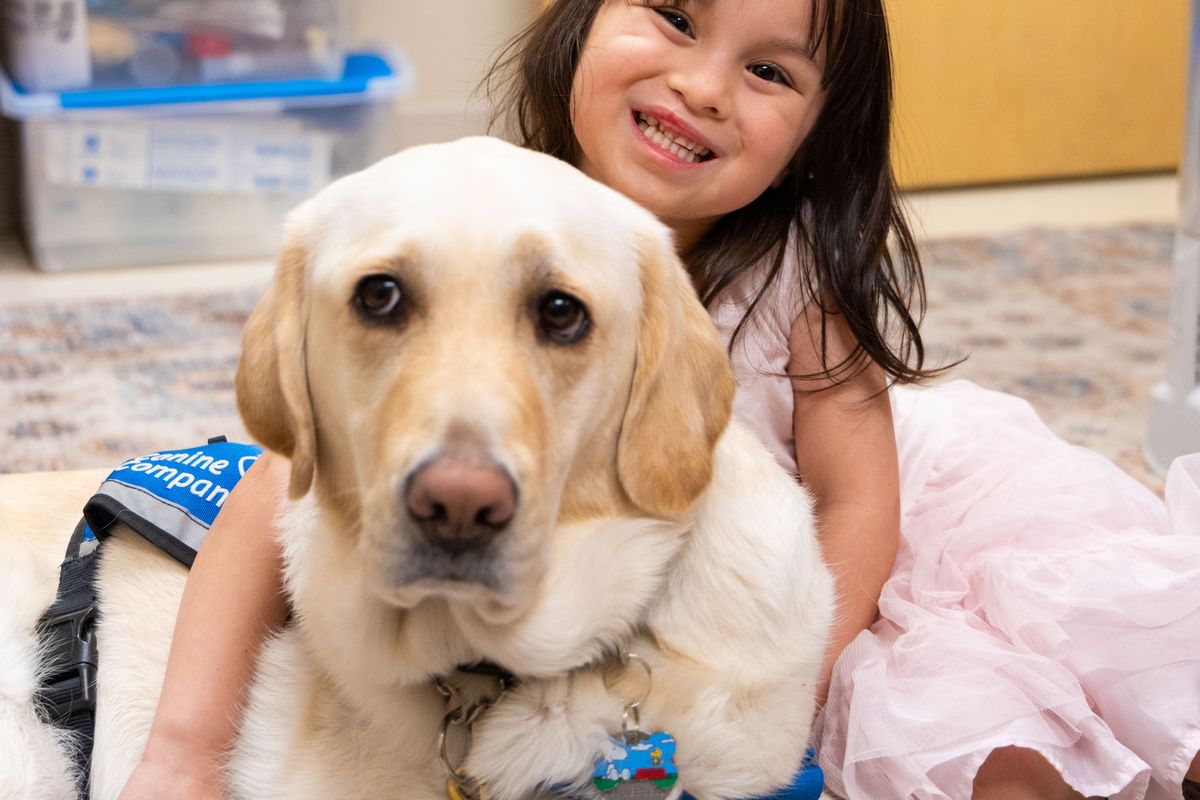
Wearing a blue princess gown, 6-year-old Mira seems at home as she plays around a kids clubhouse at Providence Sacred Heart Children’s Hospital.
Mira’s formal name is Merveille, French for wonder. But she goes by the nickname Mira for miracle, said mom Riza Warner, who first thought of what to call her child after early-pregnancy pains required an emergency room visit. A doctor warned about a threat of miscarriage.
“I responded that, ‘It’s OK, doctor; if this baby is meant for us, then God can do miraculous things,’ ” Riza Warner said.
About seven months into her pregnancy, Warner’s water broke, along with bleeding. The couple rushed to Providence Holy Family Hospital, where Mira was born Sept. 20, 2019, weighing 3 pounds, 7 ounces. She was taken by helicopter to Sacred Heart’s neonatal intensive care unit.
Since then, Sacred Heart has offered her a haven more than once, including 11 weeks in that neonatal intensive care unit. Along with preemie care, Mira also was born with a cleft palate and cleft lip, both detected with imaging during pregnancy.
The cleft issues complicated feedings in the NICU and required care beyond. She has had three cleft-related surgeries, and a range of support services from the Providence Maxillofacial Cleft Lip and Palate care program.
These days, Mira’s smile comes quickly as she talks about attending events for the Children’s Miracle Network, which named her as one of 20 national champions for 2026.
Last year and for 2026, Mira also is a regional champion for the nonprofit’s local arm benefiting Eastern Washington and North Idaho. The titles mean sharing her journey and photo and visiting a few corporate fundraiser sites, as a real story behind how the donations help.
“I tell them I have a cleft lip,” said Mira, about being at fundraisers in recent months.
“I tell them, ‘thank you.’ ” Her smile then widened as she talked about once pushing a whipped-cream pie into the face of a top fundraising winner at one event.
Rachael McKinney, a regional Children’s Miracle Network program director, said 100% of Eastern Washington and North Idaho donations go to the children’s hospital toward specialized pediatric care, equipment and programs.
Riza and husband John Warner said NICU equipment – partially or fully funded by the network – made a difference for Mira, including beds that mimic the womb and a swing-seat to elevate after a feeding.
Specialists battled her feeding issues and lactose intolerance, so Mira could grow and leave the hospital.
After the NICU, a nurse coordinator at the maxillofacial cleft program helped the couple past struggles to get Mira to take a bottle and ensure her nutritional intake, along with later care, John Warner said.
Babies with a cleft palate often can’t create the necessary suction to use a standard bottle, so the program’s nurse helped the couple get a specialized Dr. Brown’s system, with a one-way feeding valve that lets the baby bite down on the nipple to get the milk without sucking.
“The nurse coordinates all the kiddos in Spokane with cleft issues, does check-ins, monitors how they’re doing,” John Warner said. “That’s also now partially funded by the Children’s Miracle Network.”
In the United States, about 1 in 1,050 babies is born with cleft lip – with or without cleft palate – and about 1 in 1,600 babies is born with cleft palate alone, says the American Cleft Palate Craniofacial Association.
Cleft lip – an opening in the upper lip – and cleft palate – an opening in the roof of the mouth – occur when a baby’s lip or mouth doesn’t form properly during a pregnancy.
Riza Warner, raised in the Philippines, described crying when she first learned of her baby’s cleft lip and palate. John Warner knew something about what to expect. He was born with a cleft lip.
“I thought I did something wrong,” Riza Warner said. “Growing up in the Philippines, there is a lot of stigma when you have a cleft baby.”
But her mother-in-law gave reassurance: “She said, ‘Oh, don’t worry about it; we’ll be there for you. Your husband had a cleft and look how amazing he turned out to be.’ ”
The couple also knew from his experience to seek Mira’s palate repair early, to benefit speech or other development.
The couple said the same nurse coordinator who helped them with feeding issues also connected them to the Center for Pediatric Therapy in Spokane for speech therapy, feeding-related support and early therapy for Mira’s rib and spine alignment after birth.
Mira had a lip repair in March 2020. John Warner said the cleft program nurse then helped them find Dr. David Gailey, when an original surgeon wasn’t available, so Mira could have a palate repair by the end of that year.
In 2024, she had to have a slight revision surgery on her lip, her dad said, “because kids are developing, sometimes the scar tissue does things, so they pulled the lip line down and got things more aligned.”
He said Mira also will need jaw surgery as part of her cleft palate repair, likely next year. It will require taking a small piece of bone out of her hip, and she’ll need orthodontic care.
“With cleft kids, it’s not just one and done,” he said. “If we didn’t have this program, we’d have to go to Seattle. It’s a huge benefit as a family to have this program, locally funded partially by Children’s Miracle Network.”
Today’s cleft patient care is broader than in his childhood, he said, and it takes a multidisciplinary approach, including doctors, dentists and speech therapists.
As cleft-care children’s teeth and bones develop and grow, that can affect when certain interventions occur.
Related to his cleft lip, Warner dealt with needing crowns on his teeth in childhood. He had ear infections. “We’ve picked a dentist who has specific experience with cleft kids, to get her on fluoride drops and get extra protection.”
Another valuable resource, the couple said, is an annual maxillofacial review for all Inland Northwest children in cleft-related care until they’re age 18, which involves a network of care providers.
“Every 12 to 18 months, all the cleft kids in the area have a chance to have what’s called a board review where they get to see audiologists, dentists, orthodontists, speech therapists and other specialists,” Warner said.
He said the family enjoys going to places such as Dairy Queen, Costco and Valvoline that support the nonprofit.
“We say, ‘Thank you; this is our daughter,’ ” Warner said. “We want people to know all the money raised in this area stays in this area and helps kids like Mira.”