
One Piece ‘saved my life’: Card game community thriving in Spokane despite scalpers online and at Gonzaga games
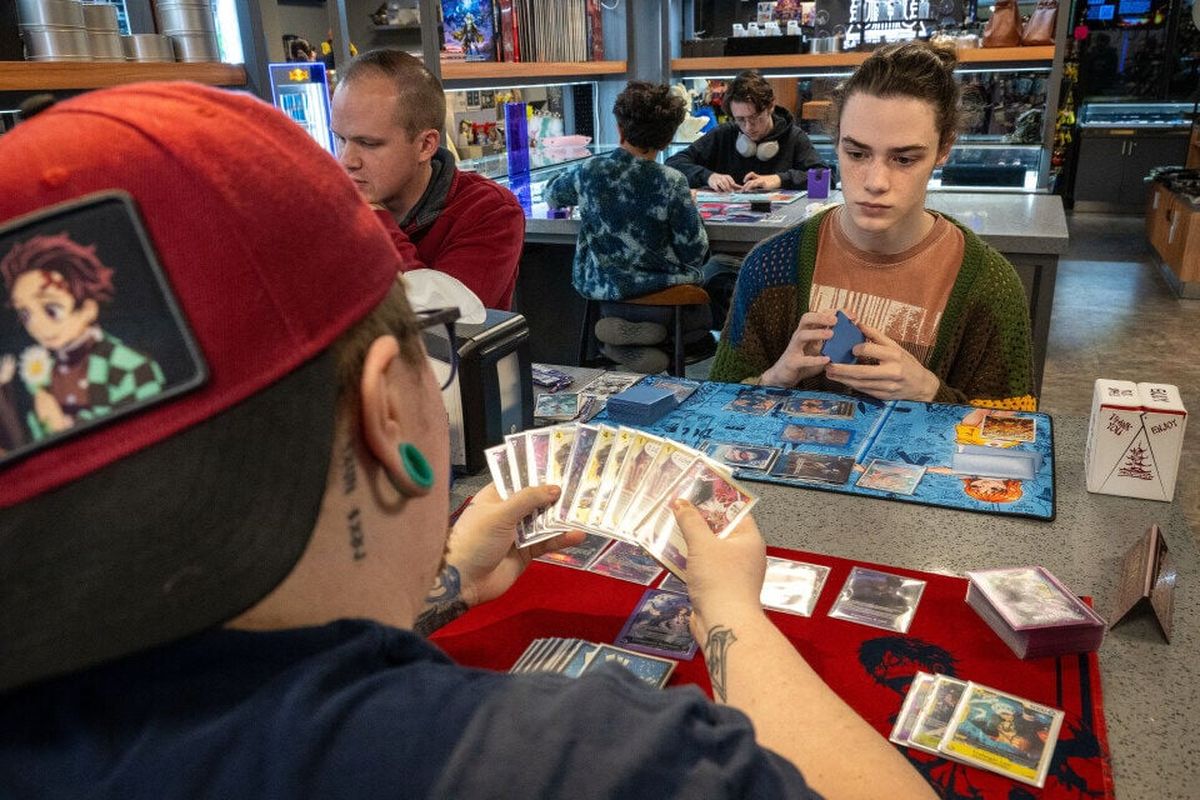
Connor Labrot is not embarrassed to say the One Piece trading card game community in Spokane saved his life.
“They just gave me a place to belong at a really tough time in my life. I have no problem saying that this community saved my life,” he said.
Labrot had just started playing One Piece as he moved to Spokane from California. He did not know a soul here when he moved to the Inland Northwest. The lifelong friendships he made in the hobby gave him an instant community in a place he had never lived.
Based on the popular manga and anime of the same name, the trading card game has made headlines in recent months as limited-edition One Piece cards were given out at two recent Gonzaga basketball games. College basketball fans were stormed while leaving the games by dozens of collectors hoping to buy the cards for cheap and sell them online for hundreds of dollars.
But behind that frenzy is a game deep in strategy where each player uses their 50-card deck and a leader from the popular TV series to reduce the life of their opponent. Reminiscent of other trading card games like Magic: The Gathering, the One Piece card game has exploded in popularity since its debut in 2022.
Those motivated by profit rather than a love of the anime or game gives the local One Piece community a bad name, Labrot said. Over the past year scalpers have hoarded cards and driven up the price for those who play. Decks that would have cost several hundred dollars now reach into the thousands.
“It’s pretty frustrating for those of us who actually want to play the game. Like if they actually want to play, that would be one thing. But it makes it really hard for me to continue doing what I love because I’m getting priced out on it,” he said.
One card Labrot wants to put in his deck has shot up to $300 a copy.
“That’s just crazy,” he said. “I can’t pay a thousand dollars just for a playset of a card I need.”
Between Spokane and Coeur d’Alene, One Piece players can find a card shop holding a tournament nearly every night of the week. Anywhere from a dozen players to more than 50 compete for packs of cards and bragging rights among their friends.
Sage’s Portal Board Game Cafe often has 20 players show up to their Spokane storefront for twice-weekly tournaments.
“One Piece has been phenomenal for Sage’s Portal. We will keep supporting the game and continuing to try to weed out scalpers for as long as the community has interest in the game,” said store co-owner Eric Compogno.
Since the store started carrying packs of One Piece 18 months ago, it has been one of the harder games to keep in stock. While that is driven by its high demand, the store is unable to get more boxes of One Piece packs when they run out.
“Distribution is incredibly constrained for One Piece. It is one of the more difficult games to acquire product for, and when we do get our shipment it tends to be all we get,” Compogno said.
The game is produced by Japan-based Bandai TCG, which ships cases of cards to U.S.-based whole distributors. Local card stores get packs to sell based on their tournament attendance and number of events. But so-called scalpers buy large amounts of product to resell on the secondary market, which can make it more difficult to get cards in the hands of players.
“Bandai can’t seem to keep up with the demand for the game, and the number of distribution sources in the U.S. is very small,” Compogno said.
Sage’s Portal limits the amount of One Piece packs that can be purchased at a time to incentivize sales toward players. At some stores, players and scalpers alike wait outside stores for hours to get the newest cards.
“One Piece has attracted scalpers in recent years because the rarest cards in some sets can sell for tens of thousands of dollars,” Compogno said. “Get a high-value hit from a box, you can stand to make back your money, and a whole lot more, off a single card. Some people see it as a way to make a quick buck.”
That price tag makes it difficult for John Castillo to play that game casually with his 9-year-old son. The pair started playing the game four months ago and now go to a local tournament in Spokane four times a week.
The game gives the father and son a structured activity and teaches important life lessons, Castillo said.
“Being in a competitive environment like this, I think it teaches him to be gracious in losing. It helps a lot with math skills and interacting with strangers. And it’s just a lot of fun,” he said.
Elliot Castillo said the game is “pretty fun and he has even “beat my dad a bunch.”
“You get to put down characters and do some cool abilities,” he said. “And I get to do it with my dad.”
The community itself has kept the pair coming back night after night.
“The first day that we decided to come and play in a tournament, a couple of the local players bought us some One Piece sleeves for our cards. Everyone here are really some of the nicest, most welcoming people that I’ve ever came across in my 41 years,” John Castillo said.
The game also promotes high levels of competition among its players. Earlier this month, more than a dozen Spokane players traveled together to Las Vegas for the One Piece national championship. One of the local players got sixth place.
Faraz Abounorinejad plays One Piece in between his busy schedule as a medical student at the University of Washington School of Medicine in Spokane. A longtime card game competitor, he acted as a judge in Spokane’s national qualifier tournament. Because he oversaw games, he could not qualify for nationals himself.
Abournorinejad traveled to Vegas anyway with 11 of his friends. He competed in a last-change qualifier the day before the big tournament. His strong finish there allowed him to play in the main event and he nearly won the whole tournament.
“I was just fighting among all the bottom-feeders just to get a chance to play in nationals. It was just a grueling all-day battle just to get my foot in the door. And I was pretty confident in my deck, but I didn’t think I was going to do as well as I did. I took it as far as I could,” he said.
Before competing in large card game tournaments, Abournorinejad had never traveled much. And now he gets to compete in card games across the country.
“When other people ask you about the people you know from One Piece, it’s just some guy at the card shop. But that’s someone you’re hanging out with literally every day,” he said. “I don’t even go on trips with my friends from high school. Buddies I’ve known since I was 4. But with these card games, I’m just casually renting out a Vegas Airbnb with 11 other gamers.”
One of those 11 was Labrot, who competed in nationals for the first time. He did not do well, but that will not stop him from enjoying his hobby with his friends.
“I love this game so much. This is my game. I’m not good, but it’s become my life,” he said.